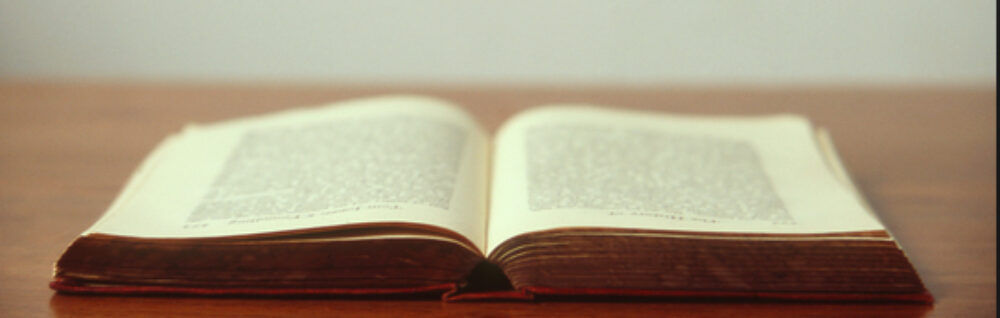
The first printed edition of Elements by Euclid on May 25, 1482–also the first printed book to include geometrical diagrams (SDSU Special Collections). A gold line runs along the edge of the black pigskin binding, complementing the gold title on the spine and green covers. On both sides, the spine is separating from the binding, the split revealing dark orange. The fore-edge is a dark, vibrant red which bleeds into the pages occasionally.


The flyleaf is annotated “Hain-Copinger*6693 Proctor 4383”. The leftmost inch of the flyleaf contains some kind of tape or glue, potentially as a result of earlier repair. The paper is thicker and with stronger grooves than the rest of the book. The first page of the book block contains a name in watery brown ink. It reads “Rizancdi Rizax Ph., is.M., 17 amicoz”. The ink and handwriting remain consistent throughout. Despite being otherwise empty, it contains one of the strongest fingerprint markings in the whole book on the bottom right and significant staining Overall, fingerprint markings and other staining is much more noticeable in the beginning and last 15-20 pages


The following two pages contain an introduction of some kind in Gothic type. The left page is only writing, however, the right page has a floral woodcut and woodcut historiated initials. The woodcuts were floral, resembling flowers and leaves. The second page also contains the introduction of geometric shapes. Pilcrows (used to indicate paragraphs) are scattered throughout. The first woodcut of the book also makes an appearance, of the biggest size present in the book. The rest of the writing in this book follows this format.

There are no page numbers throughout the book. Readers can keep track of their place and reference sections with the book number and its’ subheading. Each paragraph begins with a woodcut historiated initial which reflects the woodcut in the introduction. The sizing depicted below was most common, though it would occasionally be larger.

Diagrams
Geometric diagrams are a vital part of this book and are present on most pages. Fundamental parts are straight lines and circles. These form the basis of various semicircles, circles, squares, rectangles, triangles, crosses, and more. Occasionally, squiggly lines are used to form these shapes..
Often, the vertices are labeled with printed letters in the same font as the rest of the text (henceforth called variables). Variables are occasionally placed in blank spaces, such as variable a in the middle triangle below. Diagrams often have imperfections. As circled in red below, the semi-circle at the top has a hole next to variable h, the bottom right vertex of the middle triangle is incomplete, and the bottom right triangle’s vertex is missing near variable e. Similar imperfections are present throughout the book.

The image to the right displays two circles of differing sizes yet joining at one intersection. Despite the precision necessary for this diagram, both circles are disconnected for a similar length.


Complexity of the diagrams increases over the course of the book, indicating an increased complexity of the material. There is a sharp increase in variables and number of lines.

3-Dimensional shapes begin to appear in conjunction with more complex diagrams. Such an example is the triangular prism to the left. This comes in tandem with diagrams to support the 3-D diagram, as illustrated to the right of the triangular prism where the author decided to include a 2-dimensional demonstration of the lengths of distance in the triangular prism.
Circles take a slightly different form as the complexity of the material increases.
The circle is much more regular when it is inscribed, as shown in the bottom right diagram. When a circle is circumscribed, the printing method tends to create small divots at each vertex, as seen in the diagram to the left and top right. Given the pervasiveness of this quirk, it is not likely that it was intentional.


Marginalia
In terms of marginalia, there is a brown penned notetaker throughout the book. They annotate certain sections more than others. Their handwriting, pen color, and method of notetaking remains consistent throughout the book, alluding to a single reader


The most common form of annotation is additional variables added to the diagrams. These are rarely paired with additional calculations. Common in certain sections were annotations in Latin, occasionally paired with underlines or insertions (“carrots”).


Early into the book, there is small hole surrounded by ink. The edges of the hole are irregular, indicating some kind of accidental and natural damage (as opposed to the fine line of something such as, say, scissors). The ink is stronger on one side of the page (see Figure 14) than the other (see Figure 12). The pages before and after have no visible marks of damage
Miscellaneous Markings


The damage resembles an annotation next to the left of the diagram. The unintelligible letter implies a mistake in printing or annotation. It is possible that the paper got soaked due to a surplus of ink, causing a tear.
Stains are easiest found towards the beginning and end of the book, but they are not impossible to find in the middle and end. Stains are typically brown or gray. On the bottom right corner of pages, they are typically the size of a fingerprint and gray. When brown, they are large light-colored splotches or deep dark brown sections.


The End(sheets)
On the bottom of the latter quarter of the book contains a wormhole. The endsheet and cover are not damaged by it. The endsheet is in good condition, with very little staining and damage. Nor is there sign of repair, unlike the flyleaf.


One of few signs of use on endsheet is small handwriting on the top right, written in pencil. There is no similar marginalia throughout the whole book.

Analysis
This edition of Elements was published in the height of the Renaissance and was the first book to have printed geometric diagrams. Printing allows for the mass production of books. Complexity does not make a significant difference once the initial print is made. Diagrams with many different shapes and variables were created for unprecedented numbers of people. The ability to print diagrams allowed for complex visualized math to reach the hands of more people than it had ever been able to in the past. This was all done during a time when science as we know it today was more important to the general population than it ever had been. I chose to write about the diagrams in this book as they provided intellectual accessibility in the middle of a period of massive cultural change.
Within geometry, the Oxford English Dictionary defines diagrams as “a figure composed of lines, serving to illustrate a definition or statement, or to aid in the proof of a proposition”. This definition feels lacking the cultural context of a diagram. The broader definition given by Oxford English Dictionary is “an illustrative figure which, without representing the exact appearance of an object, gives an outline or general scheme of it, so as to exhibit the shape and relations of its various parts” (emphasis added). Diagrams display what you need to know of complicated visual concepts to understand them. They exist for the same reason why this class goes to Special Collections every Tuesday—visualization is essential to understanding. The diagrams in this book were evidently important to the learning process because they were present on almost every page of the book. The gold outline on the binding of this book and the red fore-edge shows that this was a high-quality book for the time. Yet, though the quality was above average, it was not rare to see variables off-center or lines which were incomplete or smudged. This goes to show that the quality of this book was not necessarily in its’ aesthetic—rather, it was in the knowledge it made available.
Mathematics is a theoretically heavy subject which is the basis of many scientific discoveries and explanations. Without geometric diagrams, it was significantly more difficult to understand complex mathematical concepts. The Renaissance put man at the center of the universe–there was an unprecedented surge in science and technology in conjunction. The diagrams in this book put complex mathematical concepts in an understandable and accessible form for the first time. The fundamental basics to scientific and mathematical discovery were made more easily understandable than they had ever been. In other words, the diagrams in this book are a direct reflection of the revolutionary values of the Renaissance.
The creation of the diagram put it in the hands of an individual to teach themselves concepts. By making it easier to learn complex topics, the teacher is no longer necessary. Learning becomes an isolated activity. In other words, by making it easier to self-teach and visualize complex mathematical theories, learning as a social activity is obsolete. If the medium is the message, then the message of mathematics turned into one of the relationship between human and their book. Reflecting man-centered ideas of the universe, it was no longer necessary for one person to teach another core ideas of their world. Mass-publication of the bible and increased literacy coincided with the decline of Catholicism as a pervasive social structure. It was no longer necessary for there to an arbiter of what is and is not a moral action because the people had gained the ability to read the bible directly and make decisions for themselves. Similarly, there was no longer a need to learn math in a classroom setting to the same degree because it was possible to own a book which showed you it directly. Students were able to teach themselves concepts in a manner which provided them with an agency in how to approach the material.
Reminiscing on Marshal McLuhan’s words: “we march backwards into the future”, the popularization of mathematical diagrams makes me think of modern forms of math education. Since the Renaissance and the publication of this edition of Elements, there have been thousands of versions of math and geometry textbooks. Yet, nothing compares to the change which was the video. Animation has made it possible to show diagrams in a dynamic manner. YouTube and other video platforms provided audio-visual learning experiences which made it possible to learn and review complex topics at any point with unprecedented ease. The parallel I am trying to draw here is between something like Elements with its’ diagrams and modern educational YouTube videos which use a variety of animation styles to teach an audience. The intellectual accessibility which animation has provided reflects that of the diagrams in Elements.
Works Cited
“Diagram, N., Sense 1.” Oxford English Dictionary, Oxford UP, July 2023, https://doi.org/10.1093/OED/1591277285.
“Diagram, N., Sense 2.” Oxford English Dictionary, Oxford UP, July 2023, https://doi.org/10.1093/OED/1021068184.
Euclid., et al. Preclarissimus liber elementorum Euclidis perspicacissimi: in artem geometrie incipit qua[m] foelicissime. Translated by Adelard, [Erhard Ratdolt], 1482.