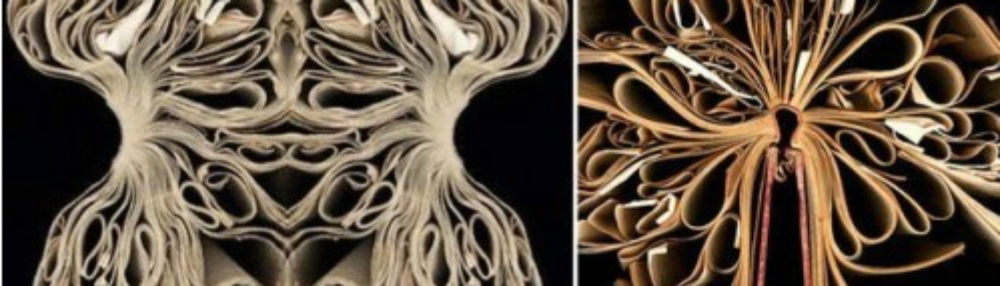
When I read Katherine Bode and Roger Osborne, one thing stayed with me, the difference between the archive you can touch and the one you can search. On one side, there is the quiet room, the box, the folder, the paper. On the other, a glowing screen and a cursor. At first, they seem like two versions of the same thing. But the more I thought about it, the more they felt like two different languages.
Bode and Osborne write that archives hold “the material evidence of print culture” (p. 219). That line made me pause. Material evidence makes the archive sound like a witness, not just a container. The paper, its edges, its marks, even its weight are all part of the story. You don’t just read the text, you also read the object.The digital archive changes how we enter that story. It makes research faster and broader. You can map a question across thousands of records and find patterns you would never see by turning pages. It has a different rhythm with less waiting and more moving, less surprise by accident and more discovery through search.
Still, something feels different when reading on a screen. The page becomes an image surrounded by tools such as a zoom bar, a search box, or a download button. These tools help, but they also create a small distance. You can zoom in and see the ink in perfect detail, closer than you might in person, but you cannot feel the give of old paper or the tightness of a stitched spine. Bode and Osborne describe how the “weight, smell and feel” (p. 233) resist translation. That line captures exactly what gets lost. You can see everything, and yet something is missing.
It is not about choosing one side. The best work happens when both worlds meet. Digital archives open up scale and connections, while physical ones remind us of size and texture. One teaches us to ask and the other teaches us to look.
Even the idea of chance changes between them. In a reading room, coincidence happens in the margins, like a note on the back of a letter or a slip of paper left behind. Online, it happens in the search results, when a word you did not expect brings up something new. Both moments matter, they just belong to different kinds of touch, one physical and one digital.
Bode and Osborne end by saying that different archives serve different purposes and that neither is naturally better. That feels right. It reminds me that reading today means being bilingual, fluent in both dust and data. The slow turn of a page and the fast scroll of a screen. Dust reminds us that knowledge has a body. Data reminds us that it has a pattern. Reading the archive in both languages lets us hear both.
Hello Tanya!
This is great! The archive is no longer a binary (not to say it was), but digital media has shaped how we see and perceive the archive. It does not have to have the characteristics of a physical object but acts as a mode of medium. And, you capture perfectly what is it like to read online against conventional paper, “You can see everything, and yet something is missing”. This is great Tanya.