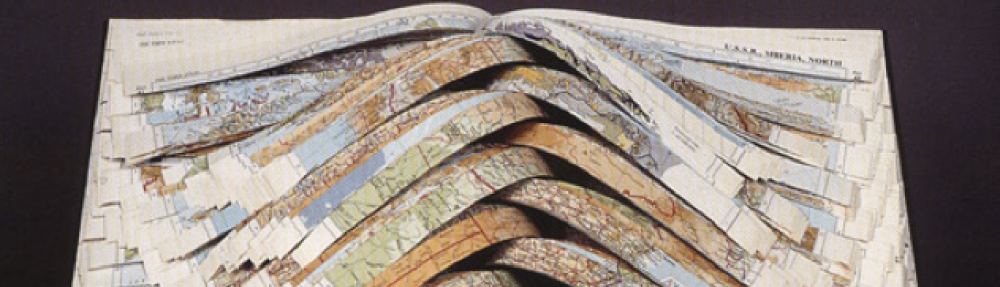
Jorge Luis Borges The Library of Babel demonstrates the ideological power of the archive. Rather than the archive working as a tool of power and control I seek to expand on Borges’ representation of the library– a system of classification that shapes ideas and beliefs. Specifically, their sense of what is important– what constitutes knowledge and what does not. Ultimately, demonstrating how The Tower of Babel is an allegory of the archive, reflecting on the conventions of language and communication. In Borge’s story, language is not communal but enigmatic, revealing the impossibility of a single stable meaning and truth, exhibiting how language obfuscates itself.
Language and communication gives birth to a different type of “uncovering”—not in the traditional sense as found in the scriptures, but in our human desire to seek one. Humans are creatures that seek to categorize, classify, and label, looking to find meaning and truth in a world where language obfuscates itself. Words bounce between signifiers, blurring the line between the truth and the illusion of it. However, this raises the question: is it possible to seek and find truth through the archive—a system that operates in a feedback loop of classification and preservation? The archive is not neutral; it mediates based on the prejudices and biases of scholars and reflects our anxieties. It directs us to one path while it alienates us from other possibilities. Intrinsically, this action not only preserves meaning but produces it. Borges’s Library of Babel exhibits this ideological power; through a system of classification, the library shapes scholars’ ideas and beliefs, obfuscating what constitutes knowledge and what does not. For Borges, the library is endless: “The universe (which others call the Library) is composed of an indefinite, perhaps infinite number of hexagonal galleries… Each wall of each hexagon is furnished with five bookshelves; each bookshelf holds thirty-two books identical in format; each book contains four hundred ten pages; each page, forty lines; each line, approximately eighty black letters” (Borges 112–113). The description of the library indicates that the library is a means of production. It demonstrates how language operates and circulates. Although the description of it demonstrates a system of classification and order, there are an infinite number of possibilities and probabilities regarding the conventions of language—falling into absurdity and incoherence in the attempt to find stable meaning. Similarly to the account of Genesis, language and communication break down, demonstrating that language works as a limitless sprawling web; the abundant amount of possibilities overburdens the possibility of finding stable meaning.
Furthermore, Borges deepens the instability of the archive as he demonstrates the angst that classification brings. In an attempt to search for the truth, scholars are overwhelmed as this pursuit is fruitless. Borges notes, “I know of one semibarbarous zone whose librarians repudiate the ‘vain and superstitious habit’ of trying to find sense in books, equating such a quest with attempting to find meaning in dreams or in the chaotic lines of the palm of one’s hand” (Borges 114). To find the sole truth is pointless—scholars create their own meaning based upon their desire to find one; therefore, producing meaning based on their own understanding—creating new meaning that is not grounded in objectivity but in their longing to find a sense of purpose in this vast universe. Paradoxically, the library is a place that should provide scholars with meaning and purpose yet continues to alienate them from their desired answers—objective answers are not found, but their insights become their facts. In this manner, Borges showcases a melange of emotions regarding the library—it is vast and incomprehensible and pointless to attempt to find static answers. The library generates more confusion and brings more questions than it answers.
The destabilization of meaning not only obfuscates language but uncovers ideological apparatuses that seek to assign meaning to the uncertain; it nurtures an environment where scholars create a belief system—one rooted in the absence of truth and their longing for explanations. This catalyzed the rise of spirituality—answering the unknown and anchoring a belief system. Borges mentions, “Mystics claim that their ecstasies reveal to them a circular chamber containing an enormous circular book with a continuous spine that goes completely around the walls. But their testimony is suspect, their words obscure. That cyclical
book is God (Borges 113). Because there is no certainty in the archive, scholars seek to create answers; creating divinity in the realm of social perplexities, emerging from the unknown and the confusion from within. This is further noted as Borges writes, “We also have knowledge of another superstition from that period: belief in what was termed the Book-Man… it was argued, there must exist a book that is the cipher and perfect compendium of all other books, and some librarian must have examined that book; this librarian is analogous to a god” (Borges 116). The Book-Man is a figure that symbolized divinity and more than likely emerged as a social construct that provided relief from the despair of not having congruent answers regarding the universe. The lack of truth or stable meaning lead to scholars creating their own ideology. Perpetuating the idea that the archive continues to ideologically shape their ideas and beliefs demonstrating how it operates on a continuum. This omniscient deity/ figure is a product in relation to the absurdity of seeking truth and stability in an environment where the infinite possibilities obfuscates itself– it represents and reflects the scholars anxieties and, rather than being a literal figure it embodies meaning and truth– even if it is a mere illusion. The instability of the archive produces its own belief system that is anchored in the uncertain and the desire to fill in absence of answers.
Similarly, as in the account of Genesis divided the people building the tower due to the breakdown of language, or lack thereof, The Library of Babel continues to divide people. Rather than being a place of unity, the polarization of different truths alienates scholars and believers from one another. The emergence of the “Book-Man” not only serves as an illusion of the truth but demonstrates the emergence of a collective need for meaning and purpose. As mentioned earlier, words bounce between signifiers– demonstrating how easy it is for language to break down and to create miscommunication. Therefore, the perceived meaning becomes fragmented which allows for different groups to anchor themselves into different interpretations regarding the truth; just as language breaks down, so does their sense of community. Borges writes, “ These pilgrims squabbled in the narrow corridors, muttered dark imprecations, strangled
one another on the divine staircases…Others went insane … . The Vindications do exist” (Borges 115). The division amongst the pilgrims is a direct consequence of the conventions of the archive. The endless amount of meaning and possibilities divides people and fragments them– specifically between the polarization of different ideologies. For example, the Mystics turned to spiritual and/ or religious interpretation to understand the archive whereas the vindicators claimed their actions would be vindicated– leading to the consequences mentioned above, violence amongst themselves in light of their “vain to find vindication”– atone for their sins (Borges 115). The Book-Man emerged from the uncertain, providing relief and acting as the illusion of truth and divinity as opposed to a group that seeks to eliminate parts of the archive “the first thing to do was to eliminate all worthless books. They would invade the hexagons, show credentials that were not always false, leaf disgustedly through a volume, and condemn entire walls of books” (Borges 116). These conflicting ideologies demonstrate the instability of the archive and further fragment their sense of reality—demonstrating that in the search for the truth it alienates them more and obfuscates their sense of community, being divided by the same paradigm that promotes unity. The fragmentation catalyzed by the archive does not merely alienate scholars but also perpetuates the instability from our own self.
In Borges and I, Borges demonstrates a fractured self—one produced and mediated by the archive; exegeting how language not only breaks down communication but also our identity. Borges and I echoes the instability from The Library of Babel—readers are not able to decipher who is the one speaking. Borges writes, “The other one, Borges, is the one thing that happens to… I hear about Borges in letters, I see his name on a roster of professors and in the biographical gazetteer” (Borges p.1). One Borges is constructed through media—through letters and texts—whereas the other one has been archived by the conventions of the persona he has written; their identity is interjected by the archive. The identity of the outside Borges is not a shared living experience nor influenced by them but affected by records Borges has written of him. Parallel to The Library of Babel, where scholars are in search of the solemn truth, Borges encounters himself through an amalgamation of writings; writing that he authored. Through this experience it is revealed that his identity is fractured and unstable—it is dependent upon interpretation and the assigned meaning one gives to it. Therefore, echoing the topic from The Library of Babel—there is no inherent truth but one assigned that reflects the reader’s anxieties. Furthermore, the conventions of language and communication also demonstrate how the truth is distorted; it creates a distance between himself and his authored persona—further perpetuating how interpretation continues to bounce between different signifiers, alienating himself from the truth, or the perception of it. Additionally, it demonstrates the self as an archive; specifically, his self becomes similar to the library. One of the Borges is a compilation of writings and texts—one that is being recognized as such rather than being acknowledged by his own existence. It creates a place of collections rather than uniformity. Ultimately, Borges and I demonstrate the same instability in The Library of Babel. The archive does not only fragment language and communication but alienates regarding how scholars engage with the world; it fragments our sense of understanding but also fractures our self. It demonstrates that identity is not intrinsic but mediated through an amalgamation of apparatuses. The instability of languages extends beyond our means of communication and produces endless interpretations, as evidenced by The Library of Babel.
Derrida’s Des Tours de Babel further demonstrates the fragmentation of language and meaning. Derrida notes, “The calm irony of Voltaire means that Babel means: it is not only proper name, the reference of a pure signifier to a single being—and for this reason untranslatable—but a common noun related to the generality of a meaning…even though “confusion” has at least two meanings, as Voltaire is aware, the confusion of tongues…a certain confusion has already begun to affect the two meanings of the word “confusion” (Derrida 166-167). Derrida argues that “Babel”– the word itself is a double entendre without a stable signifier. This reveals the grammatical complexity of words and their meaning– there is no pure original language as its name is associated with multiple meanings. This parallels Borges discourse; in The Library of Babel, in that universe, meaning is depended upon interpretation, bouncing between subjectivity and objectivity without clear stability. It is obfuscated due to the constant shift in words and letters– this causes scholars to anchor their ideas and beliefs in their longing for viable answers as opposed to a solemn static reason. Intrinsically, this causes different modes of interpretation and ideological systems; just as scholars are overburden when seeking to confront the realm of possibilities of the archive only to discover the single truth is not achievable, Derrida suggests that different modes of media– translation and interpretation are processes that are unstable do to its evolving nature, making them incomplete and intangible. Furthermore, in Borges and I this instability is demonstrated through a fragmented sense of identity and reality– the instability of language creates a sense of fragmentation that is mediated by Borges writings. Therefore, Derrida exegeses and demonstrates that the archive is not stable nor clear but exhibits the multiplicity of meaning. Ultimately, Borges and Derrida expose the conventions of language and communication– the truth is constructed through subjective interpretation of experiences rather than being static, further perpetuating the idea that language intrinsically produces and obfuscates itself.
Ultimately, Borges demonstrates communication and language conventions/ structures are not inherently stable but bounce between meaning and text. In an attempt to find clarity, it has been demonstrated that shared living experiences interject and create different ways of seeing; systems that follow a structured ordeal are not able to contain the endless possibilities followed by the archive. The Library of Babel exposes how fragile the conventions of the archive are– endless possibilities alienates scholars from the truth in an attempt to pursue it. The archive not only stores but mediates and produces new ideas in the absence of truth– prompting further a sense of fragmentation between scholars. Furthermore, Borges and I perpetuates the sense of fragmentation and instability at an individual level. Similar to the archive, identity is incomplete and created through an amalgamation of experiences; Derrida’s explanation and interpretation of The Tower of Babel confirms the instability of language. Because words hold different meanings it obfuscates communication and does not nurture unification but fragments our senses; altogether, the texts mentioned above for our innate desire to search the truth– to find lifelong answers that texts have not been able to provide. The archive mirrors language– unstable, bouncing between signifiers, obfuscating meaning and words by fragmenting our limits and understanding.