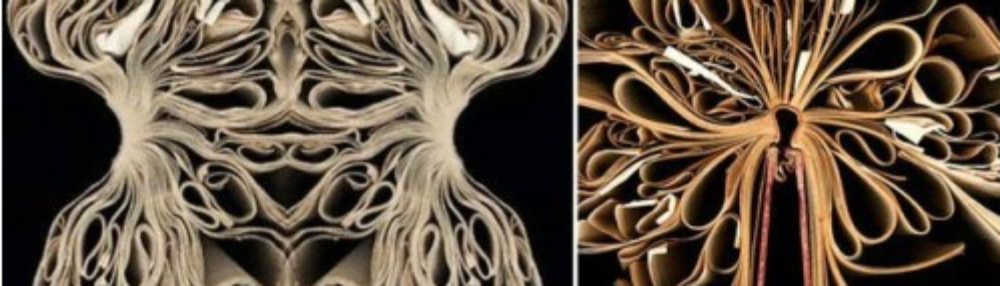
New York Times writer Noam Cohen names Jorge Luis Borges the “Man Who Discovered the Internet” (“Borges and the Foreseeable Future” 2008). Borges (1899-1996) envisioned prescient models of hypertext and the Internet not only as technologies, but as cultural institutions which shape human relationships to reading and space. The Library of Babel, Borges’ famous 1941 short story, is framed as the late dispatch of a philosopher in the limitless, arcane Library of Babel. Borges suggests that the custom of reading is a perpetually iterated project in which we interpret our environments, and through which we construct and deconstruct knowledges.
The narrator of The Library of Babel catalogs the esoteric architecture of the Library, defining its physical properties much like an archivist recording the material data of a book object. The datific language of this archival reads the Library itself as a book object. (The fabled “book that is the cipher and perfect compendium of all other books” would thus seem to be the Library itself, and all librarians within it thus together compose the demi-godly “Book-Man” [116].) The narrator’s descriptions increasingly focus in scale, suggesting the labor and time taken to read the Library space: while it might take quickly enough to mark that “[e]ach wall of each hexagon is furnished with five bookshelves”, for how long have the librarians studied to find that “each line” of every book contains “approximately eighty black letters” (113)? The labor of cataloging the Library’s material properties, as visible in the narrator’s report as it is in the metadata of SDSU’s library catalog, is bound up in bodily time. Borges situates archival, reading, and knowledge production as material, time-bound labors that interface with violence and mortality. Before the Internet exists, Borges reminds us that this network is a material construction through which human labor produces means of interpreting information. This seemingly prophetic image indicates Borges’ understanding of books, reading, and knowledge production as material objects and actions.
More under the cut.
Despite warring answers regarding the proper way to read and interpret the Library’s books, the societies of its “circuit[s]” share the same basic physical needs: hexagons contain two “vestibules,” “[o]ne . . . for sleeping, upright; the other, for satisfying one’s physical necessities” (113, 112). Borges’ inclusion of these processes grounds his text in bodily rhythms, contrasting the processes of mortality against the “interminability” of the Library’s unknowably immense physical body. Likewise, the Library population’s proneness to disease, murder, and suicide indicate limits on each librarian’s own embodiment of knowledge (114, 118). The institution of knowledge production outlasts the production of knowledge, predicting the anxieties surrounding generative AI writing explored by Rita Raley and Russel Samolsky in “Borges in AI” (2024).
Mark C. Marino’s narrator C.K. annotates an archived version of Noam Cohen’s Borges article in the online hypertext Marginalia in the Library of Babel (2007). Where Borges’ narrator exits with the philosophical suggestion that the Library has no end, Marino’s C.K. begins with the theory that “the vast holdings of the Internet library have achieved interminability as has our knowledge and misapprehension, which is, in itself, another kind of knowledge” (“i blog, you blog, weblog >> The Library of Babel”). What Borges’ narrator terms “the formless and chaotic nature of virtually all books” is mediated through online hypertext’s multidirectional, non-sequential movements and interpretations (113).
The Electronic Literature Directory’s description of Marginalia notes that the reader is intended to leave annotations of their own across the hypertext’s pages, inscribing marginalia of their own into the text. The decay of the Diigo plugin used for this annotation changes our relationship to Marino’s hypertext. The psychosomatic act of creating annotations would involve the reader in expanding the online Library’s many-roomed body. C.K.’s annotations are not visible in the ELD’s archived edition of Marginalia, but the archived edition simulates the original visuals of Marino’s hypertext.
I read Marginalia across tabs and editions, getting familiar with the visual character of the ELD’s version and then reading the text with its annotations on Marino’s recent re-edition. Even with a refresher plugin to simulate the annotations of Diigo, I know that I would not replicate the conditions or the content of Marino’s initially-published hypertext. But this is where the “interminability” of the Internet, and in fact of all media, comes in: the process of interpretation, where I read the live annotated text while envisioning my understanding of the visuals which once accompanied it, constructs a new edition in my mind. You create another. Hypertext like Marino’s leverages its medium to hypermediate the transformative processes of this knowledge production.
This expansiveness of the imaginary recurs in Borges’ writing, as in his poem The Unending Gift: here, Borges’ blindness re-contextualizes a once-seen picture as “limitless, unending, capable of taking any form or color and bound to none” (In Praise of Darkness 31). I’d like to note that Borges’ understanding of reading and knowledge construction was shaped by his distinctly disabled, non-normative methods of writing and reading as a man with degenerative vision impairment and head trauma that contributed to psychosis. Donald A. Yates notes that, by 1960, Borges was “dictating his work to his mother because of his deteriorating sight” (ref. in Rita Raley and Russel Samolsky, “Borges and AI” 285). Borges’ expansive understandings of media and reading were influenced by his adaptive means of reading with others and through memories. The inaccessibility of visual text coincided with Borges’ understanding of the book as a technology imbued with politicized expectations of use.
While death for Library’s narrator is heralded when the narrator’s “eyes can hardly make out what [the narrator has] written,” this would seem to be a cultural construction within the narrator’s home “district,” as in others people read in nonvisual ways like “prostrat[ing] themselves before books and . . . kiss[ing] their pages” (112, 118). Borges understands that reading is a constructed and historic custom shaped by bodily labor, limits, and innovation; the same understanding shapes Marino’s work and my reading of it through multiple modes of reading. Thinking about books as objects networked through labor and time will help to guide me as we begin examining materials in Special Collections.
Brilliant post, Raine. Truly smart, insightful, and inspiring, as you are developing an argument– a thesis-driven argument about the importance of materiality in knowledge production, and how ” reading is a constructed and historic custom shaped by bodily labor, limits, and innovation.” Just wonderful. Certainly the foundation for a longer project/essay.