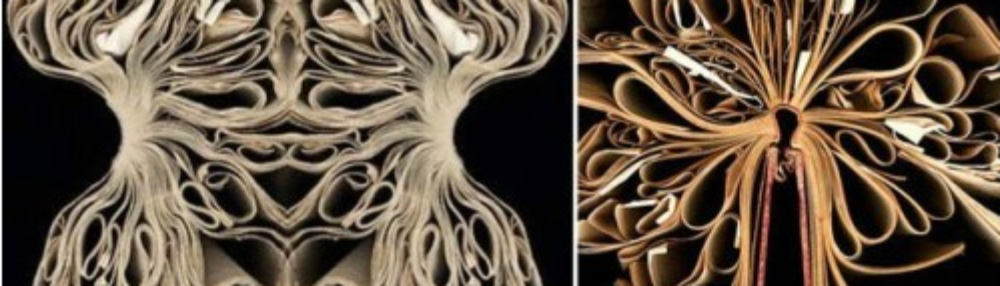
I think that most people in our day and age tend to think of books as a part of a larger whole. They’re things to be collected. They’re things to be placed upon shelves and organized in neat numerous rows either by author last name or spine color or the Dewey decimal system. To see a book all on its own seems so rare that my mind has difficulty even picturing it. I am sure that I have seen it, but there seems to be no good way to orient the display of a single codex on a shelf or on a desk, and it is equally difficult to imagine dedicating oneself to a single text.
But when we think about the history of reading (because to read them is the only rational reason to have any books at all) as something that has evolved over time, with various practices and methods, and we go back, perhaps, to the time of the first codified printing of Don Quixote, readers would have approached the text of the first modern, widely dispersed novel very differently.
As Levy and Mole explain in the introduction to The Broadview Introduction to Book History, “historians of reading sometimes distinguish between “intensive” and
“extensive” reading. Reading “intensively” means returning to a small number
of books again and again, whereas reading extensively involves reading
a much larger number of books (or other printed matter), and often reading
them only once” (xvii). They go on to explain that extensive reading is something of a novel phenomenon in the past hundred years and is a result of easily accessible printed material; “when books were very expensive and labour-intensive to produce (especially when they had to be copied by hand), most people had access to very few books. People often read these books intensively because they didn’t have access to any other reading matter. As a result, they came to know their books well and invested significant emotional energy in them” (Levy et al xvii-xviii). I like to imagine some simple, moderately well-off person in the mid seventeenth century going back to Alonso Quixano and the jousting of the windmills and the trot of Rocinante time and again by the glow of a lantern. There is no doubt that intensive reading of Don Quixote is nothing particularly unique, as it is probably the most studied novel of all novels, but to be that invested in that book because you have no other choice of reading material makes for a much different experience than that of the scholar who can understand why Steinbeck’s truck is named Rocinante in Travels With Charley, and who can tie Cervantes’ novel to numerous other works in the 400 years since its publication.
How does that type of reading alter the reader’s conception of the book itself? Are we still drawn to the same plot points? Do plot points then become of lesser importance? Are we more interested in language? Do we have time for more ornately written sentences? And are we more privy to social commentary, or are we less, with no (or few) other written works to compare to? Is the book something self-contained, as I believe we view it now, or does the book only become a launching pad for the more creative parts of our brain? Must we memorialize it and make it something more than a story?
The last two questions seem to have some answer. We can see it in the artworks of every part of the Spanish speaking world, and very much of the rest of it too. Don Quixote and Sancho Panza may be the most represented characters in sculpture and painting who are not religious figures. You can find them, if you look well, cast in bronze everywhere from remote regions of the Camino de Santiago in northern Spain to bustling downtown squares in Brussels, Belgium.
I would argue that intensive reading of Don Quixote, (and of other books of the early era of widely-available novels) of prolonged, nearly undivided attention to the story and the characters within, allowed readers to elevate them to something of a mythic status. There were artworks created, false sequels written, conversations in the public square, and this came from an inability to access other books.
Readers must have had a sense of infatuation with early novels, allowed themselves to fully exist in their worlds, used these stories as inspiration (not unlike religion), and this is something we’ve seen peter off through the centuries as readers have had access to more and more stories, whether that be in the form of books, television, cinema, video games, or other kinds of entertainment. We read now in a series of flings, ever moving on to the next thing that catches our eye, which in some ways may have led to our viewing them as “a thing to fetishize rather than to use,” as Jessica Pressman says in “Old Media/New Media” (1). Books exist in collections. They are housed in vast libraries. And so, a deep relationship with a singular set of characters and pages and words in a singular world is largely a thing of the past. They are largely ornamental except in the brief periods of time we have them cracked open.
I really liked how you imagined someone in the 1600s rereading Don Quixote by lantern light. That picture stuck with me. I agree with you that today we jump from book to book (or even from book to Netflix or games), and it’s hard to have that deep connection with just one story. Your point made me wonder what we might be missing by not reading as “intensively” anymore.
Hi Warren! Gosh, the question you raise about whether we’re missing something essential is haunting. It really got me thinking, are we trading depth for range in ways that degrade both our individual reading experience and our collective cultural memory? I find that when every book becomes part of a collection rather than a world to inhabit, do we lose something essential about what literature can do, its capacity to reshape our lives rather than simply entertain or inform us?