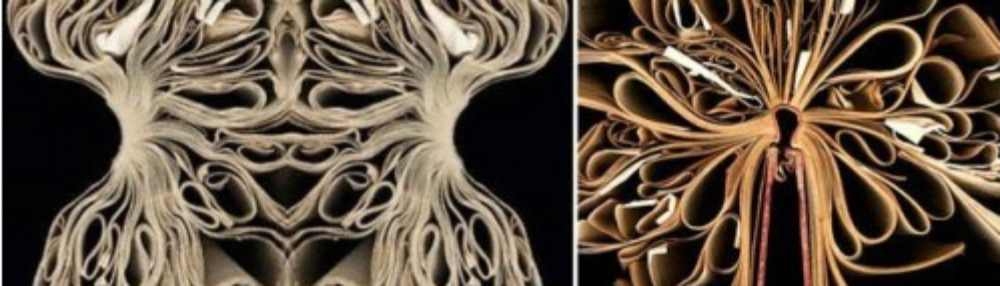
Somehow, I feel that our obsession with the ideas within books restricts us from our understanding of them as commodity. As Borsuk illustrates in chapter 2 of The Book, the actual item of a book gradually morphed from something hand-done by scribes to production on an industrialized scale. Sandcasting has been done since ancient times, and in the renaissance it was utilized to form fonts, you had pressmen organizing and creating spreads of pages. This was a sector of the economies of the times that must have employed a large percentage of the working populace as literacy rates increased and the demand for books became something ravenous.
What really captured me was the realization that these early books were often created without covers. Borsuk writes that prior to “the nineteenth century, the cover [was] certainly part of the codex, but it [was] not, in fact, part of the book,” and the cover was only affixed to the pages as customers ordered books and publishers bound them once the purchase was made (74-76). I think many bibliophiles can conjure up the dream image of their own library, each book on the shelves bound in matching leather covers, as the aristocracy of prior centuries once did. As the book became a more widespread commodity, this fell largely by the wayside, though there are some contemporary bookbinders that will create wonderfully decorated bindings for the pages of your favorite book, like McCall. However, this practice has become a boutique niche well off the beaten path for most readers.
It’s hard to look at any of this and not think of the fears that must have arose from the workers in these sectors, as type became easier to create and set, as the pressing of pages became automated, as covers and bindings became cheaper to produce or changed in some way, these workers must have been terribly worried about the security of their jobs and the livelihoods of their families. I think in no small way that this mirrors many of the same fears we have today with the rise of digitization and the exponential expanse of AI in our world. What will become of us? What are we to do?
If we look to the book and its manufacture, I think there should be some answers that lay to rest the fears many in society now have in regard to this. As the creation of books changed with the values of consumers, so too did the industry. While at one time, bookbinders might have been employed in the thousands, it is now largely automated and a few have continued the practice. I think that the book, and knowledge, or humanity in general, will follow much the same path. The way we arrive to its end might be ever shifting, but there will always be a need for the human hand to mark the world in some way. It might be tempting to agonize over the looming iRobot or Wall-E end of civilization, but given the tenacity of mankind, this is terribly unlikely. As bookbinders faded from the forefront, artists took up the mantle, creating the wonderfully decorated covers we see today. As readers once relied on a few authors to create the vast majority of content, now there are an uncountable number of those laying words to paper. There is an ebb and a flow to all things. I think that no matter how our perceptions or stereotypes of it might shift, the book will always be.
Hi Warren, I enjoyed reading your post and how you discussed the way that we are far removed from the process and artistry of making a book. We are so used to automation that it is easy to forego beautiful products in favor of something mass-marketed. In my post, I discussed how some people are taking matters into their own hands and are rebinding their books often in styles that resemble old illuminated manuscripts. Even large companies like Barnes and Noble and Waterstones are selling special editions of books. Like you said, because of the lack of bookbinders, artists have taken up the role and filled their space. We don’t know where the book will go, and although the industry keeps changing, I appreciate your sentiment that “the book will always be.”