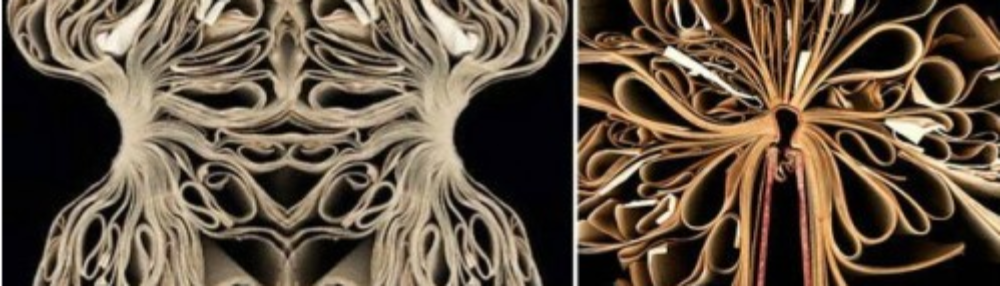
Chapter 3: The Book as Idea

In Chapter 3 she writes: “Muted books take on a totemic significance. Because we can’t ‘read’ a book object or book sculpture, we see the idea of the book, a metaphor that has penetrated our culture so deeply it informs the language we use to describe ourselves.”

This made me realize how much the book is more than just paper and ink. Even when we strip away the actual text, the shape and idea of a book still carry symbolic meaning.

Borsuk connects this to how deeply the book is embedded in culture and language. I never thought about how many expressions in English (and in German, too) are built on the metaphor of the book. For example, someone can be “an open book,” or we might “judge a book by its cover.” These phrases have nothing to do with literal books, but they show how strong the idea of the book is in shaping how we talk about people and life.

The phrase “totemic significance” stood out to me as well. I learned a totem is something that represents a belief system or community identity, and thinking of the book in this way is powerful. It means that books are not only tools for reading but also cultural symbols we treat almost with reverence. I thought about how in my home, even when we didn’t read certain books anymore, we still kept them on the shelf, as if just having them there made the room feel more intellectual or meaningful.

For me, this passage helped to see that books work on two levels at once. They are objects you can read, but also symbols you can’t escape. Even in an age of screens and e-books, the metaphor of the book is still shaping how we understand knowledge, identity, and even morality.

Bibliography Defined

On the Bibliographical Society of America’s page “Bibliography Defined: Further Reading”, I was surprised how many different ways there are to define bibliography. At first, I thought it was just about making lists of books, but the readings show that it’s much more complex.

One sentence that stood out to me was from G. Thomas Tanselle, who defines bibliography as “a historical scholarship field investigating the production, circulation, and reception of texts as physical objects.” When I read this slowly, I realized how much is packed into it. Production points to the craft of bookmaking, from scribes copying manuscripts to modern printing. Circulation reminds me that books move through time and space. Who owns them, how they get into libraries, or how they are traded and collected. And reception shifts the focus to readers, how books are actually used, marked up, or even censored. This short definition opened my eyes to how dynamic the life of a book really is.

The other scholars on the page expand on this in different directions. For example, W. W. Greg focused on the material study of books, while D. F. McKenzie argued that bibliography must also include social and cultural contexts, not just paper and ink. More recently, Derrick Spires writes about liberation bibliography, which shows that the history of books is also the history of exclusion, who gets to be published, preserved, and remembered. Thinking about this makes me realize that bibliography is not neutral. Just like Tanselle says, books are physical objects, but the way they are made and circulated is shaped by power.

As a German exchange student, I think about how our libraries at home privilege certain “classic” authors while other voices are harder to find. Bibliography, then, can also be a way to uncover those silenced histories.

Overall, the BSA’s list shows that bibliography is both technical and political. It studies bindings, editions, and typography, but also the cultures that decide what counts as a book.

Reflections on Blue Humanities: Thoughts After Dr. Mentz’s Talk

Last Thursday, I had the chance to attend a talk with Dr. Steve Mentz about Blue Humanities, and it really made me think differently about water and how we experience it. What stood out to me the most was how personal and global this field is at the same time. Dr. Mentz talked about swimming in La Jolla Cove, and how each body of water has its own local culture like rules, rhythms, and even wildlife interactions. I found that fascinating because I had never thought about water as something so socially and culturally alive. Even if someone can’t swim or lives far from the ocean, he emphasized that water is still part of our daily lives. It flows in our bodies, it rains, it’s in clouds. Water connects us in ways I hadn’t realized before.

Another part that struck me was the connection between movement and thinking. Dr. Mentz described how swimming, or even walking and running, helps him work on writing, rhythm, and language. The idea that bodily movement can shape how you think or write was new to me. It made me think about my own study habits and how maybe I could find ways to learn that go beyond sitting at a desk.

I was also interested in the stories about how humans shape oceans and vice versa. From historical shipwrecks to oyster farming, the ocean isn’t just a backdrop but it’s an active participant in history and culture. He even connected these ideas to modern issues, like offshore wind and deep-sea life, showing that the way we interact with water has ethical, political, and ecological dimensions.

Finally, I loved how the discussion included clouds, ice, and rain as part of the Blue Humanities. Water isn’t just liquid; it’s solid, gaseous, and everywhere. Thinking about these different forms reminded me that water shapes so much of life in ways we often overlook.

Overall, the talk left me inspired. I realized that learning about water isn’t just about studying the ocean, it’s about seeing the world differently, noticing the rhythms and flows that connect humans, animals, and environments. It made me want to pay more attention to the water around me, wherever I am.

Week 5: Chapter 2

In Chapter 2, she talks about the book as content rather than just an object. One sentence that immediately stood out to me was the first one: “The Renaissance inaugurated the age of books, at least among the aristocracy, and many of the features we now associate with the codex arose in response to the boom in silent readership.”

I find this so interesting because it shows that silent, private reading is not something obvious or natural. Before, many people read texts out loud, often in groups. When people started reading quietly to themselves, the book had to change too. Things like page numbers, indexes, and even margins became more important, because readers needed ways to navigate on their own. It reminds me of how we now expect search functions and hyperlinks in digital texts. The way we read always influences the way books are made.

Borsuk also explains how books became status symbols in the Renaissance. Rich families had small, decorated prayer books or even books in unusual shapes like hearts. That made me realize that books were never only about information. They also showed something about identity and culture. Today it’s similar. Some of my friends love to buy fancy hardcovers, even though they read mostly online. But I get it, because it always feels different to hold a real book from holding a Kindle or a phone.

What I also found fascinating is how silent reading changed people’s relationship with texts. Reading alone makes the experience more private, almost like a personal conversation with the author. I notice this in my own life too. Reading out loud in class feels very different from reading quietly at home. Silent reading makes me think more, but group reading makes me feel more connected but also nervous.

For me, the main point of Chapter 2 is that content and form cannot be separated. Books adapt to how people read, and at the same time, they change the way people think and learn.

Week 4: The Book, Chapter 1

When I read Amaranth Borsuk’s The Book, Chapter 1, one sentence really caught my attention: “Content does not simply necessitate its form, but rather writing develops alongside, influences, and is influenced by the technological supports that facilitate its distribution.” (p. 17, ll. 17-18)

At first I had to read it twice because the English is a bit heavy, but what it means is actually simple. Books and texts don’t just find a form because of their content. Instead, the medium itself, like clay tablets, papyrus scrolls, codices, or today’s e-books, shapes how we write and what we write. And at the same time, writing pushes those technologies to change too.

I think this is super interesting because we often believe that content is the main thing and the medium doesn’t matter. But if I think about my own reading habits, it’s clearly not true. For example, when I read on my phone, I definitely skim more and jump around. When I read a paper book, I am more focused, I even underline or make notes. So the form totally changes my behavior and also the way the author can reach me.

Borsuk also points out that throughout history, different forms didn’t just replace each other. Scrolls and codices coexisted for a long time, just like today I read both on my phone and in paperback. It’s funny, because when I came here for exchange, I couldn’t bring many books in my suitcase, so I rely more on my e-books on my iPhone. But when I go to the library, I really enjoy holding a physical book again. I wouldn’t say one is better, but they feel completely different and change my relationship with the text.

This makes me think about how new platforms influence writing styles today. Twitter/X with its character limits made people write in short, sharp bursts. TikTok captions and comment sections encourage different rhythms, more visual, more fragmented. Even academic reading changes when you can search PDFs instantly instead of flipping through pages. None of this is neutral.

So maybe the big lesson is that the book or text is not just about content, but always about the interaction between content and form. Borsuk helps us see that the “death of the book” is not really happening, it’s just transforming again. And maybe in 100 years, students will look back at our e-books the same way we look back at scrolls. As just one stage in the long, messy coexistence of forms.

Week 3: Different Eyes on the Same Book

When I first started reading about book history, I thought it would be a simple field with one clear method. A book is just a book, right? But I quickly realized that the history of books has been studied in very different ways, depending on the country and the tradition. In France, for example, book history focused on how books moved through society and how they influenced big historical events. In Germany, where I am from, the field called “Buchwissenschaft” was more about the practical side, how books were published, produced, and distributed. In Britain, book history developed from bibliography and textual editing, which meant looking closely at different editions of the same work and how small changes could affect the meaning.

I find this really interesting because it shows that each approach asks different questions about the same object. The French way treats the book almost like a historical actor, influencing revolutions and social changes. The German way is more focused on trade and infrastructure, thinking about printers, publishers, and markets. The British way zooms in on the text itself, paying attention to words, punctuation, and editing choices.

As a German student, I can understand why it developed in this way. Germany has a long tradition of book production and publishing, from Gutenberg’s press to the Leipzig Book Fair, so it makes sense that the focus was on how books were made and sold. At the same time, I also appreciate the French and British perspectives because they help me to see other sides of the book that I might not think about otherwise.

What I take away from this is that no single approach is enough on its own. If we only follow one national model, we miss the bigger picture. A book is never only a text or only a product. It is also a cultural force that both shapes and is shaped by history. That is what makes book history so exciting, it asks us to see books from many different angles.

Introduction – Alin Kilicoglu

My name is Alin and I’m an international student from Germany. Back home I study Education at the University of Siegen, which is in the western part of the country. I’m now in my fourth year, and I hope to become a teacher in the future, because I really enjoy working with people and sharing knowledge.

One of the reasons I chose education is that I believe learning can open doors and change lives, and I’d love to support students in discovering their own strengths. I’m especially curious about how different cultures approach teaching and learning, which is also why studying abroad is so exciting for me.

Outside of class, I enjoy traveling and exploring new places, spending time with friends and reading. I also like cooking and watching movies. Being here gives me the chance not only to improve my English but also to connect with people from different backgrounds, which I really value.