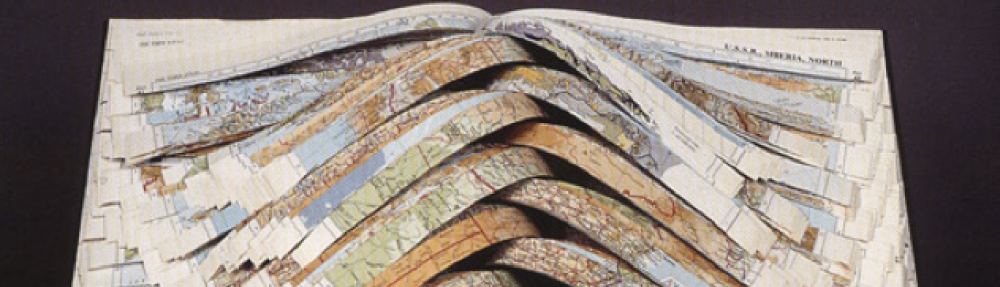
Book as Idea

As we near the halfway point in our semester, we have spent most of our course searching for answers to how we define what is a book throughout our traditional history. What is interesting with this week of “Book as Idea” is taking into consideration books that do not present in a linear format or that are unconventional in the sense of not presenting language. As the relationship of form and content continues to unravel in the digital age, I found the bookish artwork by Doug Beube and Brian Dettmar particularly astounding as their altered book sculptures challenge our assumptive qualities about what a book should be. 

In discussing their work with Dr. Pressman, both book artists emphasize the cultural zeitgeist they find themselves in as they strip the book of its traditional utilitarian usage of reading in a linear fashion to create paper and book-based art that experiments with perception and meaning. Through such interactions with the book, Doug Beube describes, “The book as an object is generic in a sense. All books basically look the same: they’re rectangular, have a front and back cover, etc., so its form and format is almost (and I emphasize almost) immaterial to its content. I see the literary aspect of my art as a collaboration between me and the other creators involved in making the book…I consider these acts of engaging in conjunction with literary criticism—a way of building my own critique,” (3). As Beube’s work subverts the usual entry point of readers’ interactions with a book, he acknowledges the qualities that books have been standardized to meet that are often looked for subconsciously when deciding if an object is worthy of the “book” title. With his placed emphasis on how “form and format is almost immaterial to its content,” we know as scholars of the book how form, format, and content will always impact the meaning of the other, but Beube suggests a decreasing impact of form and format as modern printing and book production follows a familiar or “generic” idea of what a book is.

Though the book is not a very malleable object due to construction and low quality materials, Doug Beube and Brian Dettmar experiment with physicality to craft new meaning, redefine “reading” of the book, and as Dettmar suggests, “force a fluidity onto the book that isn’t intended,” (4). In pushing the book to its limits and thus adding additional texture to book analysis, the book’s authority is destabilized where readers are challenged to pursue atypical interactions with the book and think in a spatial pattern that does not follow the linear pattern of moving cover to cover. Considering our class discussions of how the book is not a stable medium, this act highlights such instability as it is made into both a collaboration and a critique as aforementioned by Beube. Through such sculptural interventions, the artists reinforce the book as a living object by fostering active conversation between the author, artist, and reader.

The Life of a Book

When being taught to write and research in schools today, students are often only introduced to the enumerative bibliography which systematically lists books, however, physical aspects of the book are ignored. While this approach is vital for organization and giving credit in Works Cited pages, it overlooks the important historical and cultural insights that can be gained from considering the story told from a book’s physical form and materiality. As book scholars, creating analytical bibliographies, which study books as physical artifacts, allows the book to be understood as a living object that has its own history shaped by geography and culture and its own story that exists separate from its contents. 

W.W. Greg, a 20th century leader in establishing the bibliography as the study of a book’s physical evidence, advocates for the significance of a book’s material existence. He highlights the significance of the analytical bibliography by describing, “the object of bibliographical study is, I believe, to reconstruct for each particular book the history of its life, to make it reveal in its most intimate detail the story of its birth and adventures as the material vehicle of the living word. As an extension of this follows the investigation of the methods of production in general and of the conditions of survival,” (27). By making specific note of the book having a “history of its life” within its materiality, Greg acknowledges the book as a living object that is not static throughout its existence. As the book evolves from “its birth and adventures,” it can be understood how the book’s existence amasses its own stories separate from the author and its contents. Through observing the physical composition of books like its paper, spine, binding, ink cover, the book reveals how it is an agent of active change rather than a container for information.

Recognizing these conditions is especially important in telling lost histories. While book production and circulation has been historically dominated by white wealthy men, liberation bibliographies can help combat systematic suppression of minority groups by recognizing oppressive structures. Similarly, critical bibliographies explore how book history can be reshaped for the bibliography to be used to resist oppression. Through the utilization of bibliographies as a restorative tool, those historically erased have the opportunity for their histories to be restored and written. For the humanities, this is an important political act in forming a more complete understanding of human history and as a political act recognizing the errors in how we’ve viewed dominant historical narratives.

Book as Content

As we have grown up in a modern world where the most common book is cheap paper bound together by glue beneath a cheap cover, it can be challenging to undo our orientation to what qualities we expect to be “normal” of the codex and typical to the reading experience. Before this class, I was aware of “book history” as a field of study, however, knowing little, I never anticipated how our interactions with and expectations of a book reflects and constructs meaning. Though these biases may be unconscious, they reflect Borsuk’s observation that “Our conception of the book and access are intimately shaped by the shape it takes.” (Borsuk 89). With content, form, and format being inseparable entwined with each other, Borsuk acknowledges how the material form of the book as an object influences our interaction with the book as a form of content that contains information within its vessel. 

Something I had not recognized within my own perception of the codex was addressed in Chapter 2 of The Book as Borsuk makes note of how we often consider books that are larger as more valuable. Reflecting on our visit to Special Collections last week I can now recognize how in handling the archives I did view the Torah scroll and the very large book with the wooden cover (I am drawing a blank on what the book was called) as more valuable or as deserving more care than some of the smaller books like the artist books. Intrinsically, I felt the size and more elaborate nature of their materials like wood and metal deserved more reverence. In contrast, the small nature and more common materials used in the other books felt more casual and approachable because of their similarities to the modern book, which is why they didn’t feel as significant. 

Through this experience, I better understand my orientation to the book and Borsuk’s emphasis on the importance of shape. Without knowing or understanding the contents or histories of these different artifacts, my mind followed social and historical constructions that larger items demand more authority and legitimacy partially due to taking up more space. Therefore, form and format impact content as our instinctual need to judge a book by its cover provides the framework for how a work’s meaning is interpreted and the medium is integrated into the book’s message.

Book as Object

As presented by Amaranth Borsuk in The Book, it is important to understand the history of the book and how it developed as an object within our culture before we can have debates on what classifies as a book. While the portable, durable, economically accessible book we know today may seem like a fixed cultural artifact, throughout its history, the book has continuously transformed with material availability and changing societal needs. Reflecting on the earliest books being made from papyrus in Egypt, bamboo in China, and animal hides in Greece to name a few of the first bookish societies, books have always been in a close personal connection to its cultural context.

In considering these various origins and how their ideas merge or influence each other, it is clear that the book which has resulted today is a cumulative product of human innovation rather than one that can be claimed by one culture or event. To help explain this phenomenon, Borsuk cites D. F. Mckenzie who writes in Bibliography and the Sociology of Texts, “A book is never simply a remarkable object. Like every other technology, it is invariably the product of human agency in complex and highly volatile contexts,” (42). The book has never been a static object and is continuously recreated by humans to cater to the shifting needs of time and various societal climates. While the book has largely been credited as a German innovation due to the printing press revolutionizing book production and accessibility, by looking back to understand the origins are writing and writing production, it is clear that the creation of the book is a global, collective effort. While humans more and more enter an age of technological innovations being a competition of time and ownership, the book is one of centuries long development that has been slow and collaborative. As a chain of evolution and reimagination, the book is strong in representing diversity of thoughts and being adaptable to ever changing needs. With the definition of what makes a book continuously up for debate, the book should be recognized as a global success of humanity in creating a living form of technology that may adapt to informational and distributive needs of any given culture.

Week 3: Book Studies as Media Studies

Books have always served as a source of comfort and nostalgia in my life. As I’ve grown older, my childhood joys mirror much of my adult hobbies as I still love to read on the beach or before bed as much as I loved having books read to me. Something that has continued to interest me throughout our course so far is the concept of preciousness surrounding books that most of our class expresses experiencing. With daily life and academia continually evolving into a more digital world, it is important to consider how our bookish behaviors have evolved or resisted the shift from pages to screens.

In considering the book amidst media studies, Dr. Pressman defines bookishness as “the book is figured within literature an aesthetic object rather than a medium for information transmission, a thing to fetishize rather than to use,” (Johns Hopkins Guide to Digital Media and Textuality). Through this definition, we are compelled to view the book as an object of aesthetic and symbol. Due to the historic exclusivity of the book, the book has become a status symbol of education and wealth and it may have more significance in society as a visual signifier of these notions than as a tool to access the knowledge inside of it. Though books have become more accessible in the digital age through e-books and audiobooks, the symbolism of possession has not diminished. This can especially be seen through online trends and the rise of Internet subcultures like “BookTok” and “BookTube” where creators show massive libraries or book hauls often without including any critical response or review to the material of the books presented. That’s not to say that books can not be read for leisure as Michelle Levy and Tom Mole’s introduction to book history reinforces, however, these platforms exemplify how the book has continually grown to be a fetish object.

Books as Media- Borges and Marino

In continuation of our discussion on what defines a book, Jorge Luis Borges illustrates the impossibility of a definitive answer in his exploratory short story, The Library of Babel. An author and librarian, Borges provides the perspective of both creator and keeper as he analogues the book to God and the Library to the universe as it is composed of God’s many creations.

In looking to better understand the theological comparisons proposed by Borges, I researched Babel to discover its origin in the Book of Genesis where humans try to build a tower to heaven (Babel) only for God to not understand their various languages. Thus, when comparing The Library of Babel to its biblical roots, Borges positions humans as the God who have created books and books as creating a universe that supersedes the parts of its whole to construct a state of excess information too powerful to be understood. As Borges describes, the Library is “unending” and “ab aeterno;” a state which is hopeful in possibilities and depressing in limitations.

As the library has grown out of man’s control, it is imperfect in its ordering by theory and humans’ imperfect hands. With the galleries of the library being sorted by what Borges coins “the fundamental law of the Library,” humans continue to demonstrate a failure in self-governance as the impossibility of having “correct” answers to questions like “How do we decide what books to keep?’ and “How do we classify a book?” are haunting. Through the magnitude of Babel, Borges positions humans, the creator, in a role that is small compared to the magnitude of knowledge that can be captured by the library but not within the brain. Below is an image I found of the Library of Babel that shows just such as the humans within the drawing are miniscule against the grandeur of the galleries. (I could not find the artist or when this was created.)

Marino’s brilliance with Marginalia in the Library of Babel is captured by his ability to simulate the Library of Babel within the digital. Finding the library and the Internet to be one in their archiving of information, Marino takes the context of Borges’ stories and emulates the same dizzying effect of the library by cataloguing hyperlinks. Through these hyperlinks, readers can go down the same rabbit hole of information as the hyperlinks reflect Borges’ hexagonal library structure. While the digital and physical forms of knowledge are most often viewed as separate practices of thought, Marino makes his case for literary behaviors continuing on the web where we continue to find ourselves as small as those in the Library of Babel amidst the landscape of the web.

Introduction

Hi everyone! My name is Avery Simone and I am a first year graduate student in the English M.A. program. I completed my BA in English and Comparative Literature at SDSU and am very excited to be continuing my education at the university. 

Like most of you I’m sure, I’ve dedicated my education to books and literature, which is why I am so interested in taking this class. My favorite genre is fiction with The Great Gatsby being my favorite piece of classical literature (recognizing that much of the novel’s substance was taken from Zelda Fitzgerald) and If We Were Villains being my favorite contemporary novel. Something I am interested in exploring in this class is how a novel acquires the status of being a classic and how literary “canons” are formed. I’m looking forward to this class with you all!

Additionally, for anyone interested in publishing, writing or a creative outlet, I also run a magazine on campus! Femininomenon Magazine’s mission is to amplify the voices, experiences, and art of women, gender nonconforming, and all creative individuals. Though much of our work centers on female empowerment, all are welcome to join our magazine and submit works to our writing, photography, and/or art teams. Below are the links to the magazine and GroupMe for anyone interested in joining 🙂

Femininomenon’s Website: https://femmemag.wixsite.com/mysite

Femininomenon’s GroupMe: https://groupme.com/join_group/108618690/EORV2Eh9