Final Project: To Be a “Man of the Book”

In 1941, Jorge Luis Borges published his short story, “The Library of Babel.” This winding labyrinthine narrative details an infinite library in which every possible book written in every conceivable language is stored within the hexagonal rooms. The librarians of Babel wander through the library and dedicate their lives to reading as many of these books as possible. Some rarely leave the vicinity of the hexagons that they were born in while others search for the Vindications, books that detail someone’s entire life. Others devote their lives to finding what Borges describes as the book of all books, which is theoretically the cipher to the entire library. The desire to learn it all fuels their search and they become consumed by it. 

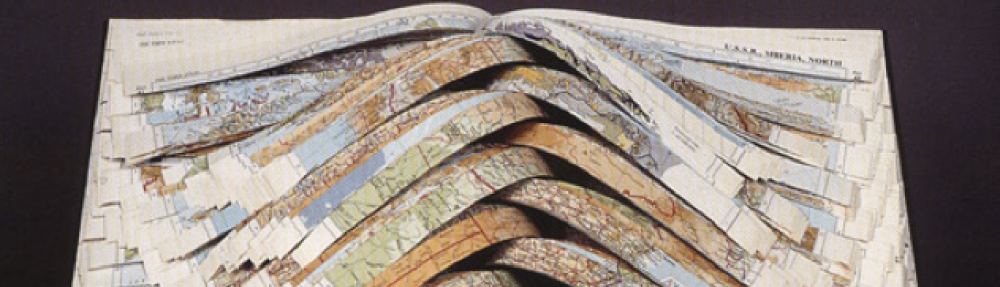
This book of all books is the heart of my project and led me to create the impossible through the form of an artist book. Taking inspiration from the artist books we examined in Special Collections and Amaranth Borsuk’s “The Book,” I created an artist book that utilizes tunnel binding to create the illusion of infinity and capture the weight of Borges’ work. Each hexagon slowly became a room in the library, complete with bookshelves that span the walls and a stray librarian wandering through. I used watercolor paints to add depth and dimension before attaching each paper to an accordion folded strip of paper. This allows the reader to pull the pages out and see the illusion of infinity when looking through the cut out. In Borsuk’s “The Book,” she describes tunnel books, “When fully extended and viewed through an opening in the cover, the tunnel book’s superimposed flat planes create the illusion of depth.” This description inspired me to create a tunnel book in order to portray the infinite in a way that was conceivable. Even the title, taken from a quote of the short story, “The Library exists ab aeterno.” On the back of the first panel, I wrote the first few opening lines from “The Library of Babel.” Due to the construction of the artist book, the reader would have to dismantle and possibly damage the book in order to read the quote. This detail alludes to the frantic destruction of the Library of Babel that some of the librarians caused in search of the Vindications. What I hoped to achieve with this project is to demonstrate the fanatic need to pursue knowledge, to pursue more. We live in a time where information is quite literally at our fingertips and we have become oversaturated with new publications. Due to this, Borges’ work remains prevalent even nearly 85 years later as he demonstrates the deep rooted fanaticism that surrounds books and the pursuit of knowledge. 

Borges’ narrator is one of the many librarians who explains the unusual inner workings of the library and how different librarians navigate the books and mythos of the library. He recounts the many theories surrounding the library, and how it was determined to be infinite. He states, “when it was proclaimed that the Library comprised all books, the first impression was one of extravagant joy. All men felt themselves lords of a secret, intact treasure. There was no personal or universal problem whose eloquent solutions did not exist– in some hexagon. The universe was justified, the universe suddenly expanded to the limitless dimensions of hope.” The overwhelming joy at discovering the library is infinite is similar to the introduction of the internet. There were hardly any regulations on what could and could not be done on the internet. This freedom seizes the librarians and leads them into chaos. At first, having all knowledge at hand seems like a good thing as every single problem would have a solution. However, it creates more problems. Borges notes that the librarians became consumed by the possibilities that the library had to offer and sparked their interest in the Vindications. In their search for these biographies, the librarians were frenzied in their lonely searching, abandoning their hexagons, murdering one another, and destroying books in the process. The pursuit of knowledge becomes a dangerous quest that taunts the seeker.

Further in the short story, Borges introduces the concept of ‘the Man of the Book.”  Borges writes, “We know, too, of another superstition of that time: the Man of the Book. In some shelf of some hexagon, men reasoned, there must exist a book which is the cipher and perfect compendium of all the rest: some librarian has perused it, and it is analogous to a god.” The concept of the Man of the Book is at the root of my project. The idea of someone discovering and reading the cipher to all knowledge is incredibly moving and it fuels the librarians’ desire to learn more and strive to become a Man of the Book. To read and absorb everything means that they are well rounded in their research and knowledge. Today, readers attempt to read and collect books as fast as they possibly can because there is an incredible influx of media to consume. However it is impossible to read all of it. In Gabriel Zaid’s book, “So Many Books: Reading and Publishing in an Age of Abundance,” he confronts the issue of the overabundance of books and how it is just not possible to read every book published. In his book, Zaid writes, “When we say that books should be read by everyone, we aren’t thinking. Our simple physical limitations make it impossible for us to read 99.9 percent of the books that are written. Humankind writes more than it can read. If for every book published one or two languish unpublished, then two or three million books are written every year.” Much like the librarians’ work being futile, it is impossible today for a reader to attempt to read everything. In order to become a Man of the Book, we must be more open to conversation and piece together information gathered from other people. Zaid remediates these concerns with the suggestion that readers do not need to read everything. Rather, readers should not focus on reading everything but dabble in anything. The conversations drawn together by various media sparks more connection between people.  In order to become a Man of the Book, we must be more open to conversation and piece together information gathered from other people. 

In conclusion, Borges’ short story, “The Library of Babel” explores the fanaticism of the pursuit of knowledge. We must be aware of the dangers that go along with the search for more. In a time where the market is saturated with new media nearly everyday, it becomes apparent that everything cannot be consumed. Rather, we should focus on cultivating community and inviting conversation to combat the desire to read everything.

Works Cited

Borges, Jorge Luis. “The Library of Babel.” Ficciones. 1941. Grove Press. 

Borsuk, Amaranth, “The Book.” The MIT Press. 2018

Zaid, Gabriel. “So Many Books: Reading and Publishing in an Age of Abundance.” Translated by Natasha Wimmer. 2003. Paul Dry Press. 

Final Project Proposal

For my final project, I wanted to circle back to the beginning of this course and re-explore Jorge Luis Borges’ short story, “The Library of Babel.” Within this short story, Borges explores the complex power dynamics that surround books and the readers/owners of them. One of his main focal points is an indescribable index that contains the entire library within it and is thought to be the cipher of everything else. Many librarians dedicate their lives trying to find this book and in their search shifted the politics and ways of living in the library. This devotion results in fanaticism and new religions in the library. With my project, I want to explore how books and knowledge have become symbols of power and privilege. Many people have spent their lives searching for more knowledge and they will go to extreme lengths to obtain this knowledge. I also want to focus on the librarians/gatekeepers of the books and content and how they determine what to keep in the archives as a way of wielding power. I am still trying to hone in my thesis so any feedback would be greatly appreciated.

For the creative aspect of the project, I am going to make a physical representation of the Book and make the intangible tangible. I will achieve this by using inspiration and techniques from the artists books we have looked at in Special Collections. I am planning on doing a concertina- style book that emulate the vastness of the library when you look through it. This piece is to represent the lengths one would go in order to seek out more knowledge.

Bookishness

Reading Dr. Pressman’s book, “Bookishness: Loving Books in a Digital Age,” felt like the perfect capstone to this class in the way that everything fell into place and how the book related to many of our discussions. At the beginning of the semester, we discussed how books were once a new technology that sparked wariness and various discussions about their impact. Now, centuries later, a new conversation has spread about our ventures into the digital space and how it would affect books. “On page 26, Pressman writes, “Five hundred years after Gutenberg’s invention, we have become used to books as accessible, ever-present commodities and personal comforts. We forget that the book was once the new media, raising concern about its potential power.” Within this quote, Pressman acknowledges the commodification of books, the evolution of book technology, and how power is deeply entwined with it. Since the beginning of the semester, we have discussed the commodification of books and how it has become a main aspect of books. Books became portable, marketable, and desirable, which is seen in the way that books have become an aesthetic. Anything could be rebranded with the image of a book and it would sell. Another point that Pressman addresses is how books have evolved over time inclduing views on them. During a time where everything is saturated with books and bookish content, it is easy to forget that books were once a new technology that fed many fears. Pressman includes a quote from Victor Hugo’s “The Hunchback of Notre Dame” where the Claude Frollo declares that the book will kill the church and its influence. Despite being centuries ago, the sentiment has remained the same in which we see this same fear as we venture into digital spaces. Finally Pressman ackknowledges the power that books hold. At first glance, it is easy to ignore the importance of books and how they can shape people. She writes, “experimental novels play with the materiality of the book to present narrative allegories that figure the digital as monstrous and the book as a powerful weapon against it.” Books hold an incredible power that challenge the digital realm and it is clear in Pressman’s book that she wants to express this notion.

The Shadow Archives

I found the introduction of “Shadow Archives,” by Jean-Christophe Cloutier, to be extremely intriguing because it discusses the concept of ‘shadow books,’ which are works that are either forgotten, discarded, removed, or never published. Cloutier places special emphasis on the importance of these works and the preservation needed for them. On page 2, Cloutier writes, “the preservation of the removed is precisely the condition which genitor criticism depends: the alternative versions and abandoned drafts retroactively cast their shadow back upon the maimed books that survived. By disrupting textual stability, special collections further encourage “a willingness to recognize the unfinished” as a condition of the literary– not only what has been removed but also what the removed may one day inspire.” These shadow books are a crucial aspect of the literary world because they offer insight into unknown stories and allow people to gather more information and context surrounding the work. In this introduction, Cloutier discusses Richard Wright’s Black Boy, a book that had been heavily edited or had text removed. Years later, it was republished with notes from the author and a ‘restored text’. With this updated version, Black Boy has become a staple in African American literature. Imagine what lessons, ideas, and opinions could have been lost without that revised edition. Cloutier’s chapter provokes the question of what can be done about lost media and the importance of trying to preserve it. While it may not seem like much at the time of publishing, some works need to be processed with time. Richard Wright, along with countless other authors are recognized posthumously through their work and the resurfaced shadow books. The preservation of these shadow books bring more awareness to the author, publisher, and the ‘invisible labor’ that Cloutier mentions. in the article, Kevin Young states that he became a collector “to save what we didn’t even know needed saving.” This statement really stuck out to me since we live in a time where so many pieces of work are discarded or ignored. Sometimes there is just no time to view it. Despite that, it doesn’t lessen the work and becomes something worth saving. Often items are ignored when it comes to archives so it is important to be aware of what is saved and recorded while other material is lost or ignored. This circles back to the power of an archivist and collector. They are able to pick and choose what they want and exert power over what they deem worthy to be collected. Shadow books fight against this and prove that awareness is always shifting.

The ‘Talking’ Archive

When I was reading, “Book Histoy from the Archival Record,” by Katherine Bode and Robert Osborne, I was intrigued by how much information can be gleaned from archives. Within Bode and Osborne’s chapter they are adamant about conveying how archvies are able to tell so many stories beyond the content of the collection. For example neart the start of the chapter, they write, “Quite simply, achival research provides the principal way for book historialns to explore and understand the history and nature of authorship, publication, distribution, and reception of print culture.” They discuss the corresondence that happens between the people who are involved in bookmaking and how it can reveal so much about the context of the product or the book’s market. The letters can offer a lot of insight into the industry. Although archvies seem simple, merely collections of media used for remembrance or preservation, the can reveal so much more than that. The act of creating the archive is one of its most crucial aspects. Bode and Osborne write, “Most records have already undergone a process of ‘archiving’. Individuals make decisions about what documents they want to keep or discard… All archives are formed in relation the methods, rules and spacial limitations of their managers, whether the archivist is professional or ameteur.” This quote brought to mind the act of reading that we have discussed in class. Just as no two people can read the same way, there are no two archives that are identical. The thought and intention that goes into the archives are what makes them crucial to society. The archives provoke questions such as “who determines what is kept in or out of the archives?” or “why is the media worth preserving?” So many factors can be at play for this, including accessibility, time, space, and money. The items stored in an archive can say a million things about the owner or curator. Studying all aspects of the archive can reveal a lot about the archivist, society, and the content. After detailing these archival studies, Bode and Osborne write, “such studies as these draw attention to the content of archives by compiling rich and compelling narratives that make the archives ‘talk’.” The ‘talking’ archive was extremely fascinating to me because the media stored within the archives have a conversation with the ones who are studying it which leads to questions and ideas flowing back and forth between them.

Midterm: 1866 Edition of Milton’s “Paradise Lost”

New York: Cassell, Petter, Galpin & Co. An 1866 first edition of John Milton’s Paradise Lost, illustrated by Gustave Doré. This book is featured in San Diego State University’s Special Collections. The book is bound in a brown pebbled leather cover. It is embossed with black ink and embellished with gold foil along the spine and front of the cover. The cover features the image of an angel holding a sword and spear with an embossed black sun with golden rays behind the angel. The title is inlaid with gold foil and curves around the sun. On the back of the book, a symmetrical floral design is embossed into the leather. Inside the cover, there are white and pale green endpapers with a floral design. The edges of the pages are gilded and retain most of the gold. There is mild scuffing on the spine and along the edges of the cover. The pages are made of rag cotton paper and have slight foxing throughout the book. They are bound together with thread and are mostly intact, however the first few pages are loose. The entire book is printed in black in and uses a roman font. The text is also large and easy to read. This edition includes notes and a biography written by Robert Vaughan, D.D. in which he explains the life of John Milton. Scattered throughout the book are large plates that were illustrated by Gustave Doré. Each of them are caption with a quote taken from the text.

Gustave Doré’s Illustrations in Milton’s Paradise Lost

In 1866, the publishing house, Cassell, Petter Galpin & Co. published a new edition of John Milton’s Paradise Lost. This book delves into the rebellion of Satan and his journey to seek revenge on God which results in the downfall of Adam and Even and thus humanity. This edition was accompanied by 50 wood carved etchings made by Gustave Doré, an artist famous for his depictions of literary classics such as Dante’s Inferno and Samuel Taylor Coleridge’s The Rime of the Ancient Mariner. These etchings are incredibly detailed and are easily recognizable today. Although Doré’s etchings are intricately beautiful, they serve a larger purpose than aesthetics. Doré’s illustrations help aid the reader understand the content of Milton’s work and enhance their reading experience leading to the revitalization of the poem. 

Throughout Milton’s poem, Gustave Doré’s illustrations are included every few pages, ranging from depictions of the fall of Satan to the temptation of Eve and her exile from Eden alongside Adam. In order to make these images, Gustave Doré designed each plate before handing the illustration to a group of woodcarvers who crafted the etchings that were used for printing. In the 1866 edition of Paradise Lost, each plate takes up a full page with a small caption of a corresponding quote from the passage. The large size of both the page and plate allows the reader to fully examine the image and absorb the content completely. Due to Milton’s dense content, Doré’s work offers visual aid. The illustrations break up the long passages and depict specific scenes. Though they are carved into wood, the carvings have high levels of detail, displaying incredible emotion in the characters. There is also high contrast between the deep shadows and bright highlights, which further depicts the juxtaposition of holiness and sin. These excruciatingly sharp details allow the reader to make their own interpretations of Milton’s work. Readers could synthesize what they believed through Milton’s words and Doré’s images. 

Illustrations can greatly impact a reader’s experience, especially for a book that is as heavy and dense as Paradise Lost. The illustrations that are included in the 1866 edition of Paradise Lost is no exception. The article by Sarah Howe, “Illustrating Paradise Lost,” discusses the first edition of Paradise Lost, in which there were no images to accompany it and resulted in mediocre sales in the late seventeenth century. She writes, following the publication, “The poem’s popularity gradually grew, but by 1687, no new edition of Paradise Lost had appeared on the shelves for a decade.” She goes on to explain that in 1688, a publisher named Jacob Tonson published a new edition of Milton’s work which featured artwork from three artists. This new edition became extremely popular and reignited intrigue in Milton’s poem which resulted in Tonson “realis[ing] that pictures sold books and in doing so, set Milton on the path to becoming a national classic.”  Tonson’s publication, “Paradise Lost: Adorn’d with Sculptures,” paved the way for future editions such as the 1866 edition with Gustave Doré’s etchings. Tonson’s realization is crucial in understanding how images can influence a reader. Much like diagrams included in textbooks, the illustrations in Paradise Lost help the reader break down what is happening in the book. The images were meant to convey what Milton wanted and to Doré’s illustrations allowed for readers to view the content in a new light and see what Milton was trying to convey. With nearly 200 years between the first publication of Paradise Lost and Gustave Doré’s illustrated edition, his artwork is crucial to breaking down Milton’s meaning. The intense images are harrowing and unsettling, thus provoking the reader to take a deeper look into the artwork and the messaging behind it. The accessibility of Doré’s artwork and Milton’s words is also aided by the inclusion of footnotes within the book. In the book, some of the pages had small footnotes that explained certain phrases or meanings. This inclusion makes it clear that this edition was meant to be studied and interpreted, making it far more accessible to the common reader. 

In addition to making the content accessible to readers, Gustave Doré’s etchings became an accessible way for people to own art in their homes. During the Victorian era, art was available through purchase if you were wealthy enough to afford it as well as reproductions in cheaply made books and magazines. A book like the 1866 edition of Paradise Lost, allowed for more art distribution since it came with the book. With this book, people were no longer just reading Milton’s poem, but rather immersed themselves through the artwork too. The owner of the book would have been able to own 50 pieces of artwork stored within the large pages, which is an incredible amount in an era where art was difficult to come by if you didn’t have the means to afford it. In this edition of  Paradise Lost, accessibility is a key feature, seen through both the format and the artwork. 

In conclusion, Gustave Doré’s illustrations in this book have also made a large cultural impact on how the world views Paradise Lost. His work has become synonymous with the poem and is easily recognizable. For years, his artwork has drawn people in and immersed readers into the poem with his rich, dramatic compositions. He allowed readers to view Milton’s poem with new eyes and made the heavy text more understandable through his dramatic yet intricately beautiful etchings. Through the size and formatting of the plates within the 1866 edition, Doré’s work made it easier for readers to see the intricate details and allowed them to fully appreciate and admire the artwork. The inclusion of his art in the publication made it so readers were able to own their own pieces of artwork and even influenced the sales of the edition. Within the 1866 edition of Milton’s Paradise Lost, Gustave Doré’s work is highly influential, admired, and sought after. It has become a crucial part of Paradise Lost’s identity and will continue to lure in readers for years to come. 

Works Cited:

Howe, Sarah. “Illustrating Paradise Lost” Darkness Visible. Christ’s College at Cambridge University. 2008. https://darknessvisible.christs.cam.ac.uk/illlustration/illustration.html

The Future of the Book

In chapter 4 of Amaranth Borsuk’s “The Book,” she discusses how the physical book has been translated into its digital counterpart. In the same way that scrolls evolved into codices, books have evolved into the digital format. As the internet expands, so do the efforts to digitize books and make them available, resulting in digital archives and the emergence of e-readers. While there may be apprehension towards the digital books and how that changes the way people read and absorb information, Jessica Pressman reassures that “the book will not become obsolete with new reading platforms, but rather, will change and develop new incarnations and readerships; it will continue to serve certain kinds of literacy needs and literary desires.” In fact, Borsuk goes on to explain how authors, publishers, and readers are adapting to a digital reading space in which we are at the crossroads of bookish innovation. In this era of digital media and publication, there is a wide avenue for authors to decide how they want to convey their message. Much like the modernists who responded to the stiff Victorian books, we are pushing the boundaries of what makes a book a book. Erik Loyer’s digital book, “Strange Rain,” utilizes technology in a way that enhances the reader’s experience. Holding the phone or tablet up to the ceiling to convey the image of a skylight helps relay Loyer’s idea and allows the reader to become absorbed into the mindset of the main character. This unique reading experience changes the way the reader views the book. It blurs the lines between technology and books. Borsuk continues to discuss these digital formats and introduces Dick Higgins’ term, “intermedia.” This term perfectly encapsulates this new era of reading in which format and content, technology and book, collide in a new exploratory form that can go in any direction based on the creator’s intention.

The Medium is the Message

In Bonnie Mak’s introduction and first chapter of “How the Page Matters,” she introduces the importance of the page and how it influences the reader. In class, we have had many discussions about how “the medium is the message.” This sentiment has been woven through Mak’s chapters in which she argues that there is more to meet the eye when it comes to a page of a book. On page 8, of Mak’s chapter, she writes, “Yet the page has become transparent, ‘disappearing in its very function.’ So accustomed to its form, we no longer notice how the page is fundamental to the transmission of ideas and that it shapes our interpretation of those ideas.” With this quote we see how the page has slowly slipped from our minds. As we read, we no longer view the page as a canvas or artform. At first glance, a page might simply be seen as words on paper but it goes beyond that. Those words were carefully formatted in a way to capture a reader’s attention. The page is the vessel for the author’s content, able to display the information in the way that they want to convey it. Mak echoes Amaranth Borsuk’s ideas of content and books in which both of them claim that books are vessels for information. In chapter 2 of Borsuk’s “The Book” she claims, “the book as content rather than object.” These claims support that the medium is the message. The way that books present their content is extremely important to what the reader consumes and absorbs. As a result there is a deep intention placed into the consideration of format, typography, illustrations, etc. Every factor that goes into a book has the ability to alter the reader’s opinion. Later in her chapter, Mak expresses this importance of how every aspect of the page is incredibly significant. On page 16, Mak writes, “likewise, the structures for arranging these letter forms in manuscripts and printed books are graphic indications of how designers visualized ideas and organized them for themselves and other readers. The processes of thinking and reading, then, may be discerned in part from the clues offered by the page.” The page is an underrated yet incredibly crucial aspect of the book. This where the message is laid out for the reader. Significant time and effort has gone into the placement of ideas so that they reflect the author’s intentions. The layout is critical for information absorbtion. The page itself has become the message.

Artists’ Books: An Exploration of the Medium

Chapter 3 of Amaranth Borsuk’s “The Book” details the relationship between the physicality of the book and it’s content. The book continues to be a way to store information, however the expression behind the content is emphasized. This chapter goes over how many different writers and artists use books to convey messges and promote their artwork through revolutionary ways. At the start of the chapter Borsuk writes, “The clay tablet, papyrus scroll, and codex book each were shaped by the materials at hand and the needs of writers and readers. Those materials in turn shape the content with which such books were filled.” In class, we have discussed the importance of the materiality of the book. Within the pages and fine craftsmanship, there is so much information about the people, culture and regions. Each variation of the book has made a lasting impact on its evolution. There is nothing about the phsyicality of the book that is unimportant. However, in this chapter, Borsuk makes it known that the materiality of the book also alters the content. She introduces “artists’ books” which are books that convey art and defy the conventional expectations of reading a book. These artists use the book as an art medium that further conveys their messages. They play with the page’s layout, formattting, size, and technique in their artists’ books. These artists are pushing the idea of the book to the limits. Borsuk draws attention to Stéphane Mallarmé and his book, “Un Coup de Dés”. In this book, Mallarmé utilizes the space within the pages and format. The format of his book draws subtle attention to the content through which the words are printed to mimic waves. He even uses the book’s gutter to convey distance and divide. His expermental work has become influencial to the poets who came after him who now use format and layout to convery the imagery and meaning of their poems. Mallarmé utilized the physicality of the book in a new way that helped portray his story in a subtle yet clever way.

Further in the chapter, Borsuk highlights the artist, Alison Knowles, and her piece, “The Big Book” in which she uses size and interaction to bring the reader – quite literally – into the book. The reader is able to climb through the pages and explore each scene. This artist book plays with the concept of a codex’s sequential format and challenges the structure of the book. What is fascinating in this artist book is that the reader is not only interacting with the art but has become a crucial component of the book. Reading becomes a full body experience that leaves the message of Knowles’ art open-ended and dependent on how the reader views the art. Both of these artists and the many more referenced in Borsuk’s chapter three utilize the book as an art form that allows them to convey their stories and ideas. The materiality not only gives insight into stories such as region and culture but also pushes the artist’s creativity and ingenuity to the limits. The book is no longer a vessel for information but has become a work of art in its self.

The Bibliography and Book History

In class, we have been discussing the various components of the book and how every detail is crucial. In order to create one book, it has to pass through dozens of hands to get the final product. For even the smallest detail in a book, there is an unspoken craftsman behind it who spent an unimaginable about of time to create it. To understand a book, you have to understand the hard work and effort that went into the creation of it, from the paper and the binding, to the typography used and everything in between. In W.W. Greg’s article, “Bibliography – A Retrospect” he writes, “the object of bibliographical study is, I believe, to reconstruct for each particular book the history of its life, to make it reveal in its most intimate detail the story of its birth and adventures as the material vehicle of the living word. As an extension of this follows the investigation of the methods of production in general and of the conditions of survival.” With bibliograpies, these details are noticed and brought to light. In class, we have focused on the minute details of the book, even discussing how the source of paper and vellum how could be traced to a geographical region. Greg’s definition of bibliographical study explains why these small details are necessary to understanding the book.

Amarath Borsuk’s “The Book” demonstrates the history of books and how every component is extremely dependant on the others. Borsuk details how the Book is not just the content that it presents but ecapsulates the whole being of the book. The covers, paper, ink, and printing process is what makes the book a book. Even censorship, errors, and marginalia can help the reader understand more about the book, its history, and the society that valued it. Both Borsuk and Greg are pushing the limits on book studies and want their readers to understand the physicality of the book.

Bibliographies are crucial to book history in the way that they force us to read books from every aspect. They make us ask questions about the source of paper, how were the pages bound, and who were the ones to publish the work. Each book has such a rich history that we can learn a lot through the chain lines of paper and the marginalia left behind. Bibliographies allow us to make sense of these details so that we can glean more information from the life of a book.