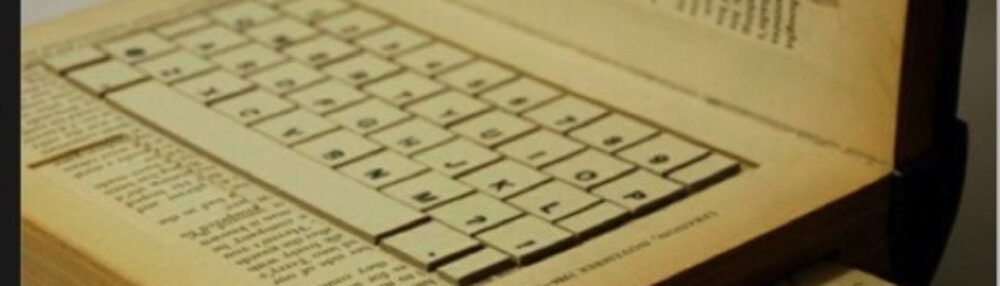
Books as Organisms

Never in my life have I considered books to be similar to a living creature. Yes, I know they are made of organic materials and that they each have a story (just like humans, dogs, or even fungi). Yet, books have evolved just like any other species, they have lived through millennia, and they have started in very different circumstances from where they are today. Books were made for humans, but the reason why and how they are still made has changed throughout history.

That is why bibliography is a thing. Yes, humans have invented a study of human inventions, but specifically for books. It isn’t simply about reading the contents of a book, but “the study of the lives of material books, widely defined, including their production, circulation, and reception” (“What is Critical Bibliography?”). Books signify great shifts in human history from political, social, and ideological means. By reading the physicality of a book (and not the exact contents), we can see how different societies functioned and how knowledge was disseminated to the public. We can see where the books come from based on the materials used as well as how the materials are used. We can see who bound the book and when based on the intricate binding patterns. All of these details matter to book history and understanding books as a functional part of human society.

While we might observe the physical aspects of books and determine where and when they were made, we can also observe intellectual and artifactual evidence of authors, readers, and scholars from a specific era. For example, an original copy of a book might’ve been handwritten, with a copy manuscripts produced. Take for example, The Canterbury Tales, one of the most handwritten English texts, that had 84 manuscripts and 4 incunabula (prior to 1500). This book received heavy criticism from scholars who’d write on copies, leaving marginalia, another aspect of bibliography to be studied. Bibliographers can use marginalia to see how books were received by audiences and learn of various social factors during that time.

What we have been learning in our lab is also incredibly valuable. It is difficult for me to even imagine a handwritten book. All I have ever read has been typescript books, all mass-produced and hardly made for longevity. The Book by Amaranth Borsuk that I own is already falling apart and I bought it at the beginning of September. We are living in an age where we aren’t taught to value the physical nature of the book but to consume the knowledge the text offers. Today, most books are made of cheap materials for cost-effectiveness and mass-dissemination, lacking the quality they used to have. While I whole-heartedly agree with the idea to make books accessible to the public and not just scholars, I also believe that, by understanding the nature of bibliography, is to also bring in perspectives that pertain to the environment and how we can adapt rather than it having to change for us.

What even are Majascules and Miniscules?

This is an awesome chapter that taught me plenty of things I’ve never known before. Of course, I don’t know everything about a book, especially the fact that upper- and lower-case letters literally meant they were stored in the upper and lower cases of shelf organization. After learning that in class, I was mind blown! It is truly such an amazing privilege to learn about the history of minute things like letters and how they originated.

I remember in class we were discussing upper and lower cases as a literal technical term for printing presses. What I find interesting is that we continue to credit Gutenberg for the “invention” of the printing press when he only created a business that spread printing throughout Europe. I’m not excusing his contributions to book history, however, I was please to learn that others came before him. According to Borsuk, a “Chinese engineer Bi Sheng […] developed a technique for printing from clay” (73), which is not as well-known. Sheng developed this in 1041, around 4 centuries before Gutenberg. This shocked me especially because of how much credit we give Gutenberg who barely even ran his own business. His financier and son-in-law took over the company when Gutenberg failed to repay investments.

But to the real point of this post, I seriously had no idea that upper- and lower-case letters are also called majuscules and minuscules. I knew miniscule was at least an adjective, but I never considered it as a noun. I distinctly remember discussing this in class because a peer asked what they were called before ever being put in cases. We didn’t know the answer, but this book revealed it. I find that aspect about reading super fun because there is always something new. That’s the reason why the definition for book gradually changed over time.

With the invention of the printing press, replications of the bible were being produced in larger quantities. Those with access to acquire a bible from a printing press had money and power, which were usually churches who read from the bible. Therefore, the definition of book shifted from more of a physicality to an ideology. That ideology was the fact that books held knowledge and, at the same time, power. It really makes me wonder if people fetishize books for their idea of “power” or if there is some other underlying reason.

How to Call Something that isn’t a Book

This past week, when we met in special collections, we were asked to determine whether the seven items were books or not. Quite frankly, I didn’t know how to consider them literally, so I assumed they were all different forms of books. However, I am glad I was able to hear from other classmates on their ideas of books as it opened up my mind to how a physical book differs from a conceptual book.

In Amaranth Borsuk’s The Book, “The Book as Object”, there is a distinctive feature of a physical book that pertains to the history of written text. While Frederick Kilgour considers the idea of a book to be a form of disseminating human knowledge (2), the physical book doesn’t arrive until thousands of years after the first documentation on tablets. And, even before books, the invention of the Alphabet changed the way Western cultures write. Rather than using pictographs or symbols, we now use letters in a variety of combinations to make words and ideas and sounds.

However, the one thing I would really like to talk about is the idea of the accordion. When we were in class on Tuesday, we observed what we might want to consider a book but wasn’t actually what it was called. It was one of the seven items with connected pages that could come out of the original cover but not go out of order. I considered that a book even though it wasn’t the most traditional, only to discover through reading Borsuk’s first chapter that what we observed was actually an accordion. Used centuries ago, was this accordion shaped codex of disseminating information in China (Borsuk 36). I found this very interesting to learn considering I couldn’t pin a name on what we looked at in class.

I guess I would venture further to consider what the other items might be truly called according to historical perspectives.

Books Tell Time and Human Adaptation

It has become relatively clear that we can base the time period of a book on its physical body. Of course, these time periods could range hundreds to thousands of years, but the way we read shows us how we’ve adapted. Although it wasn’t necessarily explicitly spoken on, humans are constantly looking for the easiest, most efficient ways to do things. This includes reading.

In The Broadview Introduction to Book History, Michelle Levy and Tom Mole explain the four epochs of book history. Even before the first epoch of books, we read from scrolls and, because of Christianity, codices became more commonplace. Second, after hundreds of years, “the printing press…made it possible to produce large numbers of (reasonably) accurate copies much faster” (xv). Because printed matter was so much quicker, it was also much more expensive. However, the third epoch occurred over several years as the prices decreased and the prints were continuously used. Finally, we stand in the fourth epoch, with digitized books we can hold in our back pocket.

In one way or another, the media adapts to our human adaptations. Therefore, we are carrying this evolving matter through our history as we find newer ways to transport information. Yet, as Professor Pressman notes, “media do not replace one another in a clear, linear succession but instead evolve in a more complex ecology of interrelated feedback loops” (“Old/ New Media”). Unlike being able to define the eras of books throughout history, it is difficult to determine the difference between the old and the new uses of books. I find this very fascinating especially since we have no way of knowing just how changed our method of reading will be 100 years from now. What used to take thousands and hundreds of years to develop can occur in decades. 

While it’s clear that the digitization of books is a current phenomenon, I wonder how long it will be until we switch to something else entirely.

Do Books Carry the World?

Reading Borges’ short story, “The Library of Babel,” was truly mindblowing. There are so many aspects of this story to dive into yet, only so many that I can truly comment on with a generally scholarly perspective. I always think to myself “it’s pretty scary that I will never be able to digest every bit of information in one single library.” And after reading Borges’ story, it really solidified that thought. However, at the same time, it made me more reassured knowing that there are so many intricacies to language, thought, ideas, and the world that it becomes an infinite amount of information. I don’t know about you but I certainly cannot consume an infinite amount of information. Borges describes the library as “the handiwork of a god” (113), which supports the daunting fact that a mortal (like me) cannot fathom the sheer amount of information in every text. 

Luckily for me, I do not read just to say I know everything in the world. I read because of the comfort a physical book gives me. I read books because of what’s inside the pages and how someone else’s thoughts from hundreds of years ago are now in my head. I also write. I annotate books to leave my thoughts and I write stories of my own on a digital screen. My digital thoughts.

Marino also brought up an excellent thought on the digitization of such information. While the library of Babel is fictional, the internet is very real. It’s abstract and untouchable, yet I use it every day as a source of information. By searching the internet, we are perusing the hexagonal rooms of the library of Babel. Every second, new information is added, and what was fictional to Borges is now at our fingertips.

What is strange, though, is that I have never once considered how scary it was that I would never know every bit of information on the internet. Maybe because there is something vastly different from the library and the internet. That, I believe, is true. While digital copies can become more accessible, physical books can never be replaced by something untouchable.

Introduction – Jessica Johnson

Hello! I’m Jessica Johnson and I’m a third year, expecting to graduate in the spring. I was born and raised in Orange County, California. Since, I haven’t lived anywhere else for more than a month, I would definitely like to move around places. I hope to go to grad school in Washington and then teacher English abroad (hopefully in Italy). My grandma is full Italian, but her parents wanted to Americanize her, so they never spoke to her in English. Unlike the rest of my family, I’m pretty interested in language, especially learning languages, so I would like to eventually speak fluent Italian. Don’t worry, I’ve already started learning on Duolingo! Should take me places.

To be honest, I still don’t have a set plan for life. I would love to also become a therapist, which means I’m in the wrong major. But, I can always start again later down the line. Aside from that, writing is my least expensive pastime. Writing is not easy, so I like solving something that doesn’t necessarily have a right or wrong answer. Traveling is my most expensive pastime. I mentioned in class that I would love to travel to every country, so might as well start off early with the small paychecks I get. So far, I’ve been to around 14 countries, so I have a long way to go but I am so excited about it!

To help fund my passions, I am currently a Writing Mentor in the RWS department. I’ve been a mentor since my freshman year, and it has genuinely been one of my favorite professional experiences. However, because of recent budget cuts, I am also working at San Diego Mesa College in the tutoring centers on campus.

I am also the co-President of the Creative Collective Magazine on campus. We are a student art magazine, and we print a collection of student art every semester. If you are interested in joining or collaborating, definitely reach out to me!!

I’m also a runner in the Women’s Run Club! It’s super fun (not in the heat). I’ve met a lot of great people there, so if you’re into running, I highly recommend you join. It is a very chill vibe, so don’t expect them to force you to sprint hills. However, if you like running long distance, I would totally run a half marathon with you!