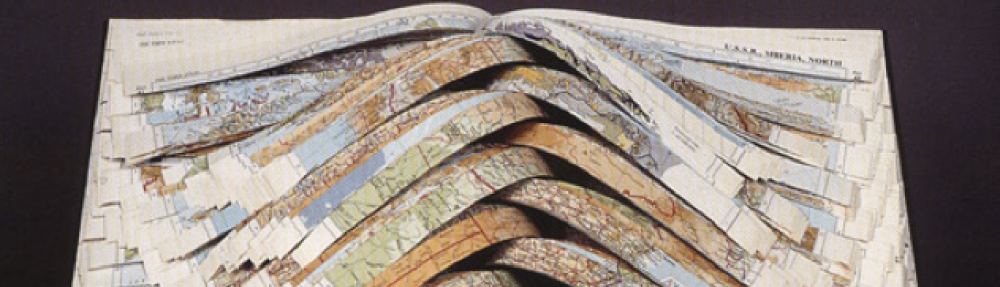
Bibliographical Book Study

I had never known that an area of study surrounded bibliographical records. Bibliographical study analyzes all of the features of a book and text, including its watermarks and how it was printed to view a book as it’s own source of record to how it was made. The study prioritizes the book as an object, an object that has record, history, and material other than the main body of text. Bibliographical study considers how a book was manufactured and transmitted and uses the features of a book, not just it’s word, as a tool to learn about “cultural change, whether in mass civilization or minority culture.” (D. F. McKenzie, Bibliography and the Sociology of Texts, 1999).

Using the structure and construction of a book as a tool for learning about the exact culture and era that produced it, rather than just referring to it’s main text, is a sort of anthropological study, investigating changes in culture through the work it produces and what they add or take away from each new iteration of work. This is an intersection between multiple areas of study, requiring understanding of historical, anthropological, and literary perspectives. Bibliographical study reveals when and why certain aspects of the book began to matter to publishers and teaches how readers would read, share, keep, and interact with their books. Those two analyzed subjects, the publisher and the reader, are signifiers of how their society at large treated and thought of literature, reading, records, and books.

This has opened up a new perspective to me, the concept of Bibliographical study has made me realize that I have never close read the entirety of a book, doing so would have required considering each detail of it’s construction, covers, spine and pages. Knowing that body of a book should be studied and taken into consideration has made me reconsider one of the first ever notions I was taught as a reader, the idea to “not judge a book by it’s cover.” I will not only judge what may be the content of the book by it’s cover, but I will most certainly begging to question what that cover means about the book’s creation, about the readers it is trying to entice, and about what aspects of our culture has influenced how that cover, and the rest of the book is made.

The Book as Content

Throughout this class, and especially while reading The Book, I realize how lucky we are as reader’s of today’s books. Reading through how books and the presentation of their content has changed has taught me how much of how we expect to read is actually new, and it makes me a bit sad to realize which practices have been lost in favor of ease of access and consumption.

Until the mid sixteenth century were shelved with inward facing spines, with their edges facing out, each distinguished by designs on their edges (Borsuk 81). What a lost art! Of course anyone could go into a book store and find books with sprayed edges making them look beautiful and rare, but those books would likely be few, or part of some special edition only sold for a set period of time. Books with distinct and decorated edges are not common enough today, if I were to flip all the books on my shelf backwards I’d only be looking at column of papers, risking a papercut anytime I wanted to pick one out. However, ss Borsuk describes, this change from out facing edges to out facing spines came out of necessity, “readers became collectors whose ever-expanding libraries served as displays of both intellect and wealth, that books were shelved with their spines outward to showcase their bindings…a feature of the codex we now take for granted.” (81). The progress of the book is the progress of the reader, instead of their fore-edges book spines become detailed in order to showcase information relevant to a reader who now owns a multitude of books, as the needs of the reader change, the book must change. The book evolves and becomes portable to, “show off one’s literacy and wealth,” the book changes and becomes a gift as “a symbol of great kinship,” and the book explodes into a catalyst of transformation to change readers, “by what [they] have read.” (82, 84).

The changes of the book has undergone have resulted in the book being amazing devices, being of reasonable weight and size for transportation featuring informative and pretty spines, and featuring plenty of room in their margins for annotations. But they are not perfect yet, they will undergo more changes and adaptions for the needs of readers now and readers of the next generations. In the future perhaps books will all be made from recycled paper, to support sustainability, or there might finally even be mass produced glow-in-the-dark books for readers who would like to read in the dark but not from an illuminated screen, only time and the desires of readers will tell how the book’s presentation of it’s content evolves.

San Diego State University Library, 4th Floor. (Extra Credit Blog)

After our visit to special collections last week and our class conversation about book call numbers and library exploration, I decided that for this blog post, and out of my own interest I would visit our library again.

I have been to our campus library many times, either to find a place to study or to find books, usually at the beginning of the semester when book lists are assigned I will look for access to books through the local libraries of San Diego/Chula Vista/National City or here at our school library. The book stacks are somewhat familiar to me, I know how to look at each books’ spine to find the right call number and locate each book, but to know that call number I always visit the library’s website first.

Displaying IMG_3613.png
Located on the Fourth Floor with the call number; PR28131. R64 2001 found online after searching for “Romeo and Juliet,” on the Library website and filtering for books.

On each floor the library has a map of the floor and stacks, the fourth floor has its books with a PG-PZ call number behind the elevators.

Displaying IMG_3612.jpeg

Usually when I search the library for a book I try to find the book quickly and then leave, but what I recently noticed at my local library, South Chula Vista Library, 389 Orange Ave, Chula Vista, CA 91911, is that when looking for a specific book on a shelf it will also be surrounded by not only other books by the same author, but the same by books by a similar genre or, if the book is by a prominent author, then surrounded by essays and other books about that author and their books. Today at the SDSU library I intentionally wanted to look around the book I was searching for, I picked Romeo and Juliet intentionally, assuming that because of it’s popularity that there must be much about it and about Shakespeare on the shelves. When I found the book in stack PR 2807 to PR 2920 I was overwhelmed, there Romeo and Juliet wasn’t just a book, but a topic.

Displaying IMG_3618.jpeg

There were multiple copies of Romeo and Juliet as well as collections of essays about it taking up a large part of the shelf, and next to it there were the other works of Shakespeare, Othello, The taming of The Shrew, and The Tempest.

Displaying IMG_3619.jpeg

Not only that shelf had works of and about Shakespeare, but seventeen others in that space did as well, Eighteen Shelves!!

Displaying IMG_3624.jpeg
Works of and about Shakespeare between stack of call numbers between PR 2474 to 2920 until stack of call numbers PR 3012 to PR 3353

I used to wonder how before today’s internet students might have gotten research projects done without the easier access that we have today. I imagined that it might have been stressful having to scour the library, hoping to find a relevant book on a topic, but now I realize that it must have been at least a little simpler than I had imagined. If I were to do a research project on one of Shakespeare’s works I’d be able to visit the stacks on the 4th floor and know that I wouldn’t only find the book, but and entire world around it, full of different essays, research books, and perspectives to help my understanding, appreciation, and reading of any book. Going to the library is not just a visit, but an exploration.

Books and Movement

Within the second line of the first chapter of the The Book, Amaranth Borsuk describes the book as a “portable data storage and distribution method,” (Borsuk 1). The book stores information within it, written and drawn to be distributed, throughout the text the importance of the book as a moveable object is frequently described. The papyrus scrolls of the Egyptians could literally move, bending and curling on their own, and their form could spread widely, being made from plant material and able to be traded and exported to other nations, allowing for movement of the papyrus. Easily and independently moved books were used by the Greeks and Romans as “pugillares,” which were “portable writing surfaces,” that could be held in just one hand (Borsuk 40). In later centuries within monasteries books moved and duplicated, “each copying texts by hand…Monasteries monopolized book production,” allowing for greater movement of books and their circulation, even if it was only within certain places or for certain commissioners. (Borsuk 48). Throughout history books as objects have been physically movable, able to change place and be transported and shared, not etched only to walls and stuck in only one location. Books must be a portable object to hold information in, however although in a literal sense not all books are moveable, some have been chained to their shelves or keep only in archives, the writing, the ideas and stories that they contain are mobile. Even if not in actual motion, the purpose of books, as “portable,” will always succeed because the material within them can circulate and be shared without the object itself needing to be moved, its data may always be distributed, therefore the book is always moving.

I really enjoyed the reading this week, I loved being able to explore the history and progression of the book as an object, how it has change and yet how it has stayed the same, how it maintains the shape of the codex but is now produced at a much faster pace. I am very excited to continue reading the rest of The Book.

Not the Old or the New but the Old and the New.

I have reflected on how “old” media has influenced the shape and creation of “new” media, but I have never actively considered how the new reframes our thinking and perspective on the old. In, Johns Hopkins Guide to Digital Media and Textuality, Pressman presents comparisons from other scholars on how old media might be analyzed through our understanding and use of our current media and technology. The postal service America’s Antebellum period is defined as a “precursor to our contemporary digital social network,” these two medias are not sperate, but related to each other in both directions, the postal service is like the social network, and the social network is like the postal service. Old media is not just what came before the new, but also an actual previous version of it. This illustrates how current new media and technology has always been desired and in development, however its previous iterations have had to be created before it.

New media is not necessarily just new, but newer, I think of it like a software update, Media 2.0. New media is not a complete reinvention of the old, but growth upon it that creates a large network of interconnected and related devices that have sprung from each other. The comparison between what is old and what is newer can of course be applied to objects outside media, a NEW iPhone when compared to its previous generations is not new, just newer, a person would not be lost on how to use a new phone, because they are familiar with the old one and vise versa, just as a person would likely quickly realize how to use and view old or new media based on their familiarity with one or the other.

Infinity

As a I concluded reading the Library of Babel by Jorge Luis Borges, my thoughts remained filled with the concept of only having a finite number of things within in an infinite space. The Library, or the Universe, is as Borges describes, “indefinite and perhaps infinite,” it stretches into vast galleries and hexagons, yet, all the books in the library reach a total number, somewhere on the library shelves the rows of books end although there is space for them to reach and take up space forever. It feels disappointing that there could not be an endless amount of books. I view this as a representation of humanity reflecting on its own limits, that although we live it what may be an infinitely stretching universe, we only fill a few rows of it’s shelves and one day the last human, the last book, will form their last thought and word, and complete the collection of books. It is also a reflection of a single person realizing their limitations. If all books that could ever be written are already written and bound on the shelves, what more could one person contribute to the Library, they must only read or attempt to search for meaning and themselves among the pages.

I have heard before that it is nearly impossible to know if you have a truly original thought that no one has ever had before, even if right now in your head you try to form the most random idea, how would you know you were the first person to ever think that out of the billions of people who have ever existed? Within the Library of Babel there all books that could ever exist, potentially holding all thoughts that could ever exist. Even within the infinity there might be a limit to the total amount of thoughts and ideas that humanity could ever think of, and what happens if the amount of new ideas becomes so very limited, how do we create new thoughts, how do we know they are new?

Introduction

Hi everyone! My name is Nina, I am a fourth year English and Comparative Literature major, however this is only my second year at San Diego State, I transferred here from Southwestern College after earning my Associates for English.

My goal is to finish earning my Bachelors this year and to hopefully enter an MA program next fall. With my degree I’d like to become a High School English teacher, however currently I am working at SeaWorld as an Educator, Narrator and Tour Guide.

I am so excited for this course and am looking forward to visiting special collections, I am glad to have the opportunity to be able to learn not only from Professor Pressman, but also from everybody in the class through these blog posts and group discussions.

Since this is a class all about books, I’d like to recommend my favorite book that I read this summer, Remarkably Bright Creatures, by author Shelby Van Pelt. It is a thoughtful and beautiful book about a Giant Pacific Octopus!