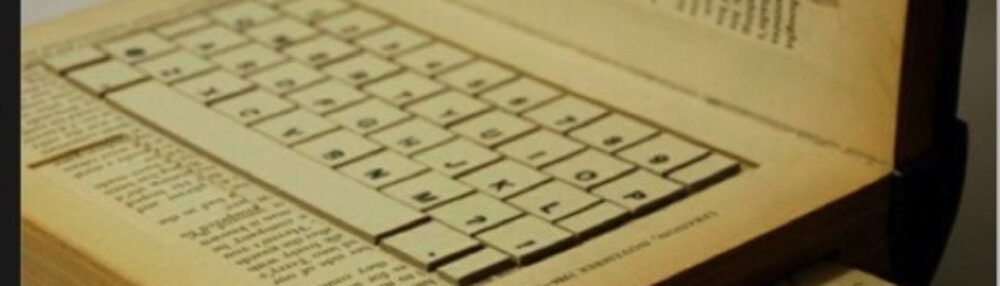
How can a book be a machine? 

While reading Borsuk’s second chapter, the following quote particularly stuck with me: “A book is a machine to think with.” This quote and its underlying interpretation greatly change the way we view books. A book is not a container for content, but rather a device that structures our thinking.

The chapter shows that our understanding of books changed with the invention of printing. Borsuk describes how early printed works introduced aids such as page numbers, indexes, etc. These elements have a clearer purpose than one might think. They are precisely the “mechanics” that make the book a thinking machine, because they allow us to organize, look up, and link knowledge. Borsuk also emphasizes that the codex is a body, with a “spine, head, and flyleaf.” Just like a machine, it has parts that interact to perform a function. Thinking is therefore always bound to a physical structure. 

The book as a machine becomes clear above all through the reader. Even in the Renaissance, readers marked passages, wrote comments, and copied individual passages. They actively operated the machine, thereby releasing knowledge. The book therefore does not work alone, but in interaction with the reader. But what does it mean for us if books are machines? Operating machines is complex, and so is reading books. We first have to learn how to use a book properly. 

For me, this also raises the question of how books from special collections make us think differently than ordinary books. No two machines are the same, and the same is true of books, scrolls, e-books, and other forms. For me, this means that thinking is a collaborative process that depends on the author, reader, and medium. And perhaps that is precisely the strength of the book: it encourages us to actively operate the machine instead of just letting it wash over us. 

Books Don’t Die

The chapter from the book “The Book” by Amaranth Borsuk is a adequate introduction to understanding books as objects. I was particularly struck by the realization that book forms do not disappear completely in history. This thought could also be connected to our discussion in class: „Fear of new media“. Borsuk argues that “Different technologies of the book exist side by side throughout its history: tablet and scroll, scroll and codex, manuscript and print, paperback and e-book”. Clay tablets, papyrus scrolls, books and hypertexts coexist for centuries and do not simply disappear. Borsuk emphasizes that the development of these forms should not be seen as a linear sequence. The new does not immediately replace the old. They complement each other.

Their coexistence shows that media change is much more complex than one might think. I find this idea particularly interesting. There is obviously a lot of discussion about whether digital media means the “end of the book”. However, Borsuk criticizes that question and emphasizes the coexistence and diverse functions between print and digital. But if no form is replaced, does coexistence mean that no form is ever definitive? According to this argument, the “true book” or the “true form” would not even exist. It is merely a matter of transporting knowledge and stories, which works in different ways. It is therefore a question of generations and individual needs as to which medium is preferred. Occasionally, I read a paperback on a hammock, an e-book on the train or bus. 

The e-book, on the other hand, which is often seen as a threat to the printed book, could be seen as part of a long history of the coexistence of individual media. Instead of splitting these different forms off from each other, we should see them as complementary media. Each form has its strengths. While the printed book convinces through its materiality, haptics and durability, the e-book is mobile, easily accessible and flexible. Both forms help to preserve knowledge and make it accessible. 

Borsuk’s chapter thus shows that the book has evolved. Each new form expands, but never completely erases. The keyword here is diversity. Dr. Pressman stressed the fear of new media in class. I somehow cannot understand this “fear“, because instead of seeing the emerge of new media as a linear process we should see it as a circular one. This whole idea of remediation is really important and an advantage for our acquisition of knowledge.

The Life and Death of Books

Although I was born and grew up in Germany, I am still learning about Germany in another country. The memorial from Berlin, which represents an empty bookshelf and serves as a symbol for the burned books from the Nazi era, has remained in my thoughts ever since. Were only sheets of paper with signs burned back then or were identities of individuals destroyed?

Reading “Book History” by Levy and Mole, I quickly realized that books not only convey certain content, but are also material objects with a history.  When someone asks me what a book is, I don’t know how to answer the question. To be honest, I never thought about it. I saw the book as a book. I didn’t have an answer to the question. Since attending our course, I realize that a book is more than just sheets of paper stapled together to convey knowledge. Rather, they are created, distributed, read and can be destroyed. The memorial on Bebelplatz shows this aspect: books are fragile, vulnerable and mortal. This raises the question of what it means when books are destroyed? Is it only the destruction of an object or also of ideas?

It can be argued that books can be destroyed as objects, but not ideas, because these can be reproduced through reviews, copies and new editions. It depends more on how many people have read, distributed and studied the book. The idea that ideas and identities can be erased by burning books therefore proved to be wrong. Books as objects are perishable, but knowledge can have a different permanence. On the one hand, books are mortal because they consist only of paper and ink. On the other hand, they are immortal because their contents remain in the mind and are copied. The burnings rather refer to the fact that such books are usually destroyed because they are significant. 

In relation to the present day, this view is also significant. In the age of artificial intelligence, we realize that texts are not physical objects. Unlike the destruction of books, digital texts often disappear unnoticed from digital archives. This raises the question of whether digital books are more durable than printed ones or whether they are just as vulnerable.

The memorial is a reminder of what was destroyed. The transience of objects meets the permanence of knowledge. Although history as an object is destroyed, new stories are produced as a result. I also see the memorial as history. When I am back in Germany and visit Berlin, I will definitely take a look at the memorial and hopefully be able to answer the question of what a book finally is.

Hopefully this book finally explains my existence

When reading Borges’ “The Library of Babel“ from 1941, I was particularly preoccupied with the image of the ‘man of the book’. After reading it, I asked myself what if there was a single book that contained the answer to every question, the truth behind every mystery and the justification of every life? Even in today’s world full of information, many long for a single source of truth. I am thinking of sacred scriptures or scientific theories that explain life and our existence. 

The quote “On some shelf in some hexagon there must exist a book which is the formula and perfect compendium of all the rest…”. The quote shows the longing for a book that explains everything. So the book lies in the middle of an astonishing archive, in the midst of chaos and nonsensical writings. Why do people believe in such a book? Aren’t there several writings that explain meaning and our existence? The book of books is therefore a symbol of the desire for truth. Borges describes how many set out in search of it, but fail. Although the search remains unsuccessful and seems hopeless, people would not stop. But this shows the character of human beings, because we want order, even if it cannot exist. Human beings cannot endure chaos. Yet what one person perceives as chaos may not be the same for another because each of us carries a subjective view of disorder. This means that the search for truth is always individual. It does not necessarily have to be found in written texts. Sometimes it takes the form of ideologies, or, in today’s world, even algorithms that claim to impose order on the overwhelming complexity of information.

Applying this idea to our digital age, I think people today are still searching for truth through religions, science, AI and algorithms. But as described in Borges` Library, there is too much information and contradictions at the same time. Maybe that’s why it’s not about finding the perfect book, but about accepting that truth remains fragmentary. Therefore, humans should question the meaning of life.

Introduction: Oz joined the room

Hey guys,

my name is Oguzhan (hard to pronounce) but you can call me Oz. You cannot imagine how my teachers from middle school called me. As a child, I was ashamed of my name because no one could pronounce it. Today, I am proud of this name because my parents gave it to me. Thanks to them, I thoroughly enjoyed my childhood. They gave up their dreams to support my brother and me. My parents always put my education and career first. From school to university. As the first in my family to attend university, I had to adjust to a completely new world. I carry a certain responsibility and have set myself the goal of making my parents proud.

Enough about my goal in life and more about me. I am an international student from Germany with Turkish roots. I’m originally from Gaziantep, a city in Turkey that is very popular for its food, which is where my love of cooking comes from (I’m not a pro, guys!!!). I love trying new foods and cooking in general. If I didn’t study Education I would probably be a chef. My favorite food is constantly changing, but right now it’s smash burgers. It’s simple. I’m convinced that I can make the best ones in the world. That’s also one reason why I picked the US for my stay abroad. Obviously, because of the burgers. 🙂 

In addition to food and excessive eating, I have been kickboxing since childhood. I am also interested in other sports, such as basketball and soccer. Another hobby of mine is listening to music and reading books (sometimes). I really enjoy listening to RnB and hip hop and reading psychological books or novels that make you philosophize about the meaning of life. Besides, I generally like to have deep conversations, but at the same time I have a unique sense of humor, which I won’t go into detail about here (let’s just leave it at that). I also love to travel. In my opinion, the meaning of life as not only creating a beautiful family and having a good career. A person should travel the world, be open to new cultures, and eat new food.

I’m looking forward to the course, making new contacts, and broadening my perspectives through different opinions.