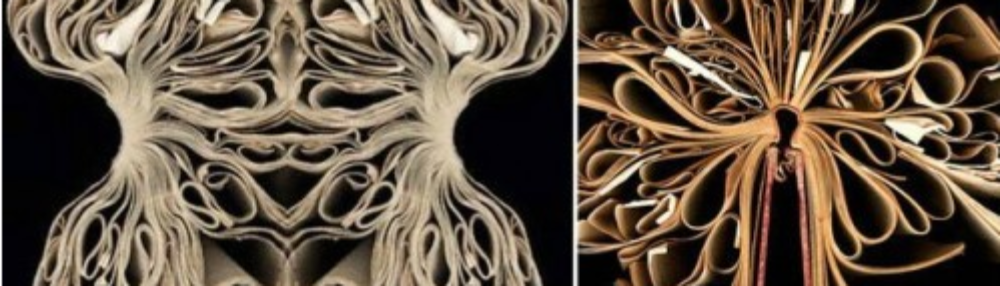
Reading this excerpt of Shadow Archives: The Lifecycles of African American Literature by Jean-Christophe Cloutier was very interesting, and had me thinking deeper about both the politics of archiving and the general public’s perception of archiving. Personally, I would define an archive as a collection of preserved items. While I do think this definition is pretty accurate, it says more about the archiver rather than the people who might use the archive. Cloutier writes “The archive is never an end in itself— otherwise we might as well call it a dumpster— but rather a speculative means to possible futures, including unknowable teleologies guided by unborn hands.” This sentence is extremely heavy, and the strong word choice here shows exactly what an archive is and isn’t.
With the first half of the quote, Clouteir is writing about the physical archive itself. Although ‘dumpster’ is being used negatively, it means that it doesn’t matter where an archive is or who runs it if nobody uses it. A pile of books sitting unused is akin to a dump. If somebody wanted it, it would be read. A preserved, polished piece of trash is still a piece of trash. The goal of writing and bookmaking shouldn’t just be to sit in an archive. The goal, for some, is that the book is important enough that the people reading the book today want people in the future to read it as well. It seems to be a shallow distinction, separating the archive from the archivers to the patrons. But without each cog in the machine, the archive becomes nothing more than a dump. Archivers are ‘speculating’ what these ‘unborn hands’ will want and need. This is where archiving becomes a necessary tool for everyone, yes, but also for marginalized communities. In terms of African American literature, it could be argued that the civil war would have gone slightly differently without the accounts of Frederick Douglass and Harriet Jacobs, but the way slavery and the civil war is taught would be completely different if their writings weren’t archived. People had to decide that these stories would survive, because they thought that those of us in the future would need them.
And towards the end of the chapter I reflect on my time spent in Special Collections this semester. While the library is an archive, I have only ever used it to read books. Some of them were old books, some were old stories repackaged and republished for the next generation. Courtier has captured how I felt working with what felt more like artifacts than books; ”This is the pledge and promise of shadow archivisim, where the preservation of records anticipates a future where the dream may once again grow young, where the vicissitudes of blackness, the split and fragmented, the delayed and deferred, the incomplete and indecipherable nature of these archives become the message.” For the books that are written languages unreadable, the words stop becoming the message. They were the originally message, but time has passed. The frayed edges of the page tell their own story, and while the archivist has saved them so they could be seen, it’s the job of the people to read them.
I did my undergrad at Texas State, and I kick myself, often, for having failed to capitalize on the opportunity to use our library’s archival collection of Cormac McCarthy’s papers. At the time, I had only a passing interest in McCarthy and had read one or two of his books. Cities of the Plain, No Country for Old Men. A professor in one of my English courses even offered to take anyone interested to the archive, and I thought at the time, “Wat would be the point in that?”
That was before I spent years poring over the vast majority of McCarthy’s bibliography and before I became obsessed with the ways in which he manufactures the sentence. I did not understand then the wealth of information I had at my disposal. As Bode and Osborne say in The History of the Book, the viewing of these archives of correspondence provide the opportunity to better understand authorial intention and “destabilize established arguments by directing attention to new information” (221). Right now, those very same archives are being scoured for any new information about McCarthy’s much younger muse and their very eyebrow-raising love affair. Destabilization is the key to the creation of greater understanding.
Research of this depth can give the researcher the opportunity to better understand the author and to also upend the status quo surrounding their work. Take, for example, the case of Richard Wright’s Black Boy, which existed in its final form only after the dedicated work of archival researchers unearthed new material, with part 2 of the novel appearing seventeen years after Wright’s death and a complete edition finally being published fourteen years after that, in 1991 (Cloutier 1-2). The status quo around Wright’s work was to shun it, but to resist that through research has allowed us the opportunity to create a new narrative around the author and his work.
I do wonder at the future of archival research, and how it might change, in some ways for the better, as a digital archive of writers’ correspondence would be much easier to navigate, but this ease of navigation might lead to less discovery, as we may only find what we are looking for and lose the opportunity for surprise that would disrupt that status quo. When information must be combed through, that is the only time you really get the chance to uncover what many may have tried to keep hidden.
Before taking this class, I never considered how we take in and shape history. I now know this is all done through the collection, discovery, and donation of archives. However, if a scholar goes into collecting and writing about archives with a bias… this can become slippery territory. This leads me to question, who are these people, and why do they obtain so much power? They have the power in their hands to shape history and even, in some cases, dispose of it.
According to Katherine Bode and Roger Osborne, “Book history from the archival record” in The Cambridge Companion to the History of the Book, “The records that are retained or donated might reflect a hagiographical impulse or the sentimental feelings of an individual. When records are donated and transferred to a formal archive- whether a library, museum, public record office, or university- other processes will further shape the archive through selection and disposal of records, according to the archivists’ methods of valuation. (page, 224″)” This quote demonstrates that some personal feelings and biases shape the process an archive goes through. They can be either deemed important or unimportant and shoved away in a folder that may never be acknowledged. This reminds me of when we were in special collections, and Anna mentioned how much is stored in the SDSU archival collections that have never been touched or read before. This illustrates that there is so much untouched archival history that might have been deemed insignificant by somebody’s biases.
This perfectly aligns with a quote from the shadows archives excerpt, “Given the lack of institutions dedicated to the black experience, the novel became an alternative site of historical preservation, a means to ensure both individual legacy and group survival.” This quote reveals that because of the lack of dedication to the history of the black experience, archives were sitting in these institutions, waiting to be examined. This leads me to question the history we are taught in school and all the facts we do know. How many minority voices have been disposed of over all of these years? Who has the power to deem an archive important or unimportant? I look forward to learning more in our classes this week.
In the chapter “Book History from the Archival Record,” Katherine Bode and Roger Osborne emphasize that archives form the foundation of book research, but are not neutral places. The following quote stands out in particular: “Archival records are not only incomplete and mediated by various levels of archival intervention; they are also subjective. The records of individuals and institutions are strongly influenced by the beliefs, perspectives, values, interests, and aims of those who produce them.” This quote sums up a crucial insight. Archives do not tell an objective story. Various institutions, such as publishers, librarians, collectors, and historians, create them. They are therefore an expression of decisions, preferences, and power relations. For example, those who archive something also influence what is forgotten or should be forgotten.
This dominant influence has far-reaching consequences, because when we understand how literature is created and disseminated, we must also bear in mind that the traces we find in archives are not random, but selective. One example would be authors’ letters, which are carefully preserved, and documents from small printing houses or readers, which are often lost. So we mainly absorb filtered knowledge. This knowledge is accessible through the perspectives of those who have decided what is “worth preserving.”
Bode and Osborne show that this subjectivity is not simply a mistake, but part of the historical process. Both see archives as constructions of cultural memory. They say something not only about books, but above all about society. In this sense, archives themselves are sources of cultural ideology.
I find the idea of implying the digital age particularly relevant here. Although digital archives appear limitless and objective, and everything is available and searchable, selection processes once again play an important role. Thus, historical truth never arises simply from data or documents, but from interpretation, contextualization, and the awareness that every source bears a human signature.
The artist’s book “Celestial Navigation” was produced in Chicago in 2008 by American book artist Karen Hanmer. Only 30 copies of this handmade work were produced, making it a limited edition. It is clear at first glance that this is not a book in the traditional sense. Celestial Navigation has neither a spine nor firmly bound pages, but consists of several triangular and trapezoidal panels connected by concealed joints. This system allows the user to fold the object into various geometric shapes. Through trial and error, one can form pyramids, prisms, or open, almost architectural structures. This design can be read page by page like a book or unfolded flat to resemble historical star charts or modern NASA composite images. In this way, the work emphasizes the idea of movement and changeability rather than linearity and closedness, as found in the classic codex.
The book appears to be digitally printed, with sharp lines and clear contrast. The typography is a classic serif font in white, which blends harmoniously with the astronomical imagery. The overall appearance is minimalist and cosmic, rigorously constructed yet poetic. The copy is in excellent condition. There are no creases, tears, or discoloration, the edges are clean, and all binding elements are in perfect working order. There are no signs of use, notes, or ownership marks. The surfaces of the individual panels are printed on a black background and feature fine white lines, dots, and inscriptions reminiscent of star charts and celestial diagrams. They are complemented by illustrations of historical astronomical instruments such as sextants, astrolabes, and planispheres. On the left-hand side of each double page is a text about a star field, and on the right-hand side is a historical star map, creating a rhythmic balance between language and image. This movement through the pages is ultimately resolved in a final double page dominated by empty space. The work thus offers three “paths through space”: a narrative track that addresses loss, and two others consisting of lists of astronomical instruments, symbols of human attempts to understand the heavens. These images refer to the history of astronomy and thus to humanity’s attempt to measure the infinite. By transforming this scientific imagery into a work of art, Hanmer removes its functional purpose and reduces it to pure form. The work thus demonstrates that every human system of knowledge has its limits. The maps of the sky, which once served as a means of orientation, become symbols of the loss of orientation. Hanmer makes it clear that the longing for order in the face of the cosmos inevitably turns into wonder.
In terms of content, Celestial Navigation can be understood as a reflection on orientation, memory, and humanity’s relationship to the universe. The text portion of the work is minimal, consisting of short English fragments integrated into the visual space: “I don’t remember what you looked like,” “I see your face in the stars,” “Like ancient navigators, I look to the sky to find my way back to you,” etc. These pieces of text are not the focus of the reading, but function as poetic elements within the field. They interact with the visual elements and open up room for interpretation on topics such as perception, forgetting, and the unknown. In this way, Hanmer connects the history of celestial observation with the experience of loss. Navigating the cosmos becomes a metaphor for the search for the past, for orientation in the incomprehensible. The sentence “Like ancient navigators, (…)” summarizes the central motif of the book. The stars serve not only as geographical orientation, but also as existential orientation. The juxtaposition of scientific precision and emotional emptiness creates a work that dissolves the boundaries between knowledge and memory, between map and memory. The work acts as a silent monument that reveals human longing. The sentences seem like intimate memories and personal confessions. Forgetting a face symbolizes the human loss of orientation and the limits of knowledge. This combination of scientific iconography and poetic language creates a tension between order and chaos. Hanmer uses the symbols of astronomy not to explain the sky, but to make the inexplicable visible. Her navigation is not a search for a destination, but a process of constant searching.
Hanmer draws on historical sources of celestial cartography, such as Alexander Jamieson’s Celestial Atlas (1822). Hammer uses their scientific precision in an artistic language and image. Just as the cosmos itself has no center, no direction, and no end, this work also rejects a fixed order. In its changeable, geometric form, it reflects the incomprehensibility and openness of the universe. Every movement of the viewer changes the object, creating new perspectives and simultaneously destroying the previous form. Furthermore, the work rejects the idea of a book as a finished object. Every individual who touches it creates a new version of it. It has no correct form. The reader is thus not a passive recipient, but an active creator. The striking geometric symbolism of the construction, represented by triangles, pyramids, and squares, has been a sign of order and harmony since ancient times. In Hanmer’s work, however, this meaning is reversed: geometry no longer stands for stability, but for movement and impermanence. When the viewer folds the object to create a cavity open at the sides, this space appears dark, deep, and mysterious, like a small black hole. This comparison is not only visually but also conceptually apt. Black holes are places where the laws of physics fail and information disappears.
Christopher Nolan’s film „Interstellar“ (2014) can also be linked to this insight. Both works take up the idea of the black hole not only as a physical phenomenon, but also as a philosophical one. In Interstellar, the black hole “Gargantua” becomes a place where space, time, and perception collapse, a point where knowledge and experience reach their limits. The situation is similar in Hanmer’s work, as the geometric folding structures create cavities and depths that are visually reminiscent of the interior of a black hole. The viewer looks into these dark openings without being able to comprehend them. Both works thus emphasize the paradox that the attempt to understand infinity inevitably ends in incomprehensibility.
The work is not addressed to readers in the conventional sense, but to viewers who explore the object through movement and touch. Hanmerk’s work thus appeals to an audience interested in artist’s books, book history, scientific aesthetics, and conceptual art. Through the artificial concept, knowledge is not acquired as linear text, but rather as a spatial and sensory experience. The integrated typography reinforces this idea by allowing the words to “float” within the visual space, turning the book itself into a small model of the cosmos.
As an artifact, this specimen occupies a position between book, map, and sculpture. Each copy of the edition is handmade and, thanks to its manual assembly, possesses an individual character that is unfamiliar in traditional books. The flexible, foldable structure makes physical interaction a central part of the concept: opening, folding, and reshaping become symbolic “navigation” through space and meaning. Her book art marks a conscious turning point in the history of the book. While early modern celestial maps chart the cosmos in order to organize and control it, Hanmer’s book, on the other hand, allows the incomprehensible to remain. It transforms the idea of navigation into an aesthetic principle.
Overall, it can be said that Celestial Navigation redefines the book as a physical and intellectual object. The art book can be viewed as a material model for thinking about infinity and ignorance, in which Hanmer combines the precision of scientific representation with the openness of poetic reflection. It is a book that is not read, but explored. In the end, Celestial Navigation remains an object that eludes complete interpretation. It refuses to be unambiguous and thereby creates meaning. Its form and imagery refer to an experience of infinity that is neither rational nor mystical. Celestial Navigation ultimately exemplifies a modern book aesthetic that transforms reading into a physical, meditative act. The work stands for a medium of open thinking. It represents the book as an experience rather than a repository of knowledge.
In his text “Electronic Literature,” Scott Rettberg describes the challenge of rethinking literature in a digital world. He sees electronic literature not as a digital replica of printed texts, but as a completely new literary practice that exploits the full potential of computers. The quote “Electronic literature is the result or product of literary activity created or performed using the computer” stuck in my mind.
The concept of “literature” is undergoing a fundamental shift. It is no longer bound to pages, printer’s ink, or linear storytelling, but arises from the interplay of text, code, sound, image, and interaction. Where writing used to be the medium of meaning, today animations, algorithms, and digital interfaces also generate meaning.
Rettberg also shows that electronic literature lies somewhere between art, technology, and experimentation. This opens up many possibilities, as electronic literature can be a visual installation, an interactive poem, or a game. This openness and broad scope make it difficult to define. “The term is somewhat fraught and often challenged as not sufficiently or accurately descriptive,” writes Rettberg. I find Rettberg’s observation that electronic literature simultaneously ties in with the history of literature and dissolves it particularly interesting. The computer does not replace the book, it expands it. Literature becomes a process, not a finished product. This blending of poetry and programming also challenges the role of the reader. Reading no longer means following a text, but controlling it. A click, a selection, an interaction changes the course of the story. We also saw this in the second week with hypertext. The reader becomes part of the system.
Thus, literature does not end in the digital realm; it loses its boundaries. It becomes fluid, interactive, unpredictable. And that is precisely where its future lies: not in clinging to old forms, but in the courage to reinvent them again and again.
When I think about electronic media, the first thing that comes to mind is how normal it feels now. Screens have become part of almost everything I do. I wake up to an alarm on my phone, read the news online, study on my laptop, and talk to friends through messages and calls. It’s strange how invisible all of this has become, how natural it feels to live inside something so artificial.
But the more I think about it, the more I realize that electronic media are not just tools they shape how I see the world. When I scroll through social media, for example, the rhythm of the feed trains me to expect constant change. There’s always another post, another notification, another story. It’s not just about information; it’s about movement. The pace becomes the message. I don’t even have to be aware of it, my attention adjusts to the speed.Reading about the history of electronic media helped me understand this differently. The shift from print to broadcast to digital wasn’t just about new inventions. It was about changing how humans experience time and space. Before, you had to wait: wait for the newspaper, for the letter, for the film to develop. Now everything happens at once. Instant communication sounds efficient, but it also means there’s no natural pause anymore. We fill silence with sound, stillness with updates.Sometimes I wonder what that does to our sense of self. With books, I feel like there’s space to breathe time to think between words. With screens, I feel pulled outward, stretched across messages, links, and notifications. It’s not that one is better than the other, but they produce very different kinds of attention. Reading a printed page makes me feel like I’m inside a conversation. Scrolling through a feed feels like I’m standing in a crowd, trying to catch a voice.Yet I also see beauty in it. Electronic media connect people who might never meet otherwise. I’ve learned about art, language, and culture through people’s posts, videos, and even memes. There’s a kind of shared creativity that feels alive. It’s collaborative, fast, and unpredictable. And even though it can be overwhelming, it’s also exciting to witness how human imagination adapts to new forms.I’ve started to think that every generation has its own rhythm of communication. For ours, it’s electronic , quick, bright, and constantly evolving. But what stays the same is the desire to connect. Whether it’s ink on a page or pixels on a screen, we’re still reaching out, still trying to make sense of each other. Maybe that’s what makes electronic media so powerful. They don’t replace older forms of expression, they continue them, just in another language, made of light.
When I first opened The Divan of Hafez in the Special Collections room, I just stared at it for a moment before even touching it. It wasn’t only the smell of old paper or the way the leather cover seemed to crumble slightly at the corners it was that strange feeling that the book was somehow awake again. Like it had been waiting for someone to open it. It’s small, smaller than I expected. It fits perfectly in my hands, the way an object made to be handled should. The leather cover is dark brown, with faint decorative lines and small patterns pressed into it. It’s worn at the edges, the spine a bit loose and there’s a tear near the bottom. But instead of feeling fragile, it feels alive. You can tell it’s been used, used, maybe passed from one person to another, maybe read out loud many times. When I reached the first illuminated pages, I couldn’t look away. Both sides are full of bright floral patterns blue, pink, gold carefully mirrored across the gutter. It’s almost too perfect. The two pages look like a carpet, a symmetrical design that draws you in before you even start reading. It’s as if you’re invited into the text, but you must cross through color first. The gold still catches the light, and for a second it doesn’t feel like looking at a book it feels like entering one. The poetry itself sits neatly in two vertical columns, framed by thin colored lines. The script Nastaliq (main calligraphic hands used to write Arabic/Iranian scrip) flows softly, like it was written by someone who didn’t just know how to write but how to breathe through ink. Most of the text is in black, but here and there, words appear in red. The red is not random. It marks the start of each ghazal (poetic form) or a name, or sometimes a single phrase that stands out. When I noticed it, I realized how rhythmic it makes the reading (even I can’t read nastaliq writing) like a pause, a heartbeat, or maybe a reminder to pay attention. The color gives the text its own kind of movement. Then there are the miniature paintings. They show small scenes two figures sitting together, a courtyard, the suggestion of conversation. The colors are still strong: deep blues, pinks, oranges, gold. I think they don’t exactly illustrate the poems but echo them, like visual metaphors. You can almost imagine someone reading the lines, then glancing at the image beside them words and paint reflecting each other.
The paper is another story. It’s handmade, slightly rough at the edges, with faint laid lines visible when you tilt it toward the light. Some corners are darkened, maybe from fingers. A few pages are torn or uneven. But none of it feels like damage. It feels like proof that the book was alive in the world. I kept thinking about how every part of this object the script, the pigments, the binding mirrors the same balance that Hafez plays with in his poems: between the sacred and the sensual, between what fades and what lasts.
The beauty isn’t separate from the meaning; it is the meaning. During my research I often read that Scholars probably place this copy in the late 18th or early 19th century, during the Qajar period, when Persian calligraphy and book arts were at their height. The design, the script, the color palette it all fits that time and region, maybe Shiraz or Isfahan. I like imagining the person who wrote it: a scribe bent over the page, drawing each curve of Nastaliq carefully, mixing red pigment for the next ghazal, leaving a small trace of their hand on every page. Now, it lives in the Special Collections library, resting quietly on a soft cradle. There’s a white catalog label near the spine a sign of its new life as an archive object. But even in that careful, quiet space, it doesn’t feel still. It hums in a way. The folds, the loosened binding, the little spark of gold along the border they all suggest motion, like the book hasn’t finished being read yet. When I started describing The Divan of Hafez for this project, I realized that what I was really describing wasn’t just a book but a set of relationships. The way beauty turns into language. The way a reader leaves fingerprints behind. The way an object holds memory. Hafez often blurs the line between earthly love and divine love between what’s fleeting and what’s eternal. And somehow, this manuscript does the same. It’s worn, but it shines. It’s old, but it still speaks. And maybe that’s part of the reason why I chose this book. I’ve heard of Hafez before not in a classroom, but in conversations with friends from Iran and Afghanistan, who talk about him the way one talks about an old relative, or a wise friend. His poems are still alive in their homes, spoken at gatherings, quoted over tea. I’ve listened to them talk about the Divan as something that helps them express love not just romantic love, but love for friends, for parents, for life itself. When I read Hafez now, even though translation, I feel a bit of that. There’s something about his words their openness, their trust in beauty that makes me want to look differently at the people I love. Maybe that’s what poetry is supposed to do: to make us more tender, more attentive. I think that’s why this manuscript matters to me. It’s not only a historical object; it’s a bridge. Between languages, between centuries, between people. Between me and those moments with my friends when they tried to explain what Hafez means to them. Somehow, in the pages of this old book, I could feel it that poetry still carries the power to connect us, to remind us of that love, in all its forms, keeps circulating, just like the hands that once turned these pages. Maybe that’s what makes it so hard to walk away from: even after all this time, The Divan of Hafez still knows how to look back at you.
Part 2: When I think back to my time with The Divan of Hafez, what stayed with me most wasn’t the gold or the binding it was the red ink. Those strokes of pigment, placed with so much intention, divide the black text like breaths between thoughts. The red rubrics that signal each new ghazal (poetic form) don’t just organize the text, they give it rhythm, almost like a pulse. In many manuscripts, red ink is a practical device. But in this one, it feels emotional. It glows against the black, soft but steady, like a flame that refuses to fade. Reading it, I kept noticing how this tiny change in color turns reading into something physical. It makes you stop, breathe, look again. It slows you down the way poetry should. I started thinking about what that gesture changing color means in the life of the book. I keep coming back to the thought that a book is never just a container, it’s an active space where meaning happens through touch, color, and movement, not just through language. The red here isn’t decoration, it’s part of the act of reading. The page performs the poem. These marks of use, the worn corners, the uneven ink, the slightly blurred red lines belong to the same story. They show that someone once cared enough to make each beginning visible. This attention to beginnings makes me think about how books move through the world: from the person who makes them, to the places that share them, to the readers who leave their traces behind. The red rubrication makes that journey visible it marks the moment when writing becomes reading, when language re-enters life. The scribe’s hand, the reader’s eye, my own curiosity: all of them meet in that flash of color. At first, I thought I was writing about a decorative feature. But the longer I looked, the more I realized that the red ink is an argument about devotion. It is the manuscript’s heartbeat the sign that beauty itself can be a form of knowledge. When I think about why I chose this book, the answer is partly personal. I had heard of Hafez before from my Iranian and Afghan friends who talk about him with warmth, almost as if he were family. They quote him when they can’t find the right words; they open his Divan to seek guidance. For them, poetry is not distant it’s alive, intimate, daily. I kept thinking about how fragile and yet enduring this combination is the way the red fades slightly at the edges but still shines centuries later. In that small detail, I saw the persistence of love itself: delicate, but stubborn. The red marks echo that duality. They separate, but they also connect. They remind me that art isn’t about perfection, it’s about the ongoing attempt to make feeling visible. Through my friends and through this object, I’ve come to see that Persian and Afghan poetry holds a kind of emotional openness I’ve always admired a way of expressing affection, friendship, and devotion without fear. Reading Hafez in this manuscript, I felt that openness in a material form. The red ink wasn’t just marking text it was marking tenderness. What I love most about this object is how its material, emotional, and intellectual layers blend. The red pigment mark’s structure and meaning, but it also carries feeling and memory. It shows how books can hold knowledge and affection at the same time. Nothing in this manuscript is separate. The color, the words, the touch of the page all work together to create a quiet conversation about care. Even the fading of the ink feels meaningful. The red has softened at the edges, but it still shines. That change does not feel like a loss. It feels like age has given the book a new kind of beauty. The manuscript does not hide its years. It wears them with calm and dignity, as if it knows that time is not its enemy. That quiet endurance feels like an act of love too. Hafez’s poetry often moves between the sacred and the human, between devotion and desire. The red ink mirrors that balance. It separates and connects at the same time. It draws attention without dividing. It shows that art is not about perfection but about the effort to make emotion visible. The devotion here is not toward a religion or rule, but toward the simple act of paying attention. To notice, to care, to look closely. That is its own kind of prayer. This manuscript changed how I think about book history. I used to imagine it as a study of preservation, about recording what already exists. Now I see it differently. Book history is about continuation. Every time someone reads, observes, or describes a book, its life extends a little further. A manuscript does not survive because of age alone. It survives because people keep returning to it, keep finding something alive within it. Attention is what keeps it breathing. Through my friends and through this book, I began to understand something about Persian poetry that feels important. It does not divide emotion and intellect. It lets feeling and thought exist together. It treats love as something both deeply human and deeply wise. Reading Hafez in this way made me realize how poetry can teach presence and humility at the same time. The red ink did not just mark the text. It marked tenderness itself. To notice the red ink is to practice awareness. It is a small act of mindfulness, an invitation to slow down and be present. In a world that moves quickly and demands constant attention, this manuscript offers another rhythm. It reminds me that meaning is not something we chase but something we meet when we pause long enough to see it. When I left the Special Collections room, the world outside looked sharper. Even the red of a stoplight seemed different. I thought of the manuscript and how color can guide movement without commanding it. Maybe that is what the red ink really teaches: to see the world as something to be read with care, with patience, and with love. What remains after closing the book is not only the memory of its beauty but a realization. The life of a book is not just in its words but in its gestures in the way it was made, the way it has been touched, the way it continues to invite attention. The Divan of Hafez reminded me that the book is also the story of love and continuity. It shows that beauty and devotion are not separate from life. They are life. And that lesson, written in red, will stay with me for a long time. It made me realize that book history isn’t just about preservation, it’s about continuity. Each description, each reading, each observation is another act of devotion a way of keeping the object in motion. And that’s what Hafez himself seems to whisper through every verse that love, in all its forms, survives by being shared.
So, what remains after closing the book? A quiet realization that the most meaningful parts of a book’s life might not be its words but its gestures the care with which it was written, the colors chosen to emphasize breath, the way it has been held. The Divan of Hafez shows that a book’s biography is also a biography of love: how people have carried, touched, and believed in words across generations.
I’ve been a writer for a very long time. In many ways I think I can tie this back to the murder of my father as a child, sifting through his things, what he collected, what he wore, for years trying to piece the clues together to make sense of who the man was who I hardly ever knew. It led to an obsession with permanence. What are we when we’re gone apart from the things we leave behind? So I write in a kind of vain attempt at immortality. At its very best it is a noble effort to endure, at its worse it is nothing but pure vanity, of thinking one might matter enough to be spoken of far into the future.
What frightens me the most about digital literature is the knowledge that these things are ephemeral. As Doctor Pressman says in her introduction to electronic literature, sometimes we have “only seven years of access to these works,” a far cry from the tens, hundreds, and in some cases thousands, of years of access we have had to the works of literature we all have grown up with. My favorite novel is nearly ninety years old–the book I did a biography on for the midterm was first written in the thirteenth century. When writers write they write to stay. Writing has always, in some form, been a struggle against time. To record one’s thoughts and the mechanics of one’s mind takes those things from fleeting to enduring.
The three Ps of e-lit are poetics, critical practice, and preservation. “Facade” was created on a version of the web that no longer exists. Caitlin Fisher’s “Circle” plays with ephemerality in its core concept. I think it is admirable, and quite Zen, for artists to create without the impression of any permanence in their work, but what does that mean? I believe it goes against the very nature of being human, to me. It is to allow for death, to celebrate it, to accept it.
I have known very many men who have spoken of accepting the end, of being at peace with it, but when the end came I believe rather firmly that all of them realized they had been liars. And it is far different for a man with a rifle in his hands to wave away life with a flick of the wrist when they are willingly gambling with it than for someone who creates, whether to commune with the masses or in cathartic process, to accept that what they have done is of no meaning to anyone but the artist themselves. If it is true then it is admirable. But I cannot understand it. It is a complete and total submission to time and its forward progress, and to think of it makes me feel incredibly small and powerless, like standing in a field of ever-receding black, vanishing and vanishing in every direction all around you.
Seven years of access? I have blinked once and seven years passed. And to look back I often return to things I have written or things I have created. If they were not there how would I have any measure of who I ever was or how I became whoever I would be?
Maybe I am harping on some age-old fear. I know I am. But I know this because when those fears were expressed people wrote about them; people conveyed the fears in mediums that were enduring. We can look back at the historical record, and we can find them. We can trace where we once were, how we came through to the other side. What does it do to us, as a society, as mankind, if there is nothing to trace? We are floating, and maybe we always have been, but I do not know how to accept it.
PART 1: Biography of the physical descriptions of the book: Material
When you wander into the world that is the 1979 publication of Moby Dick by Herman Melville, you will first see a blue glossy cover representing the blue ocean with wave-like texture, similar to the waves that would have washed over the Pequod. On the spine, you will see Melville’s MOBY DICK Arion Press engraved on it, and when you finally open the book, you will see that the first page is a white blank page, thus representing the vast nothingness of the ocean and the whiteness of the whale. You can see it is one piece of paper, thus insinuating that this book is a folio.
You then turn through five blank white pages (showcasing the abundance of paper available in the late 1970s) before reaching the title page, which features a woodcut-stamped portrait of Herman Melville, his name, and the title printed in blue: MOBY DICK; or, The Whale and THE ARION PRESS: San Francisco, 1979. This book functions as both a reader response and a memorial, as the second page reads, “In token of my admiration for his genius, this book is inscribed to Nathaniel Hawthorne,” Melville’s pen pal for two years. Turning the next few pages, labeled iv–vii, you find the table of contents in Roman type, followed by a map of the world marking major whaling grounds and the inferred track of the Pequod. Finally, you arrive at the opening line of this great American novel, where the first word of the sentence appears large and blue, symbolizing the vast blue ocean and suggesting that, just as one can lose themselves at sea, one can also become immersed in the words on the page.
This fine press book was created for both enjoyment and aesthetic appreciation, and its large size not only represents the whale but also serves as a status symbol. I hypothesize that it would have been kept in a private library or displayed prominently by a Moby Dick enthusiast. Its thick, textured pages reveal slight lines and traces of acidity, and if you look closely under the light, you can see a whale-shaped watermark. Additionally, the pages are torn, serrated, and raw, suggesting that the entire sheet was used and intentionally left untrimmed.
The excess space on the page can be compared to the blubber of a whale and even to a picture frame, displaying the words on the page as art, not just content to be read, which is very fitting because this book is classified as an art book. The beautiful images were created from relief printing, specifically, woodcut stamps, and these scattered images are undeniably eye-catching. They help reframe and visualize the story and even create a new way to interpret the age-old tale that is Moby Dick.
My last comments about the physicality of this version of Moby Dick are that there is no marginalia, bookplate, or any imprints made by previous owners. This book has been extremely well kept over the years, and it feels almost brand new. There are also no signatures for binding, and the book was bound with blue thread. This beautiful codex contains 576 pages, ending with an epilogue and a colophon. To finish the book, you have to turn five more empty white pages to reach the end. When you reach the end, it is clear that the size, color choices, images, and textures added to the novel were purposeful and representative of its content.
PART 2 Scholarly Analysis: The aspect of this book that not only tremendously stood out to me but singlehandedly led me to choose it was the book’s size and the white space surrounding the text on the page. I found this to be incredibly interesting because I have read and studied Moby Dick before, in a small codex form, and bringing that experience with me when viewing the 1979 Arion Press publication opened my eyes to the fact that the two forms led to two completely different ways of reading the same story. This then led me to the idea that the excess white and vast space surrounding the words on the pages of the 1979 Arion Press publication of Herman Melville’s novel Moby Dick was a thoughtful and purposeful act made by its creator to reframe the words of Moby Dick and alter the way we interpret the novel. The design choice acts as a reader response which presents the novel in a new light as not just literature but a peice of art, which, instead of being viewed independently, can be viewed with multiple people. This prompts a reevaluation of how we read the “great American novel,” demonstrating that form profoundly shapes our experience of content.
The first copy of Moby Dick by Herman Melville was published in 1851, bound in the standard codex form that made the book remarkably accessible and portable, allowing readers to carry it anywhere they wished to go. This condensed, compact format creates an intimate reading experience, making you feel as though you are confined aboard the Pequod alongside Ishmael, a sensation that deeply shapes how the story is read. The words are smaller and closer together, and the margins are minimal. This small codex was designed for independent, personal reading, something you wouldn’t necessarily share with another person.
In contrast, the 1979 Arion Press publication of Moby Dick invites a very different kind of engagement. When opening its vast white pages and bold blue cover, you feel as though you are stepping into a museum or art gallery. You are no longer reading Moby Dick privately but viewing it through an artful lens, perhaps alongside someone else, much like how large art installations are experienced by multiple viewers at once. This edition’s scale transforms the act of reading into a shared, visual experience.
This codex’s considerable size, extravagant images, and vast margins allow the reader’s eyes to drift leisurely across each page, transforming the act of reading into a visual experience. In contrast, most novels, especially small, portable codices, are not designed to be visual experiences, which is one reason this version is so unique. The large format alters our perception; it doesn’t simply feel like reading an ordinary book but rather like viewing a luxurious art piece. The five pages that open and close the novel can be compared to walking through a hallway before entering a museum or art gallery. To create separation, some museums use clean white walls between each artwork, and these pages evoke that same sense of quiet transition.
This adaptation of Moby Dick should not be viewed simply as a novel but as an art piece. The way it is framed mirrors that of a traditional artwork, largely due to the use of a white background. Placing artwork within a frame with a white mat serves not only to protect the piece but also to enhance its visual impact. This framing creates space and separation, offering a distraction-free way for viewers to focus on what is most important. Similarly, the white space surrounding the words and illustrations in the 1979 Arion Press publication of Moby Dick serves the same purpose: to draw our eyes to the art on the page. In this way, the design itself reinforces the argument that this adaptation of Moby Dick is not merely a novel, but a work of art.
This form of Moby Dick and its deliberate use of paper and space on each page was a purposeful choice made by its creator. I believe this book came to exist because someone was profoundly transformed by the “great American novel” and felt inspired to craft their own adaptation. The story of Moby Dick itself is deeply concerned with reading, education, power, and how we interpret the world around us. As a result, this work of literature has sparked countless reader responses due to its enlightening and life-changing nature. I think someone was so moved by the novel’s content that they felt compelled to create a new version, one that highlights how artful the text truly is. The novel’s interpretive nature invites endless hypotheses about its meaning, much like a work of art.
In all, this adaptation of Moby Dick’s large form changes the way we read and interpret the novel. With the white framing space encircling the words and pictures on the page, we are pushed to view this codex as art, not a novel. Traditionally, novels are typically small and bound in a way that makes it easy to take from one place to the next. This codex, in comparison, is big and heavy and would be very hard to lug around with you all day. This wouldn’t be a book read on the train on the way to work or shoved in a purse or bag. This codex would be stored in a library or on display, in the same way that art pieces are set on display. This codex was created as a reader response. Somebody wanted to reframe this novel as art and change where we read it and how we read it. We no longer have to imagine what the world of Moby Dick would have looked like because it is framed for us with pictures on the page. Moby Dick also becomes a shared experience, its grand scale allowing multiple people to view and engage with it at once. Altogether, this demonstrates how form transforms the way we absorb content, the spaces in which we read, and the people we read with.