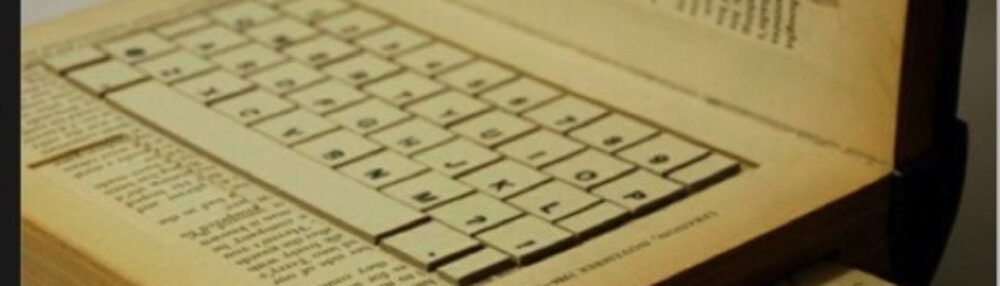
Week 3: The Intricate Dance of Old/New Media

When I read Jessica Pressman’s essay about old and new media, a quote from it that really stood out to me was “Media do not replace one another in a clear, linear succession but instead evolve in a more complex ecology of interrelated feedback loops.” (pg. 2) I felt that this observation really challenges a dominant cultural narrative that I see myself coming across a lot. That this idea that technological advancements follow a predictable path in which new technology eventually replaces older technology, making the former generation of technology outdated.

Another part of the reading that fascinated me was Pressman’s concept of “bookishness” as a response to the perceived danger of digital media to print culture. It seems that modern literature has started to fetishize books as a pleasing object to look at rather than just letting it fade away in the face of screens. I think that this type of occurrence shows how old media actively changes in response to new media, as it frequently becomes more strongly itself in the process rather than passively absorbing its effect.

Thinking about this dynamic, I can’t help but be reminded of vinyl records, in which it made a notable comeback right in the middle of the digital music streaming era. Vinyl’s very much focused more on its physical qualities, such as the album cover, the ritual of actually playing a record, and the cozy real sound. Rather than attempting to compete with the ease of digital technology. I found that vinyl records started to highlight their tactile, physical characteristics in ways that set them apart from their digital counterparts, much like Pressman’s bookish novels.

Furthermore, I thought that Pressman’s use of Hayle’s alternative term “intermediation” together with Bolter and Grusin’s concept of “remediation” raises significant issue regarding directionality and agency in the evolution of media. “Intermediation” better represents the ongoing, bilingual aspect of media influence that Pressman outlines, while on the other hand, “remediation” would imply a rather linear process of new media altering the old. The chain of feedback is an ongoing process of mutual modification rather than merely new things impacting old things.

This had me wondering, what more examples of “bookishness” or related trends may we uncover in the media world of today? For instance, how do established newspapers highlight their trustworthiness and materiality in the face of digital journalism? How do physical retail establishments renew themselves in the face of online shopping?

The Life and Death of Books

Although I was born and grew up in Germany, I am still learning about Germany in another country. The memorial from Berlin, which represents an empty bookshelf and serves as a symbol for the burned books from the Nazi era, has remained in my thoughts ever since. Were only sheets of paper with signs burned back then or were identities of individuals destroyed?

Reading “Book History” by Levy and Mole, I quickly realized that books not only convey certain content, but are also material objects with a history.  When someone asks me what a book is, I don’t know how to answer the question. To be honest, I never thought about it. I saw the book as a book. I didn’t have an answer to the question. Since attending our course, I realize that a book is more than just sheets of paper stapled together to convey knowledge. Rather, they are created, distributed, read and can be destroyed. The memorial on Bebelplatz shows this aspect: books are fragile, vulnerable and mortal. This raises the question of what it means when books are destroyed? Is it only the destruction of an object or also of ideas?

It can be argued that books can be destroyed as objects, but not ideas, because these can be reproduced through reviews, copies and new editions. It depends more on how many people have read, distributed and studied the book. The idea that ideas and identities can be erased by burning books therefore proved to be wrong. Books as objects are perishable, but knowledge can have a different permanence. On the one hand, books are mortal because they consist only of paper and ink. On the other hand, they are immortal because their contents remain in the mind and are copied. The burnings rather refer to the fact that such books are usually destroyed because they are significant. 

In relation to the present day, this view is also significant. In the age of artificial intelligence, we realize that texts are not physical objects. Unlike the destruction of books, digital texts often disappear unnoticed from digital archives. This raises the question of whether digital books are more durable than printed ones or whether they are just as vulnerable.

The memorial is a reminder of what was destroyed. The transience of objects meets the permanence of knowledge. Although history as an object is destroyed, new stories are produced as a result. I also see the memorial as history. When I am back in Germany and visit Berlin, I will definitely take a look at the memorial and hopefully be able to answer the question of what a book finally is.

Is it Useless?

The Library of Babel

Spanning the entirety of Jorge Luis Borges, “The Library of Babel,” each word seems to fit as though a dozen eyes meticulously swept through the text, line by line. Though during and after my reading, the inclusion of one peculiar word has piqued a curiosity never before known to me. As a result, the revelation is made through Borges’s short story that anything conceivable may be deemed useless due to its reliance on conception. 

Now that sounds like a lot of lengthy bullshit words jammed next to each other, but I believe (and that’s what’s important) that in Borges’ subtleties, this claim could withstand. 

The peculiar word “useless” is used five times throughout Borges’s story. Four stand in the text, with one as a footnote, though not all usages stood out to me at first. The difference relies on the understanding of what use implies, and specifically to whom. 

Due to ignorance and possibly human nature, I assumed the word implied specifically to humans. Looking up the definition of useful and seeing “able to be used for a practical purpose or in several ways.” I was surprised, though not all too convinced. Sure, a bee is deemed useful for a flower, and vice versa, but is this not told through the lens of a human? I pose the question to the class, as I’m genuinely curious, is anything objectively useful to something other than us, not because it betters our human circumstances or experience in this world, but because it just is. 

Though that is ultimately the point. Everything we know is seen through our lens. And in four of Borges’s usages of the word, they are used in relation to humans, besides one. When speaking of humanity’s eventual collapse, Borges says, “the Library will endure: illuminated, solitary, infinite, perfectly motionless, equipped with precious volumes, useless, incorruptible, secret.” Though infinite, incorruptible, and precious, it serves nothing without someone able to conceive it. Without active engagement, is there any meaning behind any of these words–even a book of “ultimate truth” or one with “Godly wisdom?” Do humans really live that shallow of life, stuck in our own thoughts and ways, unable to tap into any other desire but our own? And really, what it’s asking is: what exactly is useful in the world external to our realities? Frankly, I don’t think we’ll ever know, or we can, but then again… why’s that useful to me?

Class Introduction

Hello everyone! Although a little late, I find it no better time than to properly introduce myself. My name is Samuel Peters, a third-year English major here at SDSU. I guess the first thing I’d like to address before I comment on anything else, is my innate love for stream of consciousness. The zen of writing–my mother used to call it, who her father taught her–has always been my preferred choice of giving meaning to this otherwise hollow world we live in. In effect, I trip over my words, but I’m working on becoming more carefree about tiny errors. This is why I prefer my writing unedited and raw, so that’s what it is–a raw reflection of not what I wanted, but could say in that moment.


I grew up in a comfortable household with two loving parents, a younger sister, and an even younger brother. With that comfort, my parents were able to put me through a good education, which is where I discovered my love for all things English. My teachers all the way through high school encouraged me to explore this love, which came in the form of journalism, short stories, collections of poetry, and a complete novel my senior year (which I can share more about if anyone’s curious.) Despite my disregard for editing, I had an editor work on my novel in my ongoing attempt to publish (probably self-publish). Though currently, I am working on a couple of other ideas–a screenplay, a novel or two, and my poem-a-day promise to myself. I guess what I’m trying to say is I am seeking further application of my passions into production.


I’m looking forward to this class as a way to dissect the very entity I love to create, as well as others. I’ve always been intrigued with the prospect of passing on my “knowledge,” if I can call it that, rather passing on my love for the art, and I think it’s important to understand exactly what I’m involved in before I can share my ideas. I think human expression is essential, especially in modern times when AI threatens that very thing. Though to say AI is an enemy is ignorance and completely disregards the welfare of societies to come.


I see an inevitable day where AI integrates into our educational system, so currently I am working on passion projects supporting our eventual transition. I see AI as a tool to enhance writing, not a detriment to free thought, and I’ve been working with it in depth in preparation for our future. Though enough of my droning, I’m here to write exactly and only what needs to be said. I am much more here to listen and take in what everyone cares to share! As is, thank you for this opportunity to deepen my love, and I hope you enjoy a couple of things I write and share throughout!

Here’s a photo below by the way–an off-putting glare taken on my rather lovely Canon that I cherish more and more with each photo.

The Library as a Beehive

After reading Borges’ famous short story “The Library of Babel” (1941) for the first time, I was overwhelmed by its scope of theme. A story trying to make sense of the nonsensical is sure to be dense. The more I read, the more expansive this infinitely yet finite library became. Making sense of the story and its purpose was difficult, to say the least. Despite this, I kept coming back to one word in particular, “hexagon,” a word that immediately reminded me of something, but a thought not developed enough that I decided to brush it off. It wasn’t until my second re-reading that I was able to focus on Borges immediate description of the library’s infrastructure and architecture and the word itself.

“The universe (which others call the Library) is composed of an indefinite,
perhaps infinite number of hexagonal galleries. In the center of each gallery
is a ventilation shaft, bounded by a low railing. From any hexagon one can
see the floors above and below-one after another, endlessly. The arrangement of the galleries is always the same: Twenty bookshelves, five to each
side, line four of the hexagon’s six sides; the height of the bookshelves, floor
to ceiling, is hardly greater than the height of a normal librarian. One of the
hexagon’s free sides opens onto a narrow sort of vestibule, which in turn
opens onto another gallery, identical to the first-identical in fact to all.” (Borges 1)

The immediacy of the description suggests that Borges is not only highlighting the books and the knowledge that are on the shelves, but the architecture of the library itself.

A structure that similarly mirrors the labyrinth of the Library is a beehive. Beehives do not naturally form into hexagonal shapes. The process takes place when a worker bee molds the wax into circles, only for their body heat to melt the comb into its familiar hexagonal shape. “Roman scholar and writer, Marcus Terentius Varro, proposed that it was a mathematical hunch known as “The Honeybee Conjecture.” He said that a structure that was built from hexagons is slightly more compact than a structure built from tiny squares or triangles. The more compact the structure is, the less wax the bees need to complete the honeycomb. (Allon par. 3) Honey is important to bees, it is not only used as a food source but as a climate control for the hive itself, communication, preservation, honey is essential to bees and every aspect of their being. Bees spend their whole lives on the quest for honey, nectar, pollen. They die only for another worker bee to takes its place to continue the never ending goal of finding, creating, and storing honey.

The idea of librarians living and dying within the library, cataloging knowledge, is reminiscent of the lives of bees, and the library itself is akin to a beehive. There is a natural process in which the library and its librarians function. The process that the narrator describes within the first few paragraphs mirrors this. Natural labor is deconstructed into an animalistic, primal level, where, through instinct, bees’ lives revolve around honey, so too do the lives of these librarians revolve around the books and their potentially infinite knowledge, “Now that my
eyes can hardly make out what I myself have written, I am preparing to die,
a few leagues from the hexagon where I was born.” (Borges 1)

At its core, the library is a hub of cells filled with knowledge; it must be protected. And its inhabitants participate in eternizing it. “-The bee serves as example when one must reinforce the definition of the human as rational animal. (The first to question this complicity was Derrida in The Animal that Therefore I am.) But Borges’ brief story deconstructs each of these binaries: language/sound, rational/irrational, and human/animal. The random creation of the library’s texts shows that even the most complex achievements of human “reason” are equally possible without any animating consciousness or any intention-to-signify at all. The life of us bibliotecarios is no more justified and no more good than that of the bees. And who’s to say a bee doesn’t believe his vindication awaits in the very next hexagon?” (Basile). Of course, the distinction in my comparison is that humans have a conscience and animals, namely bees in this instance, do not. Yet the comparative nature of the library itself invites the reader to deconstruct this notion and compare a natural order to that of a chaotically infinite one and the purpose of not only the library but the librarians as well.

Reflections of Today and Borges’ “Library of Babel”

Jorge Luis Borges’ short story “The Library of Babel” is a fantastical thought exercise that essentially reflects various human reactions to abstract questions in a thoughtful and sometimes humorous way. Borges sets up the story to take place inside a library which equates to the whole world for the people living inside it. The Library contains an infinite amount of books which have a perpetually endless combinations of letters and punctuation. With this knowledge many librarians have formulated their own schools of thought and way of life to accommodate conceptualizing and dealing with their world. 

When reading the short story, I enjoyed the diversity of thought within each librarian and how that manifested in their living, or rather, coping. In the uncertainty of the Library, librarians created things like religion and a norm culture to help regulate their way of life. A group that stood out to me the most was the Purifiers, who would invade “the hexagons, showed credentials which were not always false, leafed through a volume with displeasure and condemned whole shelves” (Borges, 6). I think their response to the chaos of their world makes sense, but it almost feels rash in their need for control. The Purifiers’ line of thought mirrors plenty of people’s beliefs today, as many grapple with our chaotic world by simply trying to carve it into what their perfect world would look like. I think an example of this, relevant to today, is book banning. The act of banning books often reads as a response from adults who cannot grapple with the notion that the world is more than what they can conceptualize, so in turn, they try to control what they can to make more people similar to themselves. Borges does this reflection of our world in the Library repeatedly with different philosophies and religions, which made me love and ponder on this piece for a long time.

The Introduction of Delinda Souksavath

Hello! My name is Delinda Souksavath, 21 years old. I am currently an undergraduate student, majoring in English and Comparative Literature. What I hope to do with my education is to become an author. I was born and raised in San Diego, but my parents both come from Laos and immigrated. My mother was a student at SDSU but never got to finish her education, so I am also kind of going to school for her as well.

My hobbies consist of writing the stories I have stuck in my head, taking dance classes, going to the gym, cooking, and playing video games. I currently am obsessed with the game Peak, but I also like playing Marvel Rivals and Minecraft. I honestly like playing video games with friends more than by myself, I feel if I play by myself I kind of go crazy talking to myself.

My relationship with books has been very interesting, as funnily enough, I hated books and reading as a kid. I was a lot slower at learning than the other kids, which reflected in my reading comprehension skills and it frustrated little old me at the time. I had thought reading was no fun, until I discovered A Series of Unfortunate Events and it introduced me to the fiction genre. After that, I got sucked in. After finishing that, I read more of Lemony Snicket’s work and once I went through those I branched out to other books. Now, I love books and reading. With this class, I hope to expand my mind about books as a whole and what they do to our society and the impact they have!

Introduction: JJ

Hi all! My name is JJ. My family is from Iran but I was born in Australia and we all moved to the US when I was one (so no Australian accent unfortunately). I am a first year MALAS (Masters in Liberal Arts and Sciences) student and I graduated from SDSU last semester as an interdisciplinary studies major with a minor in philosophy. I love learning about how everything is related with each other and strongly believe nothing is produced in complete isolation.

I love social theory and hope to become a sociology professor one day. Dr. Choi in the sociology department has been a major influence in the way I think. I am interested in (but know embarrassingly little) about Postmodernism. I am considering writing my thesis regarding the social construction of reality and what it means to have “invisible” (non-linguistically defined) experiences.

I currently work as an A/V technician for the Student Union. I love the job because, simply said, it’s a lot of fun. Being behind the scenes and working with fancy equipment on major events as a student feels like a huge privilege. I also work as a Gen S instructor for first year students living on campus. This is my first semester so it is a very new job to me but so far I’m really enjoying it!

On the side, I love to cook. My favorite thing to cook is steak but I love making intricate salads as well. One of my favorite parts of cooking is looking at what’s in the fridge and figuring out how to make something that tastes great–kind of like an episode of master chef.

I am really looking forward to this class because I love learning about context. I know very little about books as a concept and am excited to learn more about it!

Hopefully this book finally explains my existence

When reading Borges’ “The Library of Babel“ from 1941, I was particularly preoccupied with the image of the ‘man of the book’. After reading it, I asked myself what if there was a single book that contained the answer to every question, the truth behind every mystery and the justification of every life? Even in today’s world full of information, many long for a single source of truth. I am thinking of sacred scriptures or scientific theories that explain life and our existence. 

The quote “On some shelf in some hexagon there must exist a book which is the formula and perfect compendium of all the rest…”. The quote shows the longing for a book that explains everything. So the book lies in the middle of an astonishing archive, in the midst of chaos and nonsensical writings. Why do people believe in such a book? Aren’t there several writings that explain meaning and our existence? The book of books is therefore a symbol of the desire for truth. Borges describes how many set out in search of it, but fail. Although the search remains unsuccessful and seems hopeless, people would not stop. But this shows the character of human beings, because we want order, even if it cannot exist. Human beings cannot endure chaos. Yet what one person perceives as chaos may not be the same for another because each of us carries a subjective view of disorder. This means that the search for truth is always individual. It does not necessarily have to be found in written texts. Sometimes it takes the form of ideologies, or, in today’s world, even algorithms that claim to impose order on the overwhelming complexity of information.

Applying this idea to our digital age, I think people today are still searching for truth through religions, science, AI and algorithms. But as described in Borges` Library, there is too much information and contradictions at the same time. Maybe that’s why it’s not about finding the perfect book, but about accepting that truth remains fragmentary. Therefore, humans should question the meaning of life.

Introduction – Alin Kilicoglu

My name is Alin and I’m an international student from Germany. Back home I study Education at the University of Siegen, which is in the western part of the country. I’m now in my fourth year, and I hope to become a teacher in the future, because I really enjoy working with people and sharing knowledge.

One of the reasons I chose education is that I believe learning can open doors and change lives, and I’d love to support students in discovering their own strengths. I’m especially curious about how different cultures approach teaching and learning, which is also why studying abroad is so exciting for me.

Outside of class, I enjoy traveling and exploring new places, spending time with friends and reading. I also like cooking and watching movies. Being here gives me the chance not only to improve my English but also to connect with people from different backgrounds, which I really value.