Artists’ Books vs Bookwork

In Chapter 3 of The Book, Borusk engages with the idea of a book rather than the concrete materiality of what makes a book, as explored in the previous chapters. Borsuk explores the idea of a book by going into numerous examples of artists’ books which ultimately “highlight the ‘idea’ [of a book] by paradoxically drawing attention to the ‘object’ we have come to take for granted” (pg. 113). Reading this chapter reminded me of our first book lab, where we questioned the qualifications of a book by looking at various book forms, from a book in a can to a triptych of poetry. This chapter expanded on the idea of the first lab as Borsuk introduces us to Stéphane Mallarmé, Ed Ruscha, Alison Knowles,  Michael Snow, and many more who play with the form of a book and the effects of the space of a book on their art or literature. 

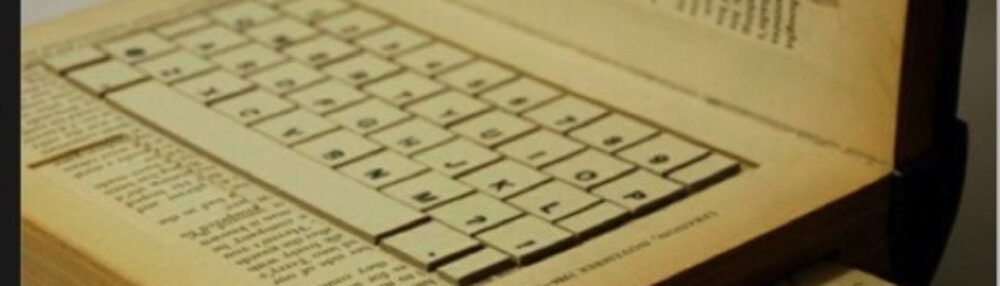
After reading Chapter 3, it was interesting to read the interview between Prof. Pressman, Brian Dettmer, and Doug Beube, as Dettmer and Beube explore their artistic processes, but not through a necessarily literary lens, as has been presented for the majority of the readings, and certainly not through an artists’ book lens. I thought it was interesting how, when asked about their work in relation to artist books, both Dettmer and Beube rejected this categorization of their work. But once, Dettmer explained his perspective on how “artists’ books use the book as a canvas and the work exists and operates within the context of a book,” and Beube said, “artists’ books still function as books… In contrast, in my work, I challenge the way we interact with and think of these objects,” I understood why they were so adamant about their distinctions as doing bookwork rather than creating artists’ books. When considering books like House of Leaves or Nox, both still work to tell their written story, but in an enhanced way. But the bookwork that Dettmer and Beube do focuses on how one can play with the form of a book and “to think differently about the media we use” (Brian Dettmer). 

With each class and reading, I am being taught and reminded that books are more than blocks of text; they are an entryway into a conversation about the society they were made in, the time period of publishing and distribution, and cultural significance. When interacting with a book, more questions are being brought up in my head and it’s interesting to see where my mind takes me and how much more I look for in a book. I enjoyed learning about how people have pushed the boundaries of what a book is, as it brings new life to books and inspires art.

The Book as Idea

The excerpt from Johanna Drucker’s work and Borsuk’s third chapter recalibrate the thought process of understanding the artists’ book as an idea. Near the end of the Drucker’s excerpt we read she states, “Artists’ books take every possible form, participate in every possible convention of book making, every possible ‘ism’ of mainstream art and literature, every possible mode of production, every shape, every degree of ephemerality or archival durability.” (14) There is a profound importance in recognizing that the idea of a book is woven from the artist’s vision and transferred to the reader. The reader then recollects, shifts, and begins anew within the mental space of their mind but only after physically interacting with the book.

Likewise, I found myself further contemplating the the power of the book as an idea as I worked through Borsuk’s book. In the section titled “The Book’s Ideas” she writes, [on examination of artists’ books] “Thy remind us that books are fundamentally interactive reading devices whose meanings, far from being fixed, arise at the moment of access.” (145) In our modern world where everything is commodified, it becomes natural to assume that a book’s meaning is limited to what is inside of it. That could not be further from the truth. The role of the reader is designated to ask the right questions and consider the book outside of the text and in its materiality. By doing so, there is a recognition that the entire book in its form, materiality, and content, require a reader to decipher and further contribute to the book as an idea.

Reconceptualizing the Book Beyond a Practical and Physical Medium

In Borsuk’s third chapter, “The Book as Idea,” the book is reintroduced as not only an ever-changing object but also a malleable concept shaped and impacted by technology, history, and culture. The key concept takeaway for me was that this mutable and evolving idea of the book is a form that will always reflect our human needs, available resources and materials, as well as our social systems, “Defining the book involves consideration for its use as much as its form. Our changing idea of the book is co-constitutive of its changing structure.”(195) With this notion we, as readers and thinkers are encouraged to refrain from thinking of “The Book” through objective lenses. As we progress through not only the book but our class as well, the idea of deconstructing the book as object becomes more pertinent. The separation, duality, and experimentation between materiality vs ideation intensifies and positions the book as a living concept, one that reflects humanity’s relationship with material technology and commerce.

Borsuk further pushes the idea of the book as conceptual and is, in a sense, teaching us to think about the book not as an artifact of craft but more as a field of inquiry. In the sub-chapter titled “The Book as Ephemeral,” Borsuk states, “Not only are their physical forms(including the tablet, scroll, codex, and variations) susceptible to decay, their power to spread ideas makes them vulnerable to censorship, defacement, and destruction, particularly motivated by ideological and political difference. Some artists’ books embrace this impermanence, inviting us to meditate on our fears that books might go up in smoke.”(179) Firstly, the idea of the vulnerability of the book really emphasizes that “bookishness” fetishization but it also paradoxically highlights the physical books obsoletion in the sense of art. There are e-books and audiobooks now, mass produced paperbacks. New mediums driven my commerce but also to meet the demands and needs of the consumer. This is history repeating itself, a drastic shift, worried thinkers, we have been here before; it gives more weight to the fact that we should look at book history as circular rather than linearly, And it is a peripherality to think that a book is just a book and that is why I love how Borsuk ended this chapter:

“It can, itself, serve as a kind of furnishing, offering as it does, a storage and filing system between its pages, in which we might press flowers, copy recipes, keep photographs, or compile clippings-habits of Renaissance readers that continue today. The book props up its neighbors, too, as we learn pulling books off the shelf and watching the adjoining volumes topple. It can take us down as well, since it’s portability makes it a handy projectile when the moment arises. Defining the book involves consideration for its use as much as its form. Our changing idea of the book is co-constitutive of its changing structure.”(195)

Week 7: Hyperactivation!!

Johanna Drucker and Amaranth Borsuk each center the book’s reader as its activator. Artist’s books, “which integrat[e] the formal means of [their] realization and production with [their] thematic or aesthetic issues”, hypermediate material production and interactivity (Drucker “The Artist’s Book as Idea and Form” 2). As both Drucker (14) and Borsuk (174) show, this meta function of the artist’s book is remediated in much electronic literature and interactive fiction. Following my interest in undertaking bibliographies of the Electronic Literature Studio’s collections, I’ve begun to read Drucker and Borsuk for guidance in bibliographing transmedia book objects. I had intended to codify these methods into personal guidelines for bibliographic work with objects in Special Collections and the E-Lit Studio, but I realized that I have more questions than answers regarding good bibliographic practice, and especially regarding the bibliography of inaccessible media.

For Drucker, an artist’s book is identified in part when “the informed viewer . . . determine[s] the extent to which a book work makes integral use of the specific features of [its] form” (9). Following this, Borsuk argues that artist’s books “remind us that books are fundamentally interactive reading devices whose meanings, far from being fixed, arise at the moment of access” — or inaccess (The Book 147, 188). Inaccessibility is intentionally encoded into many artist’s books, and, whether by artist design or tech companies’ designed obsolescence, it permeates digital media. The bibliographer’s context might itself create this inaccessibility, as in the case of a CD-ROM that can’t be played for simple lack of playback equipment. Such a bibliographer’s limited access to the object might actually invite closer documentation of what features are available for analysis, like the CD-ROM’s surface, jewel case, or related ephemera. This context also emphasizes that the CD-ROM should not be approached with assumptions that it is meant to be played or read in a singular, specific way (ex. by playback in a disc reader). Just as “‘bad’ printing” makes more obvious the materiality of printing processes (Drucker 17), digital inaccessibility makes obvious the systems on which a work is dependent for functioning. The limitations of the bibliographer’s activation invite connections between contexts.

…but where is the line between meaningful connections and presumptive conjecture? My main struggle is in balancing the positioned activation of a reader with the archival project of the bibliographer. The distinctions between speculation and inference are often ambiguous to me. What is the code for identifying conjecture versus evidence, particularly when informed speculation is the only way to connect historical gaps? Will my bibliography fail if I overly situate my own positioned interaction with the object, or is this an essential aspect of responsible bibliography?

When my group and I examined a sixteenth-century codex in class, we carefully flipped its pages, moved it through light sources, and felt its cover to try identifying its materials. These were activations made possible and necessary by our positions in relation to the book object. Even documenting the book sculptures of Brian Dettmer and Doug Beube would involve moving around the objects and examining them — breathing in their space and context, connecting ocularly with their positions. Just as Borsuk shows that a reader’s movement through a book is a movement through time, space, and meaning (156, 178), the bibliographer has to move with the book, and this means that their subjective bodily experience is the contextually significant position for their activation.

So how do I reconcile my function as activator with the documentarian function of the bibliography? Isn’t the bibliographer’s context essential to document? If an artist’s book is only identified by “the informed viewer”, and if a book’s meaning only manifests “at the moment of access”, then an objective bibliography (as all objectivity) is impossible. What makes a bibliography functionally useful, and which actions of the bibliographer might damage this function? Is this really a question of objectivity versus subjectivity, or might it be more generative to foreground the function of the bibliographer as a subjective activator?

I realize that this is one of the most basic questions of archival and historian work, but it is also among the most essential to continually ask ourselves. I’d appreciate any thoughts that you all have on this, as I was hoping to come to some guiding conclusion but am still uncertain. Isn’t it only ethical for a book’s bibliographic activator to disclose the context of their activation?

Sick again, so sorry for the weakest post of all time.

The Book as Space – Walking through Rooms of Language

In the last few weeks, I have often looked at how we move through books. From the ancient scroll to the modern codex, I kept thinking about reading as a kind of motion. Something that happens across pages, screens, and feeds. But looking back, all of these movements were still two-dimensional. They took place on flat surfaces, even though the books themselves and the devices we read on exist in a real, four-dimensional space. This week, Chapter 3 of The Book suddenly brings that missing dimension into play. Ulises Carrión’s idea that “a book is a sequence of spaces… a sequence of moments” (p. 148) opens up a completely new perspective. The book is not just something that opens before us, it opens around us.

Carrión’s line suddenly brings a sense of real space into play. It makes me see reading not as an act of moving from page to page or from chapter to chapter, but from room to room. And just like rooms in real life, every room has its own function and its own decoration. Some rooms are bright while others are narrow or silent. The same goes for chapters and pages. Each one feels unique in its own way and is arranged differently, but none of them are meaningless. When Carrión uses the word “sequence,” it already carries a sense of rhythm. The rhythm of one space leading into another, one moment following the next. “Spaces” then opens the page outward, turning reading into something we can step into. And with “moments“, Carrión adds a sense of time, reminding us that every act of reading happens only once and never in exactly the same way again.  

If we think of a page as a room, then the words become its furniture, objects carefully placed by the author. Every word sits somewhere for a reason. For me, Carrión’s idea creates the picture of the writer as an interior designer, arranging language so that the reader can walk through it. Reading, then, is not only about following a line of text. It’s about entering and walking through spaces, that slowly shape the meaning of the book.

Looking back on my earlier reflections, this feels like the next step in a larger journey. I began with the scroll, thinking about the linear movement of reading, then moved to the codex as a flexible form and later to the book as a living body. Now Carrión adds a completely new layer. The book as space. What used to feel flat suddenly gained depth. Each time I turn a page, I am not just moving forward in text but stepping into another room. It makes every act of reading feel like walking through a house built out of language, with new doors that keep opening as you go.

Chapter 3: The Book as an Idea

This chapter was really interesting to read, learning about all of the different aspects of the book and how its evolution affected different aspects of the book. Animation, spacing of texts, digital realism, forms, spatiality of a book and etc. What initially caught my attention was the first line of the chapter “The thing we picture when someone says ‘book’ is an idea as much as an object” (pg. 69). I did not realize (or think about) that I think of books this way too, as stories and pretty objects that look good on my shelves. Books as ideas as much as objects, in my opinion, is the best way to describe a book. Yes, they are aesthetic objects that hold meaningful ideas and stories, but I had never thought to define them that way myself. I think if you put the word book in front of people, everyone is going to have a different description of definition. This definition adds more of a deeper and broader of the meaning of a book. I feel like this allows everyone to have their own personal definition of a book but also the same basis. This definition adds value to every aspect of a book, crediting the similarities but also the differences of all books.

Another aspect of this reading I enjoyed was the discussion of the ebook or the kindle. “When books become content to be marketed and sold this way, the historic relationship between materiality and text is severed.” (pg. 69) I thought this was a great connection to my first point about the definition of the book. That definition highlights the importance of the book as an object itself and an idea- but the ebook doesn’t apply to this. The physical object and aesthetic is gone, which brings as much value to the book as the content itself does. This is then severed and the book has an entirely different definition now. This gave me a new aspect on kindles and ebooks, and I have a kindle and love the portability of it, but I realize my definition of a kindle versus a book is entirely different. This changes the book industry as a whole, the idea of a book being a work of art different in this context, as is the definition. I did not think about how the medium in which a book is presented changes is definition, something this chapter made me think about.

The Book as Idea

The book is an expression of ideas that are formed by the desire to create, share, and work. Each facet and piece of the book is used to express the ideas and creativity of an author, from it’s covers, which can depict great artist and introduction, to its pages that might be beautifully illuminated, and even including its fonts and included images. The book is a canvas for words and information as well as a stage for an author to fully express their point of view where they can connect with their indented reader to the best of their ability. Books in through this purpose are, as Borsuk in, The Book, writes, “always a negotiation, a performance, an event.” (147).

The book used and viewed as an idea, rather than just as an object allows for a broader and more creative use of it as a medium. It allows author to use every surface of the book for their message and tone, allowing the reader to read from the book before ever opening it, when the book is an idea the reading and comprehension of it begins at first glance, a very first touch of the binding immediately introduces the authors perspective and subject. The book as an idea also allows for more inspiration for authors writing within it, being able to take the ideas provided by the books’ shape and form into fuel for their stories, like as done by author Stephane Mallarme, who formed his story on the page like an actual shipwreck, making readers as they turned the pages, “complicit in the shipwreck.” (129). The book as an idea becomes ideas, a tool for inspiration and evolution of the books presentation and form, idea allows the book to change, not forced into a rigid and single standard shape.

Book as Idea

As we near the halfway point in our semester, we have spent most of our course searching for answers to how we define what is a book throughout our traditional history. What is interesting with this week of “Book as Idea” is taking into consideration books that do not present in a linear format or that are unconventional in the sense of not presenting language. As the relationship of form and content continues to unravel in the digital age, I found the bookish artwork by Doug Beube and Brian Dettmar particularly astounding as their altered book sculptures challenge our assumptive qualities about what a book should be. 

In discussing their work with Dr. Pressman, both book artists emphasize the cultural zeitgeist they find themselves in as they strip the book of its traditional utilitarian usage of reading in a linear fashion to create paper and book-based art that experiments with perception and meaning. Through such interactions with the book, Doug Beube describes, “The book as an object is generic in a sense. All books basically look the same: they’re rectangular, have a front and back cover, etc., so its form and format is almost (and I emphasize almost) immaterial to its content. I see the literary aspect of my art as a collaboration between me and the other creators involved in making the book…I consider these acts of engaging in conjunction with literary criticism—a way of building my own critique,” (3). As Beube’s work subverts the usual entry point of readers’ interactions with a book, he acknowledges the qualities that books have been standardized to meet that are often looked for subconsciously when deciding if an object is worthy of the “book” title. With his placed emphasis on how “form and format is almost immaterial to its content,” we know as scholars of the book how form, format, and content will always impact the meaning of the other, but Beube suggests a decreasing impact of form and format as modern printing and book production follows a familiar or “generic” idea of what a book is.

Though the book is not a very malleable object due to construction and low quality materials, Doug Beube and Brian Dettmar experiment with physicality to craft new meaning, redefine “reading” of the book, and as Dettmar suggests, “force a fluidity onto the book that isn’t intended,” (4). In pushing the book to its limits and thus adding additional texture to book analysis, the book’s authority is destabilized where readers are challenged to pursue atypical interactions with the book and think in a spatial pattern that does not follow the linear pattern of moving cover to cover. Considering our class discussions of how the book is not a stable medium, this act highlights such instability as it is made into both a collaboration and a critique as aforementioned by Beube. Through such sculptural interventions, the artists reinforce the book as a living object by fostering active conversation between the author, artist, and reader.

When the Book Falls Apart and Forces Us to Think

In the interview “Bookwork and Bookishness,” Jessica Pressman talks to artists Doug Beube and Brian Dettmer about their book sculptures. I find their statement about books as a medium in the digital age particularly exciting. Because it becomes clear that art is not just decoration, but criticism of a medium.

Beube describes his work as follows: “The book is a technology that is not meant to be malleable or flexible in the ways I use it, and I’m trying to force a fluidity onto the book that isn’t intended.” Originally, the book was a linear, rectangular, bound medium intended for reading information. However, when you bend and dismantle the book, it becomes “flexible.” This is precisely where the critical impulse lies. This even becomes clearer when he says: “Artists like myself pull the book apart to show that it is no longer the only way to present knowledge and information, especially not in a digital age.” In the past, books were considered the most important medium for storing and disseminating knowledge and information. Today, digital media and artificial intelligence have largely taken over this role. By literally taking books apart, artists illustrate this cultural shift.

Brian Dettmer adds to this perspective by pointing out the effect of media on our thinking: “The media we use has a large impact on how we digest content; it shapes our minds and influences the way we think.” He makes it clear that it is not only the content that is important, but also the framework, the way in which the medium structures our perception and thinking.  The linear book shapes our understanding of stories and knowledge. Meanwhile, digital media promote speed, networking, and multitasking.

In my opinion, Beube and Dettmer’s artworks are not nostalgic, but critical. They reveal that books are no longer a given in a world flooded with digital information. Beube and Dettmer’s artworks are not nostalgic, but critical. They reveal that books are no longer a given in a world flooded with digital information. By taking the book apart, they open up a discussion about what media do, how they shape our thinking, and why we still cling to physical books at all. Perhaps the real goal of their art is not to save the book. Rather, they want to remind us that both books and digital media shape the way we think. 

Chapter 3: The Book as Idea

In Chapter 3 she writes: “Muted books take on a totemic significance. Because we can’t ‘read’ a book object or book sculpture, we see the idea of the book, a metaphor that has penetrated our culture so deeply it informs the language we use to describe ourselves.”

This made me realize how much the book is more than just paper and ink. Even when we strip away the actual text, the shape and idea of a book still carry symbolic meaning.

Borsuk connects this to how deeply the book is embedded in culture and language. I never thought about how many expressions in English (and in German, too) are built on the metaphor of the book. For example, someone can be “an open book,” or we might “judge a book by its cover.” These phrases have nothing to do with literal books, but they show how strong the idea of the book is in shaping how we talk about people and life.

The phrase “totemic significance” stood out to me as well. I learned a totem is something that represents a belief system or community identity, and thinking of the book in this way is powerful. It means that books are not only tools for reading but also cultural symbols we treat almost with reverence. I thought about how in my home, even when we didn’t read certain books anymore, we still kept them on the shelf, as if just having them there made the room feel more intellectual or meaningful.

For me, this passage helped to see that books work on two levels at once. They are objects you can read, but also symbols you can’t escape. Even in an age of screens and e-books, the metaphor of the book is still shaping how we understand knowledge, identity, and even morality.