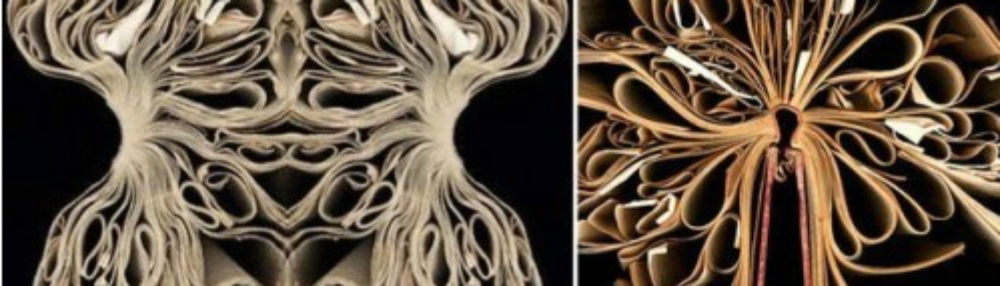
When reading Borges’ “The Library of Babel“ from 1941, I was particularly preoccupied with the image of the ‘man of the book’. After reading it, I asked myself what if there was a single book that contained the answer to every question, the truth behind every mystery and the justification of every life? Even in today’s world full of information, many long for a single source of truth. I am thinking of sacred scriptures or scientific theories that explain life and our existence.
The quote “On some shelf in some hexagon there must exist a book which is the formula and perfect compendium of all the rest…”. The quote shows the longing for a book that explains everything. So the book lies in the middle of an astonishing archive, in the midst of chaos and nonsensical writings. Why do people believe in such a book? Aren’t there several writings that explain meaning and our existence? The book of books is therefore a symbol of the desire for truth. Borges describes how many set out in search of it, but fail. Although the search remains unsuccessful and seems hopeless, people would not stop. But this shows the character of human beings, because we want order, even if it cannot exist. Human beings cannot endure chaos. Yet what one person perceives as chaos may not be the same for another because each of us carries a subjective view of disorder. This means that the search for truth is always individual. It does not necessarily have to be found in written texts. Sometimes it takes the form of ideologies, or, in today’s world, even algorithms that claim to impose order on the overwhelming complexity of information.
Applying this idea to our digital age, I think people today are still searching for truth through religions, science, AI and algorithms. But as described in Borges` Library, there is too much information and contradictions at the same time. Maybe that’s why it’s not about finding the perfect book, but about accepting that truth remains fragmentary. Therefore, humans should question the meaning of life.
Hi, Oz! You make deep points about the search for meaning. I like how you connect philosophical searches for truth to “algorithms that claim to impose order on the overwhelming complexity of information.” It makes me think about how Google and AI like ChatGPT generate answers that the human user might interpret as objective truth, but which are based off of subjective data. The way that the user actually interfaces with these technologies shapes their expectations of how knowledge and truth are sought and obtained. Thanks for this great post, it’s making me think a lot harder about philosophy and technology!
Great reading response and comment on it. We are getting started– fast and with insight– in our collaborative learning, and I am loving it!
Hi Oz! I find your mentioning of a “single source of truth” to be an interesting insight. Though I’m sure we can already defer that no such source exists, I feel like many think of religious texts as the closest form of “truth” we have. Nonetheless, these texts have gone through so many versions of translations that we can then ask if these are forms are truth then which is correct? I agree that these books are looks at as a desire for answers as we have discussed this week that infinite knowledge is a human impossibility. For most, the unknown is often feared so I feel like these texts may be moreso a tool to aid human unease towards the universe rather than a form of answers.
Thank you for your comment, Avery. I understand your point of view and it’s debatable. In my opinion, it is a question of faith. I agree with you that through many translations and over time these holy scriptures are no longer accurate and have even been falsified. Unlike the Quran, the holy book in Islam. The Arabic language is very complex, especially high Arabic, which is in the Quran. However, the translations are not 100% accurate, which is why Muslims learn to read Arabic from an early age. Unlike the Bible, there is only one version of the Koran. Muslims believe that Islam is the final message that was conveyed through Abraham, Moses, Jesus and many other prophets. The last prophet Muhammad peace be upon him was sent to teach the Quran. The Quran was given to Mohammed by the archangel Gabriel to protect the last message from God. I personally believe in the message from the book, but I also find other insights and writings very interesting. There are these books and you can fall back on them. As mentioned before, it is a matter of faith, there is no proof of what is right and what is wrong. I like this discussion though and I think that is the point of this class and what Prof. Pressman wanted. I look forward to your answer!