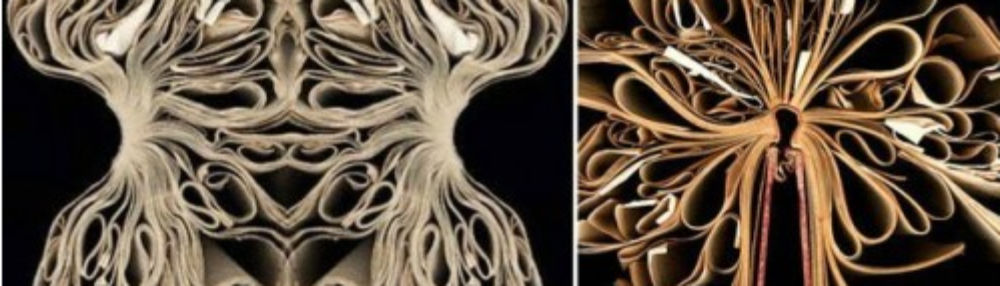
Until now, I assumed that a bibliography was another term for a works cited page. The section of a paper in which the author complies their citations. Now that I’m thinking about it, biblio means book and -graph means to study, so bibliography being the study of books should be obvious. But I had never heard the term used in such a way. Reading through the Bibliography Society of America’s website also revealed that bibliography refers to both books as objects and books as content. As modern day scholars, it’s important to realize that it is the content that decides whether we get to read an older book. I was thinking of this because of the following quote: “As an extension of this follows the investigation of the methods of production in general and of the conditions of survival.”
Conditions of survival might be the conditions of which a book was physical stored in. Was a book rarely used, and kept in a dark, dry room? Or was it touched often, stained by the oils in a hand, read in the sunlight on a wet, humid day which would effect the pages, ink, and bindings. But conditions of survival could also be about in content of the book. The importance of a book to an owner is directly connected to how it is kept. We have many versions of religious texts, because people went out of their way to preserve them. They found them important and considered that future generations would want to read them. But not all stories, all books, are given that same consideration. The only books we get to study are the ones that survived. There’s so much that has been lost to time, because the people in the moment were concerned with the present, not with saving their favorite stories for historians in the future.
As someone that reads online, as well as someone that owns a variety of digital content including video games, movies, and music, I do worry about the future of archiving and preservation. Not only can creators delete their stories at any time, but conglomerates can revoke access to previously purchased materials. It’s not truly possible to own a digital item, which will make it harder if not impossible for future scholars to truly understand digital humanities in the 21st century. How can we ensure that modern stories will survive? I know that some people do take it upon themselves to archive fanfictions; I’ve read stories from a Harry Potter archive account that I’ve really liked! So I know that their are people that worry about this as I do. I don’t have an answer for how to best preserve digital literature, but I do hope that congress passes some laws about buying versus licensing digital products. It should be clear to the consumer what we own and what we don’t.
In the end, we read what we’re told to read. We can only read from the options we have in front of us, and those options were meticulously chosen by people who don’t necessarily have our best interests at heart. As time goes on, I will continue to study older books with the question of why this specific item still survives for me to be able to interact with.
Great point here: “In the end, we read what we’re told to read. We can only read from the options we have in front of us, and those options were meticulously chosen by people who don’t necessarily have our best interests at heart.” I would add that algorithms also shape our reading practices.
As for the writing, I would like to see you start to do a little more close reading, using quotes from the text so as to ground your ideas in the text at hand.
Hi Alexis! I love the question of “How can we ensure that modern stories will survive?” I think that there was always some fear of this throughout history. What was the Library of Alexandria if not a safe haven for books that would have otherwise been destroyed by the elements or time or the touching of too many unpracticed hands? But those fears of loss of written information seem like they pale in comparison to what we stand to lose today. There are archival sites like Internet Archive and Library Genesis that try and preserve these things, but even these seem like they exist only at the whim of the hands of some imperceptible puppeteer. I think what we really are worried about is the lack of fixedness with digital text and the lack of personal control in the longevity of these things. Anything we put on the internet might exist forever, but we may never be able to see it again. I think of the phrase “you will own nothing and be happy” when it comes to subscription services, and it’s one thing for our entertainment to be bound up in this conundrum, but what are the dangers of the existence our societal knowledge being controlled by the hands of too few? I think it may ultimately lead to a much more stratified society, and I believe we are seeing the first instances of this take place now.