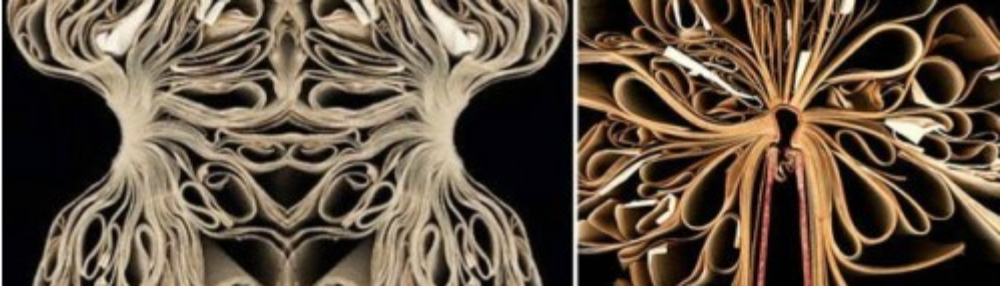
Archive as Opportunity to Disrupt the Status Quo

I did my undergrad at Texas State, and I kick myself, often, for having failed to capitalize on the opportunity to use our library’s archival collection of Cormac McCarthy’s papers. At the time, I had only a passing interest in McCarthy and had read one or two of his books. Cities of the Plain, No Country for Old Men. A professor in one of my English courses even offered to take anyone interested to the archive, and I thought at the time, “Wat would be the point in that?”

That was before I spent years poring over the vast majority of McCarthy’s bibliography and before I became obsessed with the ways in which he manufactures the sentence. I did not understand then the wealth of information I had at my disposal. As Bode and Osborne say in The History of the Book, the viewing of these archives of correspondence provide the opportunity to better understand authorial intention and “destabilize established arguments by directing attention to new information” (221). Right now, those very same archives are being scoured for any new information about McCarthy’s much younger muse and their very eyebrow-raising love affair. Destabilization is the key to the creation of greater understanding.

Research of this depth can give the researcher the opportunity to better understand the author and to also upend the status quo surrounding their work. Take, for example, the case of Richard Wright’s Black Boy, which existed in its final form only after the dedicated work of archival researchers unearthed new material, with part 2 of the novel appearing seventeen years after Wright’s death and a complete edition finally being published fourteen years after that, in 1991 (Cloutier 1-2). The status quo around Wright’s work was to shun it, but to resist that through research has allowed us the opportunity to create a new narrative around the author and his work.

I do wonder at the future of archival research, and how it might change, in some ways for the better, as a digital archive of writers’ correspondence would be much easier to navigate, but this ease of navigation might lead to less discovery, as we may only find what we are looking for and lose the opportunity for surprise that would disrupt that status quo. When information must be combed through, that is the only time you really get the chance to uncover what many may have tried to keep hidden.

Digital Archives – The Illusion of Everything

While reading Katherine Bode and Roger Osborne’s Book History from the Archival Record, one sentence in particular made me pause and think. “Digitization of archival material also increases search options.” (p. 232) It sounds simple, positive and even obvious at first. Of course digital archives make everything easier. You can sit in your room and open a document that once sat in a box on another continent. What used to take days now takes seconds. It feels like progress. Fast, endless and modern.

But the more I thought about it, the more I started to feel uneasy. Because every time something becomes easier to reach, it also becomes easier to lose. Later in the chapter, Bode and Osborne write, “If these versions are neglected or destroyed, we could witness a reduction in, rather than expansion of, our cultural record.” (p. 233) That sentence opens a whole new perspective, as suddenly the digital archive does not feel infinite anymore, but selective. It’s also about choice. What gets scanned becomes what survives. What isn’t digitized starts to disappear. The screen gives us the illusion of everything, but really it only shows what fits inside its frame. And while giving us the illusion of everything, digital archives make us lose some things we don’t really notice at first. It’s not the words, they stay. It’s everything around them that quietly fades. The little things that once made a book feel alive. The fold of a corner, the mark of a thumb, the way the ink sometimes bleeds through thin paper. All those details that told you someone had been there before.

The worry that something gets lost once it turns digital isn’t new. The same debate has been happening for years in other digital spaces. In movies, in music, in games. It’s the conversation around physical versus digital media. What seems like progress often hides a quiet loss of ownership. When you stream a film, it doesn’t belong to you, it belongs to the platform. Even when you buy it digitally, you are only buying permission to watch it. Last year, Sony removed several films from its online store and even people who had bought them suddenly lost access. They just vanished. The same thing happened in gaming. The Crew, a racing game, went offline and even though the full game still sits on the disc, it became unplayable when the servers shut down. The game still sits there, complete, but locked. Unfortunately, that’s a risk of everything becoming digital. Ownership turns fragile. What you hold today might not be yours tomorrow.

At first, I thought digitization would make the archive belong to everyone. And in a way, it still does. But something about it still feels distant, like we can enter it but not really be there. Maybe that’s the strange thing about this new kind of access. The easier it becomes, the less we seem to meet what’s actually there. We don’t enter the archive anymore, we pass through it. Maybe that’s what this text leaves behind. A small reminder that access isn’t the same as presence. That the more we reach, the less we touch. The digital version remembers the words, but forgets the world that once held them. In the end, maybe the question isn’t how much we can access, but how much we are still willing to hold.

Week 11: Close Listening in Archival Silence

In Shadow Archives: The Lifecycles of African American Literature (2019), Jean-Christophe Cloutier claims that “archivists are the life coaches of civilization’s undead” (12). This image of the archivist as conjurer brought to mind the experiential Gothic pessimism offered by Maisha L. Wester in African American Gothic: Screams from Shadowed Places (2012) and Sheri-Marie Harrison in “New Black Gothic” (Los Angeles Review of Books, 2018 — warning for graphic descriptions of anti-Black and sexual violence). As Harrison describes, the New Black Gothic represents “an ever-present and visible lineage of violence that accumulates rather than dissipates with the passage of time” — ghosts that never “move on”, wounds that never heal, and archival absences that are never restored. I consider this traumatic temporality alongside Cloutier’s “boomeranging” temporalities of Black scholarship (15) in order to question how we approach violent archival silences.

Cloutier finds that the “forensic imagination that informs much of contemporary African American scholarship (re)establishes the authority of a collective provenance” which can “allo[w] contemporary black life to imaginatively reclaim irretrievable losses” (9). This “collective provenance” or “conjured kinship” is an affective and political orientation “across time reaching back to a common ancestry in Africa and hurled forward into a speculative future” (10). Lives and sites silenced by the archive might be “reclaimed” through archival kinship, but they cannot be “retrieved.” The temporality of the archival absence must be produced by the archivist, situating silence between the rhythms of extant records. (I was led to this thought by Cloutier’s mention of Margo Crawford’s “‘rhythm’ of blackness in time”, 17). It is also possible, however, to consider the “irretrievable” as outside time entirely.

Cloutier identifies a Black “spectral poetics of anticipation that gestates in and through archivism”, “boomeranging” between temporal sites of “release” and “delay” (17). As Cloutier’s work with Claude McKay’s Amiable with Big Teeth shows, the “delay” between production and archival is sometimes lengthy — and sometimes indefinite — for Black authors excluded or expelled from the archival canon. The potentiality of Cloutier’s archival model suggests that archival absences might be understood as delays which can find “release” in the imaginings or archivism of kin across time. This might set those who are erased or eradicated from the archive as existing in an atemporal stasis. If the delay is forever, is it still a delay?

Following Wester and Harrison’s rejection of closure, I wonder if we might frame contact with violent archives as a traversal across both temporalities and atemporality. By this I mean that the archival absence — the indefinite delay — by design contains its victims in a vacuum apart from temporality, and thus apart from kinship’s boomeranging revivals. We need a framework for approaching these voids. What would it look like to embody and move through absences in the archive without seeking to restore them? We know that we can read archival silences, and Cloutier shows that speculative potentialities can be imagined across these lesions. I am thinking of a more embodied integration with the atemporality of archival rupture, one which occurs at the site of contact between traumatized archivist and traumatic archive. What in the archival silence is only possible for the listener attuned through shared or inherited trauma to hear? How does this quiet traversal differ from conventional methods of archival and reading?

I am thinking about this approach for my final project, which I will build as part of my graduate thesis on technology, disability, and trauma. I’m wondering if I could critique the “romance of the archive” through a metafictional experiment with bodily datification and documentation, destabilizing the violent archival voice through the very ruptures that it creates. This would build from my framing of cringe culture as a violent archival project which continues historic practices of racist and ableist archival. To follow Carolyn Steedman’s archival future perfect tense (qtd. in Cloutier 17), it is never going to have been acceptable that this violence has been done. Survivors can sit with that reality and, from this vantage, explore it in ways that generate “kinship” and new knowledge. If the archive is “the site where the past changes at every sitting” (31), then we also need to learn how to sit within those sites outside of time.

Edit: I just read Andrea Miller’s chapter, “Shadows of War, Traces of Policing: The Weaponization of Space and the Sensible in Preemption”, in Ruha Benjamin’s Captivating Technology: Race, Carceral Technoscience, and Liberatory Imagination in Everyday Life (2019). Miller open possibilities for exploring the “insensible” in a much clearer way than I have, and I thought I’d share their conclusion here: “Maybe it is in thinking with rather than against the insensible that we can begin to inquire not simply into other futures but also into other, perhaps less recognizable or altogether unrecognizable, presents, politics, and historical archives” (101).

Counter-archiving: What determines literary value?

In this week’s readings, both Jean-Christophe Cloutier’s Shadow Archives: the lifecycles of African American literature and Katherine Bode and Roger Osborne’s The Cambridge Companion to the History of the Book aim to define and clarify the purpose of an archive. In Bode and Osborne’s exploration of an archive, they define qualitative and quantitative methods of approaching archives to help with research in book history. In a qualitative approach, one is parsing through “the many other archival records associated with print culture” and seeing how correspondence, publishers’ records and booksellers’ and library records fit into a book’s history. A quantitative method looks at  “countable quantities: reams of paper, tons of type, print runs, and percentage returns on capital” (225) and things like “print runs, wages, shipments and sales” (226) in order to get a feel for what readership and publishing looked like. Both methods are useful in their contributions to book history, but as with most things have their setbacks, like having to rely on an archive to have all the correspondence of a book or for bias not to be included in the documents read. 

In Cloutier’s exploration of the archive, he writes that “the word archival bespeaks an underlying notion that documents have an afterlife, that they can be put to new, unpredictable uses and form the basis for new interpretive and narrative acts” (Cloutier, 2). Cloutier puts this idea in conversation with African-American literature and studies, saying that, “in part because many African American authors lived with a constant threat of annihilation and in part because of a forced self-reliance, they deliberately developed an archival sensibility whose stakes were tied to both politics and aesthetics, to both group survival and individual legacy” (Cloutier, 9). In this, he points out that African-American authors have had to do the work of preserving their art for future generations and to keep the culture alive. Cloutier then brings in the idea of counter-archiving, which is a method many African-American scholars use to preserve the culture and significant figures who history has or might overlook. This brought back the idea of who gets to dictate what’s significant and why. Throughout history, Black history and culture have been sidelined, yet are arguably the biggest contributors to America’s culture. From music, language, and even humor, Black culture has been prevalent yet underappreciated and not acknowledged to the extent it should be due to America’s want to erase its history of slavery and other atrocities. But, this is changing slowly with the accessibility of the internet and people’s interest in archiving all sorts of information in their own way and sharing that information. As time continues, I hope that archiving minority cultures’ literature becomes less counter-archiving and part of archiving and history. 

Week 11: Archives as Places of Power

A few weeks ago, I wrote a blog post about bookwork and Carrion’s characterization of the archive as a cemetery for books. This idea is revisited in this week’s reading of Shadow Archives: the Lifecycles of African American Literature by Jean-Christophe Cloutier. In the introduction, Cloutier cites Achille Mbembe’s essay, “The Power of the Archive and its Limits,” for Mbembe’s analogy of the archive as a tool for resuscitation and resurrection of texts. After this reading, we can expand upon the metaphor. An archive isn’t just a cemetery. Archives and cemeteries, rather, are two spaces which serve similar functions in society. They are both places of power, created to heighten the experience and abilities of those within them.

When I went back to get the link for my blog post, I saw that Sierra left a comment I missed when it was posted, which expanded upon the analogy of archive as cemetery. Part of this comment is a refutation:

“Why cemeteries and not memorials, or something else? The idea of cemeteries are to host the dead, but why are books dead? In our interaction with them, do we not make them alive? They are not really dead, because when one person looks at the book they are seeing it through their own lens (societal, religious, political, etc) and it is different for each person.”

Mbembe has some answers for these questions. Memorials are objects of commemoration. Mbembe says that commemoration is, “part of the ritual of forgetting” (24). Memorials serve to help us let go. Cemeteries do hold memorials, such as gravestones, but they also hold the dead themselves. They are haunted. They are places to remember, relive, and revisit as much as they are places to let go and forget.

Archives are comparable to cemeteries because, “fragments of lives and pieces of time are interred there” (Mbembe, 19). Archives conserve work produced by those who are now dead. They hold onto work by living authors, saving them for future generations. Books carry information about creatures that have gone extinct. Many physical books in archives are made from the fibers and skins of dead plants and animals. Their existence may be overlooked by many readers, but the archive is still their final resting place. Books are objects of the dead.

The content of the books, however, is in many ways immortal. I think this was Sierra’s main point in the above quote. The codices and the printed text in an archive are alive in that they continue to exist and degrade when not in use. The ideas come to life when they are revisited by the reader. That visitation becomes an impression in the reader’s memory, forever changing both the reader and the idea. A powerful enough memory will not die. Even as it fades from conscious to subconscious, it will continue to influence the reader.

The physical space of the archive is designed to heighten its ability to create a strong memory. They are not just places to access the remnants of the dead, but places to access immortal, perhaps divine, ideas. Mbembe does not just compare archives to cemeteries, but also to places of worship:

“… the physical space of the site of the building, its motifs and columns, the arrangement of the rooms, the organisation of the ‘files’, the labyrinth of corridors, and that degree of discipline, half-light and austerity that gives the place something of the nature of a temple and a cemetery: a religious space because a set of rituals is constantly taking place there” (Mbembe, 19).

Cloutier explains that these comparisons are based in the conventions of “genre fiction” (Cloutier, 19), but I don’t think that means we can’t also take it seriously.

When I visited the reading room, I felt a genuine sense of religiosity. I had to perform the requisite rituals of filling out forms and checking out books. The priest and acolyte (a trainer and trainee) quietly discussed the esoteric knowledge of proper handling as they set the books up at the tables. The library is generally pretty quiet, but it was extra quiet in the reading room. There was a feeling of being watched, not just by the acolyte at the front desk, but by some higher power that would ensure the safety of the books (or maybe CCTV). I entered through the dome, which always feels a bit like the entrance to a sacred space (even when it’s raining and they have to set up buckets to catch all the drips)(maybe especially then). Although I was looking at a book made of paper towels and cardboard and typos, a book not meant to take itself too seriously, the space elevated the experience. The book had a greater impression on me because of the architecture and aesthetics of the room and the rituals I had to perform to look at them.

Digital Archives: Bound-Less history of books

When reading Book History from the archival record, I found it quite interesting how they were discussing digital archives and books. “D.F. McKenzie reminds us, ‘no book was ever bound by its covers.’ The many other archival records associated with print culture- of authors, publishers, printers, booksellers, policy makers and readers- are part of the ‘bound-less’ history of the book” (Pg. 5). This description of the book and archival history really spoke out to me, because when we had been discussing this in class I had a similar thought. Is anything bound in its original form? All books start somewhere but almost all do not start out bound in its form, all books are boundless. Print culture normalized this idea, when this is not the original form of the book. This affects how we read and interpret an archive, and how something is archived as well. Bode and Osborne discuss an archive as something that is shifting and sorting, something not always defined by form. It is all subjective and selective when sorting through an archive, it’s important to know this in order to appreciate this field. Without any context of archives and what they are, it is hard to fully understand them or appreciate them. I agree with this notion, but at the same time I never thought about this in relation to the book, and how it might affect my reading of something. Bibliographies affect the archive and how it works, and I really did not know how important a bibliography was until this class. It is a quantitative part of book history and archives, I never thought it was that important– until I understood the different definition. Bibliography of a book is a very important part when archiving a book, or understanding it in that context. After the midterm I feel like I really understood this concept, and how it affects your contextualization of a book: the key to archives. It is important to have this perspective or knowledge before reading a book in this archival form, or else you are lost. I found this reading quite interesting when thinking about a book, how to read it, and properly understand its archival form. 

Digital archives is still a concept I’m trying to understand. Because of how broad its terminology is- it could be anything. There is no specific format, context, or content that makes it so- just any electronic document. It’s hard for me to wrap my head around how broad this type of archive is- and how many exist. Digital archives are such a large amount of information and data, which seems like it would make archival more complicated, but it actually makes it easier. It makes bibliographic studies easier to collect, which feels true as my midterm was a lot easier with the access to these archives. I was able to find more historical data about my book, but I can not imagine being the person who had to collect and organize all of that data. With digitalized information more information is accessible, but there is also a larger surplus of information spreading: which in my mind would make collecting archival data more difficult. Really, the concept of digital archives is so broad and vast, that it’s hard for me to wrap my mind around how someone is able to achieve archival digital works/organization. 

Archives… Who Decides What is Importaint?

Before taking this class, I never considered how we take in and shape history. I now know this is all done through the collection, discovery, and donation of archives. However, if a scholar goes into collecting and writing about archives with a bias… this can become slippery territory. This leads me to question, who are these people, and why do they obtain so much power? They have the power in their hands to shape history and even, in some cases, dispose of it.

According to Katherine Bode and Roger Osborne, “Book history from the archival record” in The Cambridge Companion to the History of the Book, “The records that are retained or donated might reflect a hagiographical impulse or the sentimental feelings of an individual. When records are donated and transferred to a formal archive- whether a library, museum, public record office, or university- other processes will further shape the archive through selection and disposal of records, according to the archivists’ methods of valuation. (page, 224″)” This quote demonstrates that some personal feelings and biases shape the process an archive goes through. They can be either deemed important or unimportant and shoved away in a folder that may never be acknowledged. This reminds me of when we were in special collections, and Anna mentioned how much is stored in the SDSU archival collections that have never been touched or read before. This illustrates that there is so much untouched archival history that might have been deemed insignificant by somebody’s biases.

This perfectly aligns with a quote from the shadows archives excerpt, “Given the lack of institutions dedicated to the black experience, the novel became an alternative site of historical preservation, a means to ensure both individual legacy and group survival.” This quote reveals that because of the lack of dedication to the history of the black experience, archives were sitting in these institutions, waiting to be examined. This leads me to question the history we are taught in school and all the facts we do know. How many minority voices have been disposed of over all of these years? Who has the power to deem an archive important or unimportant? I look forward to learning more in our classes this week.

Archives and truth

In the chapter “Book History from the Archival Record,” Katherine Bode and Roger Osborne emphasize that archives form the foundation of book research, but are not neutral places. The following quote stands out in particular: “Archival records are not only incomplete and mediated by various levels of archival intervention; they are also subjective. The records of individuals and institutions are strongly influenced by the beliefs, perspectives, values, interests, and aims of those who produce them.” This quote sums up a crucial insight. Archives do not tell an objective story. Various institutions, such as publishers, librarians, collectors, and historians, create them. They are therefore an expression of decisions, preferences, and power relations. For example, those who archive something also influence what is forgotten or should be forgotten.

This dominant influence has far-reaching consequences, because when we understand how literature is created and disseminated, we must also bear in mind that the traces we find in archives are not random, but selective. One example would be authors’ letters, which are carefully preserved, and documents from small printing houses or readers, which are often lost. So we mainly absorb filtered knowledge. This knowledge is accessible through the perspectives of those who have decided what is “worth preserving.”

Bode and Osborne show that this subjectivity is not simply a mistake, but part of the historical process. Both see archives as constructions of cultural memory. They say something not only about books, but above all about society. In this sense, archives themselves are sources of cultural ideology.

I find the idea of implying the digital age particularly relevant here. Although digital archives appear limitless and objective, and everything is available and searchable, selection processes once again play an important role. Thus, historical truth never arises simply from data or documents, but from interpretation, contextualization, and the awareness that every source bears a human signature.

Lost History in Lost Archives

The way that D.F. Makenzie describes the limits that we place as humans are representative by the bound covers in books is quite metaphorical. Yet, it is true that the more we restrict ourselves and others, the less we learn and the more ignorant we become. Mackenzie is a bibliographer who was able to see books’ worth for more than just their content. And, truly, when scholars (or anybody, for that matter) research and observe the details of old or special texts, they aren’t only looking at the words on the page, but the stains, tears, and materials. Studying archives is not only about studying what an original document or story said, but also studying the life of the book. To put it in simpler terms, if we were just to study the dialogue of humans, it would be an unfair and incomplete history of our existence. There is no reason why we shouldn’t study every aspect of an archive because even the slightest detail could reveal its unique history.

Reading about the different types of archival reading methods shed light on otherwise hidden obstacles. While researching archival materials, it is important to keep in mind the qualitative and quantitative, also accounting for newly digitized archives. Some aspects of qualitative research involve the correspondence between people, linking historically relevant figures through books and archives. For example, letters, messages, and legal documents can present connections between people. The reason this is so important is because if it weren’t for these documents, we would simply be guessing relationships between certain people. These archives are important because it takes away the ‘guessing’ or hypothesizing of history, and creates meaningful connections that we can use. One thing I discovered while researching for my biography of a book was how the printer worked in Venice just before and possibly during Aldus Manutius came and made the Aldine Press. I was also able to find the previous owner of the text as well as other scholars who might’ve made contact with the book during their studies. It felt like I was piecing together a puzzle made of people and how they connected in their society. While we have gotten much better about how we save archives, we still have much progress to make in order to accurately account for the quantitative method of archival history. The author brings up how “historical data is often ‘patchy…much more has been lost than survives’” (The History of the Book). I think this raises an important question about the accuracy of how we interpret and engage with history. Clearly, our records might be incorrectly kept or reported, in addition to the fact that most of what survives is from perspective. Therefore, it is hard to determine truthful versions of history when both data and perspectives prevent researchers from finding accuracy. I think about how people in the future are going to research us now and what they might interpret from our digital presence. It’s hard to account for something we aren’t sure will care about us and our records. Perhaps that is why we lose more history than what remains.

Week 11: The Archive

What drew my attention the most from this week’s reading was the inclusion of how in both quantitative and qualitative methods of reading the history of the archive in for use in book history there are difficulties in accessing information and records.

In the quantitative method of “reading the archive,” historians would collect information about “the records of publishers and allied trades; bibliographies and library
catalogues; and information created by legislative and governing bodies in
managing the book trade.” (Bode and Osborne 225). Researchers look for information that will allow them to understand the work and culture that surrounds the production of a book in order to comprehend how different eras of history affected the production and reading of books. However the quantitative method will not answer all questions, many times records are in poor quality, with “historical data often ‘patchy,'” and are also biased, with, “historical data… inflected by the perspectives and intentions of the individuals and institutions that create and curate them.” (228). In the qualitative method there are faults as well, when reading from and accessing information from an archive one must remember that the archive, although it may be expansive, is “[n]either complete or fully revealing,” as “Individuals make decisions about what documents they want to keep or discard.” which invited the bias of the archivist to affect the “completeness,” or a collection or grouping of works (Bode and Osborne 224).

In both methods bias affects the collection of work, the perspective and values of the archivist, or the organization they collect for, will frequently be the deciding factor between what is included or disregarded in a collection. The archive, which I previously believed to be a place of equality, where books and information are all kept safe to the best of the archivist’s ability for reader’s access and reference, does not view all books, and therefore information, equally. Archivists must make careful and difficult choices to decide which items deserve to be in an archive and why, knowing that the decision to preserve one book or artifact of information might mean to loose another one. It is interesting that while book historians may read books from within an archive to disseminate how certain perspectives, politics, and cultures would have affected the production of a book, the same archive that they are reading from would have be affected by those same subjects.