As we observe digital literature and how humanists are generating work in an electronic age, it is critical to consider the impact of archiving and the possibility of preserving such works, or if these projects are truly ephemeral and exist only for the purpose of creation. From our Thursday class last week, I am still grappling with the concept of creating work for it not to be remembered or lasting as I support experimentation but feel disconnected from willingness to lose time and effort. This tension is inherently echoed in the archives themselves as without rules of what should be saved, it is hard even as scholars to understand what we deem as historically, culturally, and/or creatively worthy. While the digital is frequently glorified as being an answer to such questions as seen in the rise of digital archives, Bode and Osbourne reveal that with a new frontier comes new challenges. As such, “While digital archives and methods for reading them have enormous potential for book history, this trend presents its own challenges for reading the archival record. The emphasis that is sometimes placed on the ‘seemingly infinite’ potential of digital archives – including ‘unprecedented access to rare or inaccessible materials; comprehensiveness… [and] consolidation’-downplays the many aspects of our cultural heritage that are not being, or cannot be, translated to digital form” (Bode and Osbourne 233). Even through the most sophisticated digital methods and prestigious institutions, the digital can not save all aspects of human creativity for a variety of reasons. Through our time in Special Collections and bibliographic work, the experience of materiality can not be underscored to scholarship and understanding, which is lost in digital archives. Conversely, materials that were never physical, like electronic literature, can lose their ingenuity from their original creative process with the loss of certain technologies and features like Flash. The joint challenge of physical and digital preservations reveals the fragility of archiving that has always been inherit which helps me rationalize the ephemerality of digital humanities when I consider all the born-physical humanities creations that have already been lost.
Midterm: CLAVDII PTOLEMAEI PE lufienfis Alexandrin
To preface, uploading the photos resulted in complete disarray and random photos appearing where I hadn’t intended. If you’d like to consult the photos while I fix this, please follow this link to a document including them from Special Collections. https://docs.google.com/document/d/1I10LG4d49UvafGPVNz7Q8mEN4CvsUQ0vO2HGmChkXbw/edit?usp=sharing
For centuries, no, for over a millennium, humans looked up into the sky and believed themselves at the center of everything. As far as they knew, the universe was created specifically for them, the Earth did not orbit the Sun, and instead, vice versa, as the planets were claimed to orbit Earth as well. This geocentric model dominating human thought was derived from the studies of Claudius Ptolemaeus, a Greco-Roman mathematician born around the year 100 AD (Wikipedia Contributors).
Throughout his intellectual pursuits in mathematics and astronomy, Ptolemy did plenty of writing that has stuck around until our time. Of course, it must have, or else I wouldn’t be doing this assignment. Though, given his ancient age, it’s remarkable his work stayed intact and remembered until the age of printing.
The following bibliography will detail a compilation of Ptolemy’s works, titled “CLAVDII PTOLEMAEI PE lufienfis Alexandrini omnia qua extant opera, prater Geographiam, quam non difsimiliformantrperriméadidimus fumma cura & diligentia caftigata ab Erafmo Ofualdo Schrekhenfuchfio, & ab eodem Ifagoicain Almageftum prafatione, & fidelifsimis in priores libros annotationibus illuftrata, quemadmo-dum fequens pagina catalogo indicat.
This title may be wordy in Latin, though it is just as wordy in a rough English translation reading, “The complete works of Claudius Ptolemy of Pelusium, the Alexandrian, except for the Geography, which we have very recently published in a similar form; carefully and diligently corrected by Erasmus Oswald Schreckenfuchs, and enriched with his introductory preface to the* Almagest* and faithful annotations on the earlier books, as the following page’s catalogue indicates.”
Immediately, we’re let in on a couple of important notes. First, the writing was not entirely that of Ptolemy’s. A preface to Ptolemy’s most famous work, the Almagest, was written by Erasmus Oswald Schreckenfuchs. Erasmus was born in 1511 in Austria, which gives a better idea of the date of publication (Wikipedia Contributors).
Secondly, the use of the diction “corrected,” accompanied by the annotations, implied that Ptolemy’s work had since been recalculated. This is to say, the work was not explicitly presented as fact, as it once was.
Going back to the first note, the date and place of publication are verifiable. The line reading, Basileae, in officina Henrici Petri, mense Martio anno M.D.LI.” translates to “In Basel, in the workshop (printing house) of Henricus Petri, in the month of March, in the year 1551. (“PAL: Basel, Henricus Petri, 1551”)” With the origin of Basel, Switzerland, Petri was cited as the print shop owner involved in the circulation of this book. Take, for comparison, the print of Argonautica, embellished with the town name and a similar image (“Heinrich Petri”).
Knowing the creators, it’s also neat to look at who had their hands on this work in the past. Looking at a bookplate inside the front cover, a crest could be seen with the label “Aytoun of Inchdairnie” below it. A simple Google search with that label resulted in some brief history. According to a website detailing landed families of Britain and Ireland, a member of that family, “Andrew Aytoun (d. 1513) [was], a loyal servant of King James IV, [and served as] Chamberlain and Captain of the Royal Castle of Stirling. (Kingsley)” While the specifics of which Aytoun family member created the bookplate were unknown, it is important when considering what type of family would own this book.
Now, with a better understanding of who the book passed through to get to SDSU, it’s time to look at the book itself. As everyone naturally does, the cover will be up first to judge.
The cover looks and smells like vellum, carrying a rich, intoxicating musk that must indicate years of degradation. I noted the intoxicating factor, as the smell jumped out before I even opened the book. Consistent with the fact that vellum tightens with moisture, the tan surface had a smooth texture and looked glossy in light–light that appears to have altered the materials.
Near the yapp edges, which are the vellum overhanging and protecting the fore-edge, a large discoloration could be seen (“Etherington & Roberts. Dictionary–Yapp Style”). While it appeared to be the result of light exposure or oxidation, judging by the cracked yet smooth surface, I argued it’s the result of a greater degree of exposure. Discolorations such as this were common in older vellum-based books, though the specific location and severity could suggest a human’s impact.
Another detail, just under the discolorations, appeared to be a small wormhole. Again, for old vellum-based books, this was common, suggesting various bookworms have had their turn reading. Also, no title appears on the spine.
Regarding the binding, it looked to be in its original copy, as the cover was bound over the binding. Though a better name exists as “alum-tawed thongs,” which are narrow, tanned strips of leather earning their name for the thick quality (“Thongs | Language of Bindings”). And while delicate, the book felt very much stable in its configuration.
Even with the protective layer, Ptolemy’s work suffered from human error, evident by the watermarks. These marks were littered throughout the book, usually appearing towards the top of the page, and even showing on the headcap.
This brings attention to the page itself, which, judging by its fibrous patterns in light, appeared to be rag-cotton paper. Also, the folio is quite larger than the average paper size today. It was cool to see the slightly uneven trimming of the folio, suggesting an inexact system was used–most likely a human hand (“Heinrich Petri”)..
The folio’s stiff quality was important when asking why it was made that way. Most likely, the folio needed to be thick enough for the larger woodplate impressions that appear. With a thinner material, it would have been more susceptible to wrinkling.
These woodplate impressions span the entirety of the book and are specifically notable in the printing house’s emblem and the elaborate initials. These initials, some of which display children and beasts, appeared at the beginning of most works, and even in the Index.
Clearly, the creators were not pinching pennies by minimizing text. This was also seen in the vast amount of blank space occupying the work and the wide margins. Except, this act was intentional. As stated before, Ptolemy’s work was studied for centuries, which gives this work an intellectual meaning. All blank space could then be interpreted as room for marginalia, which served its purpose.
This book was littered with annotations such as highlighted sections, added notes, and even crossed-out sections. Taking the title into account, it’s important to distinguish whether the notes came from Erasmus or a potential second hand. Unfortunately, this task wasn’t easy, yet it spoke of the intellectual nature of the book, designed for interaction and annotation.
The printed words were primarily black in Latin, with the occasional Greek, in line with Ptolemy’s origins. The font was Roman, differing in size from heading to body text. Aside from the fact that I can’t speak Latin, the legibility was clear, yet the body text was slightly tight and bloodied from the ink.
The printers included an interesting design on one page of text that I first described as an upside-down triangle. Google helped me reword this description into centered, tapering text. This style was quite new at the time and displayed the expansion of aesthetics, while also serving as more room for marginalia.
All of the works composing this book were detailed in the index, notably the Almagest and annotations on it, though it’s important to consider the imagery as well. Woodcut designs appeared mainly in the form of diagrams and models of Ptolemy’s work. Most notably, a large double-page woodcut was bound between folios, displaying a constellation map. The print was folded irregularly towards the gutter and has tape supporting what must have been a recent tear. This too-interesting topic of the imagery then finally leads to the second section.
Part II
As a collection of some of the most famous and influential scientific texts, CLAVDII
PTOLEMAEI PE lufienfis Alexandrini… detailed theories on the Earth and universe that defined human thought for centuries. Woodcut designs help relate the information, displaying an intimate focus on both aesthetics and intellect. Boasting above all the designs, the irregularly folded constellation map serves as the most unique feature of this book.
Printed in Petri’s Basel workshop with the help of Erasmus, the map, among other images, visually relates Ptolemy’s theory on the geocentric universe. In an age before Copernicus disproved the Earth as being the center of everything, these images shed light on how knowledge and belief systems intertwined to come up with universal conclusions.
Based on the extraordinary printing of the image and the later taping repairs, the Ptolemy models are representative of the importance of history in finding new conclusions. Though at the same time, for the very reason of their importance, the question is asked: Do these models hold up today?
First, it’s necessary to go back to the description. Labeled as “Imagines Constellationum Borealium,” translated to “Images of the Northern Constellations, (Google)” the large double-page woodcut makes the northern celestial hemisphere the heart of the collection. This is both metaphorical and literal when considering that the image is in the near middle of the book.
The star chart displays the region of stars and their locations according to Earth, with each constellation named in Latin. In our San Diego State University copy, the fold bisects, creating a dark aging or usage mark around what appears to be twins–the cancer zodiac sign. The twins are just one of the examples of zodiac figures recognizable today.
Whether through the crab, the bull, or the scorpion, it goes to show how this work from ages ago remains and dominates our culture today. The printers even go so far as to include an index for the zodiac signs, as seen in the photo below.
Back to referencing the constellations, black ink in the label appears to have faded, though the overall impressions look well-kept and unharmed. This preserves the geometry of the work, which was not affected by the apparent tear covered by tape close to the gutter. Despite its flaws, and maybe considering them as well, this piece is beautiful beyond belief. The aesthetics indicate how visual art and writing coincided, and how imaginative the brains were, not just in creating this, but inspiring it. It is fair to say this was an idealization of the sky, but a preferable one at that.
As seen in the photo above, in their sky, rather than the Earth orbiting the sun, the reverse occurred. Needless to say, this claim has since been discredited.
This idealization made the claim of Earth being fixed and the sky, or heavens, revolving. I note the word heavens as some figures take the form of angels, and also because belief systems at the time saw the heavens as a physical place rather than metaphysical, as is common today. It would only make sense to paint the physical sky with beauty, then, in effect, reflecting the beauty they believed to be heaven (The Editors of Encyclopaedia Britannica).
Within the geometry on the page, the predicted motion of stars and planets may be observed. One large problem appears when considering the idea of retrograde motion. While Ptolemy accounted for this, he predicted planets’ irregular movements as a result of epicycles, not full orbits. These epicycles, although mathematically regarded, were far off and did not correctly explain retrograde motion as later years would (The Editors of Encyclopaedia Britannica).
Except that, at the time of publication, these theories were already disproven. First printed in 1543, De revolutionibus orbium coelestium, or On the Revolutions of the Heavenly Spheres, relayed the heliocentric theory of the astronomer Nicolaus Copernicus (Wikipedia Contributors, “De Revolutionibus Orbium Coelestium”). This theory completely disproved Ptolemy’s geocentric model of the universe, and yet, the printers under Petri’s jurisdiction chose to move forward anyway. This then gives reason to the numerous annotations spanning throughout the work, and disregards some of its intellectual value.
Now, half a millennium later, the image “Imagines Constellationum Borealium” serves as both an artifact and an idea. As the stars have not faded, so too have the bright minds influencing our modern day not faded. Without Ptolemy’s work, there could very well be no Copernicus. And without the countless others assisting in refining what we understand as truth, we could still believe in the Geocentric model.
Under it all, a metaphor exists in the need to visualize order in the unknown. The symbols and characters in the sky represent beauty that was believed to be there, all for the good of the people. To modern eyes, the chart’s centered Earth may feel ignorant, even naïve, yet its beauty invites respect. To put that much thought into something constitutes true belief, which, now with an abundance of truth, is sometimes lacking.
Going deeper into the details, the tapeworm on the constellation map could signify a human attempt to preserve the fleeting beliefs. To adapt to new knowledge is one thing, but to drop your belief system is another. Even if Copernicus’s new model disproved the geocentric one, it could not put to rest an inherently metaphysical belief of many.
Today, many people address the Zodiac signs with the same regard as then. While Ptolemy probably didn’t predict these formations to be used as character traits and relationship compatibility, he did lay the groundwork for these developments. So, in asking again how the book’s works hold up today, disregarding the clear discrepancies from modern science, I would answer pretty well.
Within the elaborate geometry, Ptolemy and the printers remind us not of the importance of answers, but of the quest. By applying their belief systems and knowledge, we’re also able to understand why the answers were found in the first place.
And as we unfold the pages, continuing our search for the truth, we’re reminded of the countless others who have done the same. And while the truth may have been the external goal, it’s only in finding the fingerprints of others that we join our one, unified goal.
Works Cited
“Etherington & Roberts. Dictionary–Yapp Style.” Culturalheritage.org, 2025, cool.culturalheritage.org/don/dt/dt3832.html. Accessed 30 Oct. 2025.
Kingsley, Nick. “(263) Aytoun of Inchdairnie House.” Blogspot.com, 30 Oct. 2025, landedfamilies.blogspot.com/2017/05/263-aytoun-of-inchdairnie-house.html. Accessed 30 Oct. 2025.
“PAL: Basel, Henricus Petri, 1551.” Badw.de, 26 July 2025, ptolemaeus.badw.de/print/google.com. Accessed 30 Oct. 2025.
The Editors of Encyclopaedia Britannica. “Geocentric Model.” Encyclopædia Britannica, 2019, www.britannica.com/science/geocentric-model.
“Thongs | Language of Bindings.” Ed.ac.uk, 4 Aug. 2021, lob.is.ed.ac.uk/index.php/concept/3069. Accessed 30 Oct. 2025.
Wikipedia Contributors. “De Revolutionibus Orbium Coelestium.” Wikipedia, Wikimedia Foundation, 25 Mar. 2019, en.wikipedia.org/wiki/De_revolutionibus_orbium_coelestium.
—. “Erasmus Oswald Schreckenfuchs.” Wikipedia, Wikimedia Foundation, 7 Dec. 2024, en.wikipedia.org/wiki/Erasmus_Oswald_Schreckenfuchs.
—. “Heinrich Petri.” Wikipedia, Wikimedia Foundation, 7 Sept. 2025, en.wikipedia.org/wiki/Heinrich_Petri.
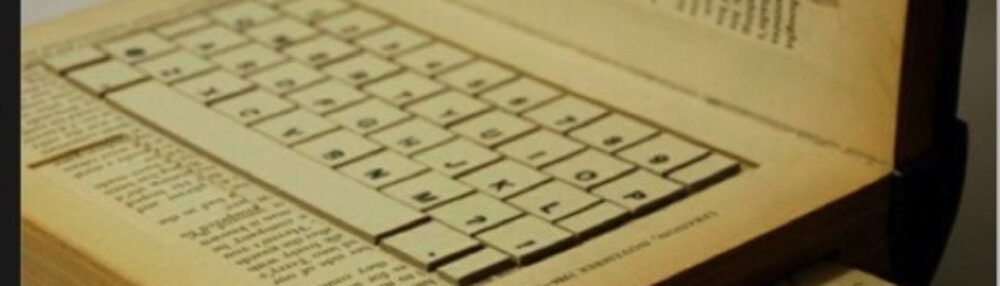
Electronic Literature and AI
Scott Rettberg mentions, “poem and stories that are generated by computers, either interactively or based on parameters given at the beginning,” as a form of electronic literature (Rettberg 172). Does this sound familiar? Because to me it sounds like A.I. Rettberg even goes on to say that these generators, “stretch back to Christopher Stratchey’s 1952 M.U.C. Love Letter Generator” (Rettberg 172). So if this stretches all the way back to 1952, why is A.I. only gaining mainstream attention and gathering worry from the majority of people today?
The first reason is AI is more accessible today. You don’t have to know any code to create an AI generated piece of work, because the AI itself is already made by others. It is now in a digestible form for most of the population that has access to the internet. It’s like when Gutenberg’s printing press vastly improve literacy rates, because the material became more accessible to the masses. it also wasn’t being used by big corporations to ‘optimize profits,’ which is just a codeword for ‘we actually think AI can replace human jobs, even if most AI is actually more costly for us.’ Fear-mongering, if one will. AI, at least to my knowledge, was not being actively used against the majority of the population in any noticeable way.
Instead, in regards to the paper and the 1952 example, it was a tool for creativity—an experimental tool at that—that did not replace a human in any meaningful capacity, because the human was involved in making the AI itself and the prompt.
So what do we do now? Well, we take the tool back and thus our power back to use it the way we want to (not a replacement, but a tool), and also try to make laws surrounding AI use. Regulations are needed, and people have a right to know when AI is used and where specifically it is used.
Dr. Bookworm and Sierra Beggs on: De revolutionibus orbium cœlestium and Stanford
As a bookworm with a PHD in 16th century Renaissance codices, I can tell you that this first edition of the first part of Copernicus’s, De revolutionibus orbium cœlestium, is a spectacularly tasty specimen. When I took my first bite, I easily recognized the vellum outer cover (a typical material used for covers when this book was published in 1543) stretched over some kind of wood. The spine also includes the name of the book in gold gilded letters.

Next, I delicately ate through the front cover, right below the bookplates with surgical precision (so as to not damage the bookplates, so I can further investigate them). I find there are three bookplates present. The first looks to be a family library crest that includes a crown and the writing “Ex Libris Marchionis Salsae,” in an almost cursive-like font. This is the bookplate of Giovanni Domenico Berio and his son Francesco Maria (Salsae Bookplate). The second is a family crest with two angles on the side of the crest along with a crown above the crest, and the motto, “Comme Je Fus” (Ward book Plate); This is the bookplate of William Ward, the third Viscount Dudley and Ward. The final bookplate is a Stanford book plate detailing the book as part of the Newton collection, with a note it was a gift from Alfred W. Van Sinderen, and a subsequent stamp denoting the withdrawal of the book from its library.There also seems to have been some kind of rectangular paper on the back inside cover that, for now, is lost to time.


Above the bookplates I process some newer paper in my gut that signifies some more information about the piece, and also on the other side in relation to the corrections made by (my mouth can’t quite make out the full name) K. Paul III from the Holy Office. The note rewrites all of the Latin corrections in one spot, but does not translate them. And right underneath this includes more on Copernicus’s life.


The book was gifted to SDSU in 1991, as stated on the donor page accompanying the book, by The Friends of the Malcolm a Love Library. The book is mostly in Latin, but also includes some Greek. And the church edits are in Church Latin shorthand. The publisher is Vittembergæ : Excusum per Iohannem Lufft, and the editor is cited to be G.J. Rhäticus (SDSU Special Collections). Although there also seems to be another publisher: Norimbergæ apud Ioh. Ptereium, Anno M. D. XLIII. But I believe Vittembergæ : Excusum per Iohannem Lufft is actually the printer as Excusum can be Latin for “to print” or “to forge” (https://www.latin-is-simple.com/en/vocabulary/verb/3773/). Either way the translation for the places cite the book being made in Germany. The back half of the book is more pristine than the front half, particularly a little bit after the famous page with the solar system diagram. Signatures are also present on the pages.

Some pages took longer than others to chew through, which means they are of varied thicknesses. Faint horizontal lines on the paper and the taste of fibers—which are also visible to the naked human eye—leads me to believe the paper is of the cotton-rag variety.

While making my tunnel I noted water damage on some of the pages. When going through the binding it is also obviously bounded by some light blue-green thread as well as tan thread, and is made up of multiple folios gathered together. And there are signs of other bookworms studying the pages of this book.


While the typeface is Roman, the ink itself pools in different places. This points to the use of a Gutenberg-like printing press being used, due to the ink being spread by hand (A video showing the process and similar ink pooling). The ink is black for the main text, and for the edits and corrections done by the church the ink is red (now a more rusted red-brown). There are also signs of the red-brown ink in multiple other places in the book.


Most sections also include an Ornamental initial lettering of the inhabited variety that includes cherubs and other figures. The book also contains various tables with data in them, the lines never quite matching up perfectly. But this book also has some amazing examples of geometric printing done for the complicated diagrams explaining the math.


Some other interesting quirks about this particular book I found includes some kind of fiber—maybe even hair—stuck to the ink on one of the pages and looks as if it is even coated in the ink. There is also a stray thread sticking out from one of the pages that seems to match the tan binding thread. There is also a page where I got a mouthful of red-brown ink due to what seems to be an ink spill of some sort on one of the pages. Stanford also added a seal on a couple pages. Lastly (even more curiously) there seems to be a page ripped completely out of the book.


Finally, the content of the book, which while all in Latin—and some Greek—is about our solar system and Copernicus’s findings in relation to a Heliocentric system along with the revolutions of the planets around the sun (also includes the moon around the Earth).

I will now pass the mic to my research assistant at SDSU—Sierra Beggs—for further postulation. Now, one particular feature I found particularly interesting is the embossed Stanford seal mentioned previously by Dr. Bookworm. First, it is important to try and pinpoint when Stanford had the book.
Stanford acquired the book as a gift from one Mr. Alfred W. Van Sinderen sometime between 1945 and 1990. Since Van Sinderen graduated Yale in 1945, and subsequently went to Harvad to get a business degree, it is more than likely to have been sometime in the 1950s-1980s (Yale Van Sinderen, Life of Van Sinderen, Death of Sinderen). Since it is a rare item, it would make more sense for it to be acquired by him and gifted to the Stanford library after becoming more established. But the main point to be made is that the seal itself shows that during this time in Stanford history, ownership of a rare item—and the knowledge inside—was more important than the item itself, instead of an item to be preserved it became a status and power symbol for an ‘elite’ institution.
There is no doubt that Copernicus’s work was revolutionary. His heliocentric solar system became the center of our understanding of our solar system in the present day. It is an invaluable piece of history that needs to be preserved, especially this first edition copy. Stanford already had a bookplate taped on the inside of the front cover, so why use an embossed seal on these precious pages? While inkless, an embossing seal still creates an indelible impression on the front and back of a page, one raised and the other indented. This is an alteration that changes the physicality of the paper. It is something that is irreversible without further damaging the book. This permanent change does not seem to be done for the sake of preservation, but solely to mark possession of the book and leave a mark of prestige.
The seal itself proudly says “STANDFORD LIBRARY,” and includes their famous sequoia tree in the center. It’s a stamp that leaves no interpretation on whose stamp it is, and the all caps gives it this booming effect. It is a stamp that is obvious and forthright. At this point it is more than just saying ‘it’s in our collection,’ but a trace purposefully left to exude a ‘mine, mine, mine,’ mentality. And later down the line when other people flip through its pages, it gives a, ‘look, this was mine once’ mentality. People will—in no uncertain terms—know that the Stanford library once held this piece of history. It’s a very showy way of claiming the book, and one that screams ‘I’m better than you, I’m allowed to mark this piece of history permanently.’ A sign of power. That they have the power to make this mark.
On top of that, if the pages chosen were damaged, then the pages are either deemed as not important, or possibly more important. It is not just marking one, but two pages due to the indentation nature of the seal. All of the seals are in the later half of the book, which is in more pristine condition than the pages in the front half; this is because the front pages seem to have been handled more than the back pages. Stanford, thus, could have believed that the back half must not be as important as the front half of the book, and chose these specific pages for this reason. It is more likely that these pages were deemed as unimportant, and thus ok to be damaged for the seal. After some digging, the first page the seal appears on is the last page of book four chapter three, and the beginning of chapter four, “The moon’s revolutions, and the details of its motions” (Rosen 208) . And also occur on the very last page of the book, which is about “Computing the latitudes of the five planets” (Rosen 379). This could also be evidence for the importance of these pages, as one involves the moon that revolves around us, and the other is the very last page of the book. The moon itself is the closest nonhuman made celestial object to us, which could be seen as very significant. And the last page denotes the end, something Stanford may have wanted to claim—the end of the book as a final calling card. That, in the end, Stanford will be remembered and its prestige will carry on forever.


Overall, the seal is unnecessary, there is no reason that Stanford needed to use an embossed seal with their library’s logo that would aid in the preservation of this historic object nor in the study of it. Instead, it can be seen as a desecration—while it is a part of this specific copy of Copernicus’s book, and thus the book’s history—it does not make it something that was absolutely necessary. The bookplate at the front was enough, even if Stanford was afraid of someone stealing it—which again is about ownership—that did not translate to marking the book in a permanent capacity.
Further points of study are needed to really flesh this idea out. I would like to reach out to the Special Collections at Stanford to inquire about the origins of when the seal was used, when it stopped being used, and if it is still in use today. It would also be interesting to see when exactly they had the book, as it is a rare item, they most likely have archival records on when it was donated and when it was withdrawn. There is no information on their archive site on it, so it is something that requires a one-on-one chat with someone in Special Collections (specifically the Newton collection, because that’s the collection this book was a part of during its time at Stanford). (It would also be cool to translate the Latin Church short hand, just to see the actual reasons the edits were being made—especially because the diagram with sun in the center wasn’t crossed out.) And that curious fiber/hair could also be an interesting point of study. Could it be from one of the workers working on the printing press? Is there any possibility of it being Copernicus’s? (probably not) Or maybe from the church official making the corrections? Lastly, was there really a page ripped out? Was it a mistake? Why was it ripped out and what was on it? All of these are questions I will try and continue looking into.
Now enjoy a couple of photos of me at Special Collections :).


(P.s. I will add the proper MLA citations [not just the links] when my migraine is actually gone.)
Book or Game
Being woken up early in the morning, with pajamas trailing past my toes, and hands eager to rip through presents wrapped neatly under the Christmas tree, little did I know I would be unboxing a book. While this “book” took the material form of a Nintendo Wii, the medium adhered to the aspects of books we recognize today. Taking thoughts from Scott Rettberg’s “Electronic Literature,” and personal anecdotes involving my gaming/reading history, the book will be compared to the console, displaying that both mediums carry a similar purpose.
Since I first got a Wii, if I had known I’d be able to excuse my screentime as reading time, I would be in a much different position than I am now. To back this statement, I draw a quotation from Rettberg’s work stating, “According to Bolter and Joyce, ‘all electronic literature takes the form of a game, a contest between author and reader.’” While they don’t outright state that Lego Indiana Jones is a form of electronic literature, the interaction between author and reader remains similar. A story is presented, then contested by the reader through their action of playing, and eventually leads to new thoughts or ideas emerging, such as the author’s intake of critical reviews or me saying, “Dad, can you please get me Lego Indiana Jones 2?”
This idea of a collaborative narrative, which relates to most games, is explored as one of the examples of electronic literature that Rettberg presents. In the description of the lengthy examples, Rettberg notes the list could be endless, and specifically cites that as the point of the list–to be endless. So, the question of if a game is a form of electronic literature becomes obvious, ensured by the limitless possibilities. Instead, as Rettberg notes, the question becomes, “How precisely do computer art installations ask viewers to read them?’”
In the case of the intermedia example, Lego Indiana Jones, it then relies on the author’s intention. Did the developers directly ask people to treat it as such–a story told through a game, or was it just a “mere game,” which is the risk of many intermedia examples? I don’t have a direct answer for that, though I do believe it relies on another factor–the reader’s perception.
At that age, did I understand I was reading in a visual format, or did I just see it as gaming? Though even if I didn’t understand that, am I still a reader, or simply a gamer? As the lines have blurred, and will continue to blur, I believe it shows how intermedia redefines our idea of “reading” and our conception of what is book material. Sure, I was just playing a game, but at its core I was engaging with a long line of authors producing material to be read. With that said, maybe my brother reads more than I.
Readership’s Evolution
For many centuries, authors of centuries ago were tasked to write with two objects: the stylus and the document. Though before even writing, the author knew the work was constrained by whichever document or medium they chose. In ancient Greece, that document could be wax or papyrus. In ancient Egypt, it could also be papyrus. This is to say, the setting and time largely determine the capabilities of the document, as well as the reproducibility and interactivity. In the midst of our digital era, the document has transformed, allowing the largest breadth of capabilities known to humankind. In doing so, our readership has been changed, though not forgotten.
The days are mostly gone when people begin writing manuscripts by hand. Whether it’s a public desktop at the library or a personally owned laptop, most writing relies on digital products. This is espoused by a study from CNET showing that over 50% of adults get their work done via laptop. So, already, the game has changed. Instead of digitizing older texts, the new norm is to make digital products physical.
With this change, authors are able to open endless doors of possibilities. Like artists’ books, authors use their medium to their advantage, for example, the novella Pry with its acclaimed cinematic experience. And while it may diverge in qualities from the typical books we’re taught in school, it is a prime example of the capabilities of electronic literature. Further, it touches on the line from Borsuk relating, “the extent to which any book is a negotiation, a performance, a dynamic event, that happens in the moment and is never the same twice.”
As claimed by Borsuk, reading indeed takes the form of a negotiation, rather than a one-person operation. Though with the modification of the medium, has reading changed, or rather, been stripped of its essence? While this seems to be a subjectively answered question, take one example, of books measuring length in “read time.” Rather than judging by the words on the page, the reader is judging by minutes left, which, previously to now, was an unknown factor. Now, with the adoption of audiobooks online, students may judge their workload on how fast they can sit through a YouTube video at 2x speed, rather than the amount of words on the page. In that regard, gone is the aspect of leisure in reading, and in is the time-crunching factor of stress.
Readership may be changed, though a book will always require a reader. Whatever form that may take in the coming years is sure to be different, as comparison continues to show, and the difference is determined by the medium.
Week 10: Electronic Literature
Electronic literature is a rapidly growing field that combines writing and technology. As Scott Rettburg explains, the term broadly refers to works with “important literary aspects that take advantage of the capabilities and contexts provided by the stand-alone or networked computer” (Rettburg). Electronic literature is more than text stored within a computer, it is literature that could not exist without digital technology. Like all of our words, the definition has evolved and changed. Before the 1990s, “electronic literature” often meant texts in digital form, such as online articles. However, authors and scholars began using the term to describe works of art/literature designed specifically for computers, such as hypertext fiction or interactive digital poetry. Boruk taught us that material influences content, and the same applies to electronic literature. The computer and specific software platforms directly influence how we interact with various texts: “The platform in electronic literature constrains and affords practices in a material-and some might even say determinative-way” (Rettburg).
Rettburg uses the example of “guard fields in a Storyspace hypertext or tweens in a Flash poem has a very specific aesthetic effect on the way that a reader interacts with and perceives a work” (Rettburg). Just as the tablet evolved into the scroll which eventually evolved into the book as we know it today, electronic literature will continue to evolve as technology advances. Electronic literature is yet another reminder that reading and writing is never static, but rather the form, style, and experience is constantly evolving alongside the tools we use to do so, physical or digital.
Biography of a Book, A Nievve Herball, or, Historie of Planets
Dodoens, Rembert, et al. A Nievve Herball, or, Historie of Plantes : Wherein Is Contayned the Vvhole Discourse and Perfect Description of All Sortes of Herbes and Plantes, Their Diuers and Sundry Kindes, Their Straunge Figures, Fashions, and Shapes, Their Names, Natures, Operations, and Vertues, and That Not Onely of Those Whiche Are Here Growyng in This Our Countrie of Englande, but of All Others Also of Forrayne Realmes, Commonly Used in Physicke. Translated by Henry Lyte and Carolus Clusius, By Me Gerard Dewes, dwelling in Pawles Churchyarde at the Signe of the Swanne, 1578.
This edition of A Nievve Herball, or, Historie of Planets, originally written by Flemish physician and botanist Rembert Dodoens, was published in London, United Kingdom in 1578. It is a herbal book, a book that describes plants and their uses. The text is in English, translated from Dutch via French. The cover of the herbal uses the three quarter bookbinding style. The spine and about three quarters of the cover are covered in one material, in this case a thin layer of vellum, while the remaining part of the cover is made with a different material. The vellum appears to be cracked, worn, and peeling in some places. On the left of the front flyleaf of the herbal, a large, vertical signature can be found.

The title page, featuring an elaborate historiated woodcut border, has a section missing, appearing to be cut out manually. Illustrations throughout the herbal are black and white woodcuts by Arnaud Nicolai after drawings by Petrus van der Borcht.

On the verso, or reverse side of the title page, is a coat of arms of Henry Lyte, the translator of this edition. A few pages forward is a portrait of author Rembert Dodoens.


The pages of the herbal are made out of rag-paper, used between the 13th-18th centuries in England. The rag-paper pages are discolored and browned, especially around the corners. This could be due to various reasons such as light exposure, oxidation, or humidity.

Book worm holes can be found throughout the pages, however, they are more concentrated in the front section of the herbal. Each section which describes various plants or flowers features a woodcut print.

Additionally, each section of text begins with a black and white initial, known today as a drop cap. There are inhabited, floriated, and foliated initials throughout the herbal. The text itself is a blackletter typeface, or gothic.


The pages of the 1578 edition of A Nievve Herball, or, Historie of Planets by Rembert Dodoens are far from the perfect, blank white pages we see in our modern books today. The pages of Dodoens’ herbal are discolored around the edges and spotted brown, with a trail of holes book worms have left behind. Before the wood-pulp paper, most commonly used today, was invented, book makers used rag paper made from linen and cotton fibers. This material is both resilient, able to preserve itself from 1578 to 2025, but also vulnerable to light exposure, oxidation, and humidity. The narrative of a book is more than just the words inside, but can be found in the physical materiality of the container itself. In our contemporary moment, when books are mass produced and easily bought and sold, we are disconnected from the material history of the book. It has become easy to think of books as static containers of text, rather than organic artifacts. The wormholes and discoloration in A Nievve Herball, or, Historie of Plantes reveal the book as an ecological record, revealing how time, environment, and organic decay shape its material identity and the story it tells. These marks not just damage, but serve to remind us that books are more than a static container of text. To be able to truly read this book, you must look beyond the words, and unto the pages that hold them.
The “damage” on this copy of A Nievve Herball, or, Historie of Plantes, is what makes it unique, bearing its own story to tell. The discolored pages and wormholes transform it from one of many identical copies, into a unique artifact with its own biography. The marks we are able to see with the visible eye tells a history, without having to read the words at all. This copy is made with rag paper, a process of paper making that uses cotton and linen fibers to create the sheet. This kind of paper making was used in England between the 13th and 18th centuries, before the wood pulp paper we most commonly use today was introduced. Rag paper is a resilient material, as seen through this copy which has been preserved for 447 years. Despite this, it is still vulnerable to light exposure, oxidation, and humidity which has allowed for the discoloration and worm holes to form within the herbals’ pages.
However, the discoloration and holes are more than mere signs of deterioration, they are evidence of the papers continuing life. On the surface, the bookworms that created these holes may be seen as purely destructive, yet, their presence should be viewed as an accidental annotation or marginalia. In chapter 2 of Borsuk’s The Book, she writes that “in addition to minute differences in the binding, each book copy will contain marginalia and other residues of reading that adhere to them thanks to their individual history of ownership and circulation” (Borsuk, 76). The bookworms are now a part of this circulation. Similar to marginalia designed or written by human hands, the wormholes give us a deeper look into the life of the book itself; the human labor that created the pages and the natural processes that have continued to shape it. This herbal has many credited contributors; the author, translator, printer, bookseller, woodcutter, artist, and now the bookworms. The physicality of the book itself tells a story that is over 400 years old. The wormholes reveal and deepen our understanding that a book is more than its text, and one that is never separated from the living world that interacts with it.
By studying the current condition of the book, the physical deterioration of the pages reveals a narrative in itself. The changing colors and textures tell us about when it was printed and published, but also a story of its survival throughout centuries of human and environmental exchange. The visible deterioration of the pages challenges the notion that the book is a fixed vessel of information. We tend to imagine books as timeless, unchanging places of storage, which is tied to their authority. However, this edition of A Nievve Herball, or, Historie of Plantes subverts this notion. The discoloration and wormholes found throughout the pages show the instability of the medium itself. Our vessels of textual information are subject to material transformation, despite how we may envision them. This shows us that reading is not a passive consumption of information, but a collaborative process between us, the environment, and the material.
The discolored pages and wormholes of Dodoen’s A Nievve Herball, or, Historie of Plantes invites us to reconsider what it means to “read” a book. In order to understand the history behind this edition fully, you must read beyond the printed text. You must read the pages themselves. The stains, the blemishes, and the holes complete the narrative. It is one that reminds us that books are not static containers of text, but living and evolving artifacts that are constantly changing, decaying, and gathering increasing amounts of information. In an age when books are mass produced, the physical condition of Dodoen’s herbal challenges our modern detachment from the materiality of the book, pushing us to see the “book” as part of a larger ecology, as more than a vessel for information.
Digital Media, A Screen and Page
After seeing the video, A Screen and Page I honestly thought it was really neat and rather interesting. I have always heard of augment reality and how it can help with a lot of things, but I do think this is pretty smart. The computer glasses read a “QR” like code which are hieroglyphs that the computer reads and then a text pops up which tend to be poems, short stories and such which I find very accessible, yet not as accessible.
I say that it is accessible, yet it isn’t because not everyone can afford augment reality glasses with a computer that is able to run the software properly. I also find it very ironic how we still need to use a book in order to have this screen and page thing to work even though society is doing their greatest efforts to go fully digital. It reminds me of previous class discussions about how technology is always looking to better itself and make itself new but always having to rely on physical book aspects to maintain its identity and proper use. Examples such as bookmarkers still being used in digital media, highlighting, annotating, circling and such. I do think the concept is really interesting and intriguing.
A Screen and Page is fascinating because it begins to make you wonder as to how this piece of literature is classified. The formatting, structure, and such are all experimentally done well and it goes to also show that literature in general is experimental, and I do believe we should play around with it more. Like our discussions and how Pressman mentioned in previous classes, there is nothing stopping you from creating a book however you want. Having this kind of mindset has me excited to see other various forms of digital media and how we interact with it as well as to how maybe one of us can create a neat book that changes how we perceive books in general. My only scare and complaint about digital media is how will AI play a part in it all and if people use AI to write their stories, then who do we call the author? The person who put the prompt into the machine, or the machine that pumped out all the words and ended up calling it a “story”? Many interesting questions and conversations to have around digital media and why it is important in today’s time.
MIDTERM – A 16th Century Renaissance Beauty
Part I.

Many of the books that I encountered during our visits to special collections were interesting and very much fascinating, but not as fascinating as the 1554/60s Latin text, Four Books of Rhetoric addressed to C. Herennius / by an uncertain author. Cicero’s/ revised by Paulus Manutius, son of Aldus which translate from its Latin name Rhetoricorvm ad C. Herennivm libri IIII / incerto auctore. Ciceronis … / corrigente Pavlo Manvtio, Aldi filio. One of the oldest if not the oldest Latin-based text that talks about rhetoric and how it was designed to help students create a more powerful speech for themselves. It is a four-part book in which is part talks about a specific rhetoric technique that can help shape your thoughts and emotions as you talk to someone. The author is claimed to be Ciceronis, but there are claims from people saying that he only simply added specific parts of information and that this is simply a compilation of works.
The book is small around 5.5 inches length with a width of 4 inches which deems it as an octavo formatted book and that tells us that this book was designed for more personal use and easier portability. Its cover has been replaced a few times, and we can see that from not only the different color scheme, but also the spine which has multiple different textures with different colors that do not correspond to our cover here. There is also a bit of writing on the bottom of the spine, but I was not able to confirm nor make out to what it was, but I did find it interesting how we are still able to see some of the spine’s lettering regardless of its readability.
The only damage and tear that the outside of the book had was mainly on the spine and we can see it from the top of it where there are 2 different types of materials being used which is most likely animal hide over a pasteboard or piece of wood. The bottom is flaking quite a bit which starts to show the wood like material used for its spine and cover.
How is the spines condition doing? Well, honestly, not too great as the spine will start to crack if you open the book too much which made it difficult to fully open and examine the book, but it is very understandable as to why we cannot open it fully. Due to it being a book that talks about how you can master speech, craft persuasion and such; it’s no wonder many people used this book back in the day and its worn-out spine is the clearest clue as to how many times it was opened and used.


As for writing or markings within the book, there seem to be only writing numbers from the SDSU special collections library which makes sense, but there is one really interesting thing that I cannot wrap my head around. That is the fact that one of the owners decided to color the publishing logo’s anchor orange/brownish which can be seen on the first page of the book when opening it. There are also really dark circles with heavy ink next to the logo as well as another hint of that orange on the top of the page as well. As for illustrations, that is quite literally the only one which is Aldine Press’s logo who are a famous publishing company known for enjoying and reviving classic literature from Greek and Latin stories as close to their original form and storytelling so that modern audiences can enjoy them. Essentially, the cared about persevering books and keeping it authentic to the source material so much so that you knew you had an official copy from them because the book would not have a stench. Speaking about it having a stench, we of course at SDSU have an official copy, and I did confirm that the book does not have a bad stench; in fact, it has a rather dirt like smell to it, but nonetheless, it goes to show how companies cared about preservation because this book is almost half a century old and it does not stink at all!

The book is also bounded by hand using a thread to sew between the pages and the spine. Aldine Press was known for their mixture of technology and hands on creation in which the print was being pressed on the paper while the rest of the book like its cover, and spine were handled by hand. Not only would they be bounded by hand, but the company would allow custom covers to be ordered. Sadly, this one has gone through many different renovations so we will never know if the owner ever ordered it in a custom way or if it just remained with the normal cover that all the copies had.
Part II.
The most interesting thing about this book is the fact that its margins are more than an inch, and the text itself is literally 60% of the pages size. You would think that the page would be filled with letters, but no, its most margins taking up the space which is neat because I would personally want a book this small for its accessibility and I don’t think I would have assumed that it had this much marginal space. It almost seems as though the text is inviting the reader to join the conversation and talk with it, which is so interesting because this is a book that teaches people how to talk in a more critical way.
I could not open the book fully, but there were multiple pages where there were book worm sightings. From the very beginning of the book to the very end, and we can see that the book worm really did dig through a good number of pages. Other than dirt, water and similar stains, book worms were often the hallmark of this book’s “blemishes”, and I think that’s pretty nice because it goes to show how the owners took care of it and how great the material is to a degree. There are other editions of the book in which they have some of the four copies inside the book or all of them such as this one right here. There were none that had a translation inside


As opposed for the copy being modified or have any writing marks on it. There seem to be none and the only “markings” I could find were just corners of the page folded which seems as though someone was reading it and decided to “bookmark” it in a way so that they may continue reading it at a later time.
The text is a Latin rhetoric book that teaches students how to argue, deliver speeches better, have better communication in general. It was widely used during the Renaissance time period and was often regarded as the book to use in school to teach to students. Considering that this is one of the oldest texts in Latin, we must also remember that this is also one of the earliest books that talks about rhetoric which makes it an extremely valuable piece of work for that time period and for the future.
I also do believe that the margins reflect a rather personal use for this book since it is a book about self-improvement in a way. The margins being more than an inch wide is what caught me by surprise because with a small book you would not want the margins to be that wide. You would want the text to fill the page and perhaps be a bit bigger so that you can read it clearer on the go. Ultimately, I can see students reading this book when going to school or simply having it on them to study one of the four books since this one book.
One final thing that really fascinated me from this book was the formatting and structure of certain pages where the text seems to just take its own form sometimes. I couldn’t make the correlation between the formatting and the content itself, but I found it rather beautiful and mesmerizing to look at which fits the standards of the Aldine Press where they would want to make their texts correspond to beauty itself.

Google Document if pictures do not load: https://docs.google.com/document/d/1WA-LfcTbBIUQa-FYXQ1VbLDSQPTHxJKcNq0qOWEd2aw/edit?usp=sharing