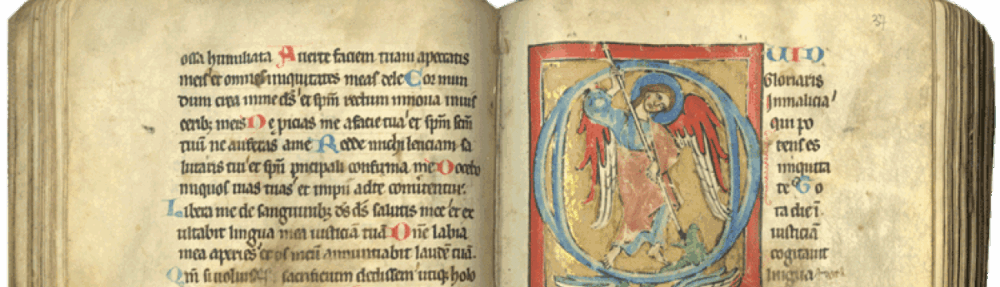
The Book as a Body

Sometimes I forget that a book is more than just words on paper. While reading chapter 2 of The Book, however, I came across Borsuk’s description of the codex as if it was a human body, with a spine, a head, and even a tail (p. 77), which reminded me that books are more than just that. At first this sounded almost funny to me. Why would we talk about a book like a person? But the more I thought about it, the more it made sense. If you take a closer look, a book is not just a neutral object. It is something we interact with, hold in our hands, and even treat with a certain care, as if it had its own presence.

This made me rethink my understanding of reading. Usually I imagine reading as something between me and the words. But Borsuk makes clear that it is also something between me and the material form of the book itself. The hinge of the cover, for example, gently pulls the first page open, almost like an invitation. That small detail makes the book feel active, as if it greets us which suddenly makes reading look less like purely consuming content.

I also thought about how this comparison points to the life story of a book. Just like people are shaped by their environment, books are shaped by many forces before they even get to us. The author gives them their voice. The publisher and designer choose their appearance. The printer turns them into a physical object. And then, once the book is finally in the world, readers add their own traces. Names on the inside cover, underlined passages, folded corners. All of these leave marks like experiences leave marks on a person.

When I think about books this way, they stop looking like static containers of text. They start to look like companions that carry their own history. Every copy has grown through different stages, passed through different hands, and therefore carries something of that process with it. To read a book is not just to read words, but to meet something that has already lived a kind of life.

In the end, Borsuk’s description made me realize how much more personal reading becomes once you see the book as a body. It is not just information to take in. It is an encounter with another form, one that has its own presence and its own story, waiting for us to open it.

Books as an intimate object

The Renaissance inaugurated the age of books, at least among the aristocracy, and many of the features we now associate with the codex arose in response to the boom in silent readership” (p. 54). Oral literature originated and refracted from the idea of providing a sense of community—it preserved traditions of the past, and typically there were multiple competing versions. There was no single “correct” version, since stories changed and evolved over time, much like the evolution of the book as an object. The book was no longer viewed merely as an artifact but as a device that contained and spread knowledge. Furthermore, because the Renaissance was a period of academic and intellectual development and curiosity, only the higher orders of society had access to books—and, most importantly, they were the only ones who had access to education, an education that gave them the tools necessary to read. For instance, books were widespread among aristocrats, scholars, and the clergy. Books also served as symbols of status, as noted by their availability “among the aristocracy.” They were not only tools for instruction and learning but also demonstrated social standing and divisions among different classes. If I were to make an educated guess, because there was a social and cultural shift in literature and literacy regarding the modern features associated with the codex, those features might include page numbers, indexes, and tables of contents. Books became tools for study and reference rather than mere amalgamations or compilations of manuscripts, serving a different purpose for a society that had shifted its values. One of the values in question is individualism over the sense of community– books and literature were no longer meant to provide a sense of community but created a space for self-reflection– making our relationship with literature private and, in some instances, spiritual and sacred. 

Reflections on Blue Humanities: Thoughts After Dr. Mentz’s Talk

Last Thursday, I had the chance to attend a talk with Dr. Steve Mentz about Blue Humanities, and it really made me think differently about water and how we experience it. What stood out to me the most was how personal and global this field is at the same time. Dr. Mentz talked about swimming in La Jolla Cove, and how each body of water has its own local culture like rules, rhythms, and even wildlife interactions. I found that fascinating because I had never thought about water as something so socially and culturally alive. Even if someone can’t swim or lives far from the ocean, he emphasized that water is still part of our daily lives. It flows in our bodies, it rains, it’s in clouds. Water connects us in ways I hadn’t realized before.

Another part that struck me was the connection between movement and thinking. Dr. Mentz described how swimming, or even walking and running, helps him work on writing, rhythm, and language. The idea that bodily movement can shape how you think or write was new to me. It made me think about my own study habits and how maybe I could find ways to learn that go beyond sitting at a desk.

I was also interested in the stories about how humans shape oceans and vice versa. From historical shipwrecks to oyster farming, the ocean isn’t just a backdrop but it’s an active participant in history and culture. He even connected these ideas to modern issues, like offshore wind and deep-sea life, showing that the way we interact with water has ethical, political, and ecological dimensions.

Finally, I loved how the discussion included clouds, ice, and rain as part of the Blue Humanities. Water isn’t just liquid; it’s solid, gaseous, and everywhere. Thinking about these different forms reminded me that water shapes so much of life in ways we often overlook.

Overall, the talk left me inspired. I realized that learning about water isn’t just about studying the ocean, it’s about seeing the world differently, noticing the rhythms and flows that connect humans, animals, and environments. It made me want to pay more attention to the water around me, wherever I am.

Week 5: Chapter 2

In Chapter 2, she talks about the book as content rather than just an object. One sentence that immediately stood out to me was the first one: “The Renaissance inaugurated the age of books, at least among the aristocracy, and many of the features we now associate with the codex arose in response to the boom in silent readership.”

I find this so interesting because it shows that silent, private reading is not something obvious or natural. Before, many people read texts out loud, often in groups. When people started reading quietly to themselves, the book had to change too. Things like page numbers, indexes, and even margins became more important, because readers needed ways to navigate on their own. It reminds me of how we now expect search functions and hyperlinks in digital texts. The way we read always influences the way books are made.

Borsuk also explains how books became status symbols in the Renaissance. Rich families had small, decorated prayer books or even books in unusual shapes like hearts. That made me realize that books were never only about information. They also showed something about identity and culture. Today it’s similar. Some of my friends love to buy fancy hardcovers, even though they read mostly online. But I get it, because it always feels different to hold a real book from holding a Kindle or a phone.

What I also found fascinating is how silent reading changed people’s relationship with texts. Reading alone makes the experience more private, almost like a personal conversation with the author. I notice this in my own life too. Reading out loud in class feels very different from reading quietly at home. Silent reading makes me think more, but group reading makes me feel more connected but also nervous.

For me, the main point of Chapter 2 is that content and form cannot be separated. Books adapt to how people read, and at the same time, they change the way people think and learn.

How can a book be a machine? 

While reading Borsuk’s second chapter, the following quote particularly stuck with me: “A book is a machine to think with.” This quote and its underlying interpretation greatly change the way we view books. A book is not a container for content, but rather a device that structures our thinking.

The chapter shows that our understanding of books changed with the invention of printing. Borsuk describes how early printed works introduced aids such as page numbers, indexes, etc. These elements have a clearer purpose than one might think. They are precisely the “mechanics” that make the book a thinking machine, because they allow us to organize, look up, and link knowledge. Borsuk also emphasizes that the codex is a body, with a “spine, head, and flyleaf.” Just like a machine, it has parts that interact to perform a function. Thinking is therefore always bound to a physical structure. 

The book as a machine becomes clear above all through the reader. Even in the Renaissance, readers marked passages, wrote comments, and copied individual passages. They actively operated the machine, thereby releasing knowledge. The book therefore does not work alone, but in interaction with the reader. But what does it mean for us if books are machines? Operating machines is complex, and so is reading books. We first have to learn how to use a book properly. 

For me, this also raises the question of how books from special collections make us think differently than ordinary books. No two machines are the same, and the same is true of books, scrolls, e-books, and other forms. For me, this means that thinking is a collaborative process that depends on the author, reader, and medium. And perhaps that is precisely the strength of the book: it encourages us to actively operate the machine instead of just letting it wash over us. 

Week 5: Morph as Content

Amaranth Borsuk defines the book as “a portable information storage and distribution method” (The Book 1).The History of Reading Working Group (William Warner et al.), part of UC Santa Barbara’s Transliteracies Project, reads these methods across time through In the Beginning Was the Word: A Visualization of the Page as Interface (2008). The Flash animation, now archived as three video simulations, “represent[s] the morphs of the page over the past 1,400 years” through “the first fourteen lines of the Gospel of John.”  I examine the connotations of the term “morph” in the context of Borsuk’s materiality studies.

I was curious about The History of Reading Working Group’s use of “morph” as a noun, which I had only been familiar with in evolutionary biology contexts. The OED lists the meanings of “morph” as “The action, process, or technique of changing one image into another by morphing; an instance of this” (first attested in 1991) or as “An image or character created by morphing”, particularly through computer manipulation (first attested in 1992). The American Heritage Dictionary of the English Language offers the additional meaning of “An allomorph” (2022), suggesting the morph as a multiple variation of a linguistic element. The OED’s examples show the morph’s prominence in discourses of computer art and digital literature from the 90s. The term frames digital media’s linguistic and visual transformations as physical metamorphoses, asserting the materiality of digital media and language.

In the Beginning Was the Word presents a sequence of morph, with its own .SWF (“john-morph.swf”) and video files representing more. The biologic connotation that is remediated in digital uses of “morph” – “each of the different forms exhibited by an animal or plant in the course of its life cycle” – presents the digital morph as one “form” in a broader media ecology (“Morph, N. (4).”). Approaching In the Beginning Was the Word as “morphs” characterizes the page, and book technology, as a multiply evolving type of body. Framing books as biological morphs frames books as biologically or ‘naturally’ mutative.

The “natural”, though, is defined through contemporary natural science’s own morphs of Enlightenment codifications. If we approach the page through a natural science framework, we need to grapple with the politics of that framework, or we risk “naturaliz[ing]” the book’s political imbrications (Borsuk 109, 1). As Borsuk writes, typography mediates “the legacy of othering embedded in language’s form” (93). Following Borsuk’s definitions, we must read the page’s morphs not simply as “content,” but as “objects.” When approaching objects in Special Collections, I’ll pay closer attention to design, including typography, as signifiers of sociopolitical contexts.

Post is no good this week as I feel like I’m under two feet of municipal hard water & I think the other 600 words made no sense. Vaxx up & mask up !

Is that true?

When I read Borsuk’s line that printing “reframed the book as content rather than object its form a mere vessel for the information it contained,” (p.57) I felt both curious and uneasy. The word mere makes it sound like the physical book is almost worthless, just a container for words. But is that true? When I think about my own reading, I don’t see books as “mere vessels.” I always notice their form. A book’s cover, the texture of its pages, even its size makes a difference. A small paperback I can carry in my pocket feels different from a large hardcover I need two hands to hold. Doesn’t the way a book looks and feels affect how you read it?

On screens, though, every book looks the same. Kindle, Wattpad or any reading app makes text uniform, black words on a glowing background. In some ways, that’s convenient the story is all that matters. But sometimes I wonder, does this sameness flatten the reading experience? Do we lose something when every book feels identical?

Interestingly, digital reading has made me appreciate physical books more. I love seeing a shelf of colorful spines or picking up a book with unusual design choices. Publishers know this too they release special editions with decorative covers or unique layouts to remind us of what makes print special. Isn’t it funny that screens, which were supposed to replace books, have instead made us value their physical form even more?

So I come back to Borsuk’s phrase. Maybe in the early days of printing, the book was treated as a vessel. But today, I think it’s both vessel and object. Books carry words, yes, but they also shape our experience of those words through their form. They are not “mere” anything they are living companions that travel with us, change us, and remind us that reading is always more than just content.

The Book as Content

Throughout this class, and especially while reading The Book, I realize how lucky we are as reader’s of today’s books. Reading through how books and the presentation of their content has changed has taught me how much of how we expect to read is actually new, and it makes me a bit sad to realize which practices have been lost in favor of ease of access and consumption.

Until the mid sixteenth century were shelved with inward facing spines, with their edges facing out, each distinguished by designs on their edges (Borsuk 81). What a lost art! Of course anyone could go into a book store and find books with sprayed edges making them look beautiful and rare, but those books would likely be few, or part of some special edition only sold for a set period of time. Books with distinct and decorated edges are not common enough today, if I were to flip all the books on my shelf backwards I’d only be looking at column of papers, risking a papercut anytime I wanted to pick one out. However, ss Borsuk describes, this change from out facing edges to out facing spines came out of necessity, “readers became collectors whose ever-expanding libraries served as displays of both intellect and wealth, that books were shelved with their spines outward to showcase their bindings…a feature of the codex we now take for granted.” (81). The progress of the book is the progress of the reader, instead of their fore-edges book spines become detailed in order to showcase information relevant to a reader who now owns a multitude of books, as the needs of the reader change, the book must change. The book evolves and becomes portable to, “show off one’s literacy and wealth,” the book changes and becomes a gift as “a symbol of great kinship,” and the book explodes into a catalyst of transformation to change readers, “by what [they] have read.” (82, 84).

The changes of the book has undergone have resulted in the book being amazing devices, being of reasonable weight and size for transportation featuring informative and pretty spines, and featuring plenty of room in their margins for annotations. But they are not perfect yet, they will undergo more changes and adaptions for the needs of readers now and readers of the next generations. In the future perhaps books will all be made from recycled paper, to support sustainability, or there might finally even be mass produced glow-in-the-dark books for readers who would like to read in the dark but not from an illuminated screen, only time and the desires of readers will tell how the book’s presentation of it’s content evolves.

Book as Content

As we have grown up in a modern world where the most common book is cheap paper bound together by glue beneath a cheap cover, it can be challenging to undo our orientation to what qualities we expect to be “normal” of the codex and typical to the reading experience. Before this class, I was aware of “book history” as a field of study, however, knowing little, I never anticipated how our interactions with and expectations of a book reflects and constructs meaning. Though these biases may be unconscious, they reflect Borsuk’s observation that “Our conception of the book and access are intimately shaped by the shape it takes.” (Borsuk 89). With content, form, and format being inseparable entwined with each other, Borsuk acknowledges how the material form of the book as an object influences our interaction with the book as a form of content that contains information within its vessel. 

Something I had not recognized within my own perception of the codex was addressed in Chapter 2 of The Book as Borsuk makes note of how we often consider books that are larger as more valuable. Reflecting on our visit to Special Collections last week I can now recognize how in handling the archives I did view the Torah scroll and the very large book with the wooden cover (I am drawing a blank on what the book was called) as more valuable or as deserving more care than some of the smaller books like the artist books. Intrinsically, I felt the size and more elaborate nature of their materials like wood and metal deserved more reverence. In contrast, the small nature and more common materials used in the other books felt more casual and approachable because of their similarities to the modern book, which is why they didn’t feel as significant. 

Through this experience, I better understand my orientation to the book and Borsuk’s emphasis on the importance of shape. Without knowing or understanding the contents or histories of these different artifacts, my mind followed social and historical constructions that larger items demand more authority and legitimacy partially due to taking up more space. Therefore, form and format impact content as our instinctual need to judge a book by its cover provides the framework for how a work’s meaning is interpreted and the medium is integrated into the book’s message.

The Press’s Redefinition of The Book As Content

Amaranth Borsuk’s second chapter, specifically, “The Body of the Book,” delves into the differences between printed books before 1501 and after. The former was known as incunables. A word used to describe the period just before the commercialization and efficient mass production of ‘books’, a time when each ‘book’ was still unique and still handcrafted to an extent. Today, when a new book is published, we have mass printings of it, and each one is identical in terms of content and binding.The process and end result was more intimate as it was a laborious task and there were many ways in which you could personalize the text and there was this idea of the residues of reading. This also created a strange paradoxical effect with the press and it production of ‘the book’. It created a clear distinction and redefined its terms forever.

Today, when a new book is published, we have mass printings of it, and each one is identical in terms of content and binding. Even more so after ISBNs were created, any two copies became interchangeable. This is the main idea in this chapter: today, the book, as a physical object, is just a uniform, mass-produced text. During the incunable period, printing was still very much in its unrefined, rudimentary form: “Scholars of early modern books make a distinction between a ‘book’ and a ‘book copy,’ since each codex produced from a given print run will be unique in its circulation, history, and materiality.”(Borsuk 74).

The printing process back then was even more intimate too. The wealthy would hire illuminators to personalize their prints further with gold or highly elaborate illustrations, therefore, making the ‘book’ a piece of luxury and a sign of wealth/social status. This made each ‘book copy’ a unique and even archeological artifact with its own unique personal history, “In additon to minute differences in the binding, each book copy will contain marginalia and other residues of reading that adhere to them thanks to their individual history of ownership and circulation”(Borsuk 76). The marginalia and what Borsuk brilliantly calls ‘residues of reading’ perfectly encapsulate an incunable copy as a snap shot of the process in that specific moment and how these ‘residues’ “are part of the copy without being part of the ‘the book.'” (76)

A less obvious point is how the mass proliferation and production of printed copies that were nearly identical allowed for the author’s ideas to spread like never before, but it also inadvertently highlighted everything outside of that printed text. The marginalia, residues of reading, provenance marks, and accretions all became important to these highly annotated/illustrated copies, meaning that the identically mass-produced and plain-looking copies lacked. During the manuscript/incunabula era, each text as a whole was unique; ‘the book’ and its contents were one. But the press redefined the terms of the book, it essentially created the distinction between the content and its container. This allowed for us to think of the book as an abstract piece of content separate from its physical body.