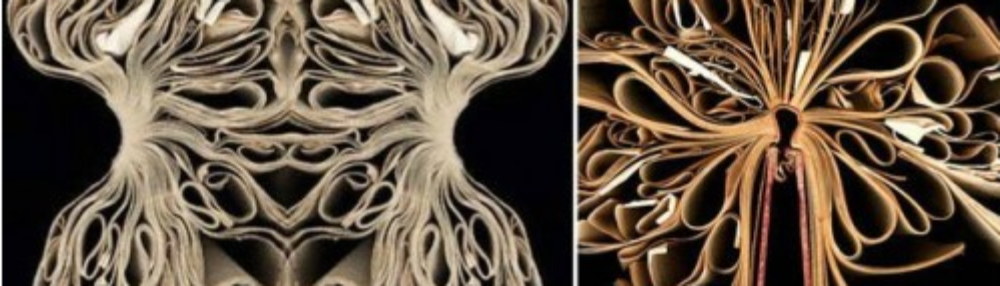
For my final project, I will be exploring the digital page and writing a scholarly essay that examines the sociocultural evolution of the page through a media archaeology framework. The transformation of the page spans centuries but in this digital epoch of history, technology has fundamentally changed the why and how the digital page matters. The internet serves as the contemporary printing press but understanding why derives from a long non-linear history.
My work will be based on Bonnie Mak’s “How the Page Matters”, as well as pulling from other texts that Dr. Pressman mentioned over the semester. Steven Johnson’s “Interface Culture” will help in ushering in the 21st century perspective of how the digital interface has changed how we look at the webpage as a tool. Additionally, I will position and introduce media archaeology through “An Archaeology of Media Archaeology” Erkki Huhtahmo and Jussi Parikka’s work, which helps guide the definition the term as “existing somewhere between materialist media theories and the insistence on the value of the obsolete and forgotten through new cultural histories that have emerged since the 1980s.” In consideration of past technologies and the temporality each incurred in its era, there is profound meaning in understanding why the digital page matters today. I have not yet looked into N. Katherine Hayle’s works but I am also interested in “How We Became Posthuman” as a means of further refining digital page in contemporary society. By understanding media archaeology and the blend of old and new media, there is a futuristic purpose in design, materiality, and content that derives from the reexamination of past iterations of media. In turn, literary history and content is continuously evolving alongside older forms but is not meant to erase it, but only to improve based on the user and who they communicate to.
Dr. Pressman’s book Bookishness and Walter Benjamin’s “Unpacking My Library: A Talk About Book Collecting” both contemplate and ruminate on the value of possessing books. While Dr. Pressman’s work isn’t purely based on book collecting, she does write [following her quote of Bonnie Mak on books attesting to the character of owners] “The bookshelves serve as evidence that the noble pursuit of knowledge can offer an alternative to a noble birth,” (Pressman, 34). This is indicative of a person self-representing themselves based on the collection of books they own in their own personal library. In today’s literary culture which has moved from the physical aspect of unpacking libraries to digitizing them, the virtual bookshelf is even greater than the physical one that Benjamin wrote almost a century ago.
Benjamin writes, “To a book collector, you see, the true freedom of all books is somewhere on his shelves” (Benjamin, 64). The 20th century perspective of unpacking a library has changed dramatically. Where Benjamin finds chaos in the reorganization of books is also where he finds peace. He purposefully proposes a physical intimacy with the books that he owns which only increases the value to him. This library that he unpacks is difficult to imagine today. Like Dr. Pressman discusses with the virtual bookshelf in Bookishness which “displays books with their covers, rather than spines, facing outward” and that it “reminds us that old and new media operate in complex loops of recursive influence rather than a linear ‘this will kill that’ model” (37) there is a certain kind of privilege that comes with physically owning books or the digitized versions we have permission to access. Book collection has changed in so many ways yet the principal of ownership remains unphased.
“Pickwick Papers” by Dickens, Charles. Published by Macdonald & Sons for the Edinburgh Society. The Broadstairs Edition. This edition was published in Pennsylvania. Impression number 101 of 250. This novel features the usual illustrations from the original work of Dickens and also features the vividly illustrated plates to accompany the story. The book is bound in three quarter leather with leather tips. The spine of the book is worn down but there is an elaborate golden gilt decoration of roses with leaves which makes it stand out. It also features slight golden gilt at the edges of each page. The pages within the book are in good condition but the edges do show signs of fading. The first volume has a decorative brown end paper, while the second volume has a decorative green end paper. The full-page illustrations are protected by tissue guards as a means to preserve their condition and color.
Side note before the scholarly analysis: I stumbled upon this book by accident. The original Pickwick that I encountered in Special Collections was only illustrations without the accompanying main text. When I came to Special Collections to research, I was given this edition of Pickwick instead and the physical aspects of this edition (rare plates, tissue guards, end papers) seemed more critical than the one I originally saw in our lab.
PART II. A SCHOLARLY ANALYSIS
Celebrated as the first serialized novel in 1836, Charles Dickens’ “The Posthumous Papers of the Pickwick Club” lays in historic and rarefied air. Ushering in the Victorian Era, the serialized novel was emblematic of a British culture that willingly valued reading for leisure. The impact of possessing and reading a physical bound copy of the inceptual serialized novel presented a monumental moment across British, and later, American culture. This 1912 edition of “The Pickwick Papers”, with all the usual illustration and very many rare plates, published by Macdonald & Sons for the Edinburgh Society, is the prime example of the novel becoming a commodified item in the 20th century. By capitalizing on the success of the serialized series in London, American publishers moved to bind the novel in its entirety to invoke commercial success. By selling limited editions which were indicated by rare and numbered book plates, “The Pickwick Papers”, in its Dickensian writing and collection of vivid plated illustrations, redefined the American literary space by transforming it into a commodified marketplace which valued the reexamination of cultural artifacts, as well as their remediation into resalable editions. The introduction of ownership in the form of book impressions, the whole number of copies of an edition that are printed at once, refreshed the purpose of the physical aspects of the book.
There are clear signs of wear and tear on the front cover and spine of the book. Being printed over a century ago though, the damage is minimal, and the leather-bound book has endured over time. As that is the case, the binding of the book has not been repaired or replaced and is authentically the same as when it was printed. The edges of the text blocks are plain. It is interesting to note that the tissue guards are markedly different than the text blocks because of their gold lettering to preface the illustration that is behind it. For example, there is a clear focused front-facing etching of Hablot K. Browne (widely known as “Phiz”), one of the main illustrators for Dickens. To guard his full-page illustration, in gold lettering on the tissue guard is information stating, “Etching by Adrian Marcel, from an unpublished photographer” (Dickens). This unique layer of protection serves the dual purpose of further adding onto the serialized novel of “Pickwick Papers”. Creating diverse and unique editions of books requires introducing new context alongside the historical artifact. In that same vein, the first tissue guard at the beginning of the second volume of “Pickwick” portrays an illustration of one of the main characters of the novel, Sam Weller. In his white hat and green vest, the gold writing reads back what are essential lines to the understanding of the character. The golden printing on the thin sheet of protection reads of a dialogue but also credits another the appropriate contributor to the illustration itself. Part of what is printed on the page reads, “Photogravure, by Felix O. C Darley. ‘Hallo,’ replied the man with the white hat” (Dickens). There is a direct correlation between the tissue guard as a form of preserving the physical condition of the key illustrations and etchings within the book, but as a refreshing way to introduce new details that are particular to this edition.
The text is written and printed in English. Originally being released as a serialized novel in what would eventually span twenty installments, it began in March of 1836 and would conclude in October of 1837. In a span of eighteen months, “Pickwick” became the landmark and iconic serialized novel that would captivate 19th century British readers. For publishers, the serialized format introduced a gateway to creating partnerships with other businesses by providing a platform for advertisements. Publishers had the ability to reach a wider audience due to the serialized format being intertwined with newspapers and magazines. Fast forwarding to the beginning of the 20th century, the technological advancements in print and illustration reproduction provided the avenue to mass produce and refine new editions of books. The content of the pages or story did not change but “… traditional texts were ceaselessly revised, adapted, translated, and changed in their physical aspect to bring them into line with the spirit of the times and to make them appeal to a specific public. The ‘staging’ of the written work – never stopped evolving” (Mak, 11). This Broadstairs Edition of Pickwick is an artifactual representation of the values of a capitalistic culture. As stated earlier and printed at the very beginning of the novel, this printed edition is impression number 101 of 250. In an American culture that was marked as the Progressive Era, there becomes a societal value of ownership of commodities. As such, the first serialized novel becomes more than a story by Charles Dickens but a representation of owning a key piece of historical importance. By owning a thoroughly upgraded and fully bound version of “Pickwick Papers”, Americans were able to possess the original serialized novel in its limited reprinted and unique capacity. Furthermore, as a literary society in the 20th century, Americans, like British citizens, were moving into the realm of reading for leisure.
This Broadstairs edition epitomized originality and a reutilization of Dicken’s work. The combination of the decorative illustration and etchings to accompany the story and the impression number of the edition give a value that can only be attributed to a consumer society, fixed on ownership. To possess a story that was historically important to the previous generation is what allowed publishers to handcraft unique editions with small tweaks such as the gold lettering tissue guards to further explain images and importance of the contributors to the ecosystem of Pickwick. These tissue guards are imperative pieces of this edition, and work as partners to the vivid illustrations to guide the consumer of the story. An example of this is the tissue guard in “The Pickwick Papers” that reads “Dismal Jemmy” by J. Clayton Clarke (‘Kyd’) and states “… strange man—all sorts of miseries—Dismal Jemmy, we call him on the circuit.” The illustration behind the guard stands alone, a daunting character with his arms crossed staring right at the reader. What the guard does is similar to a caption and captures the essence of who the character being shown is. Particular to this edition as well, it serves as a proper citation to who is responsible for the image, in this case Kyd, because Dickens did work with multiple illustrators for the images in Pickwick.
This 1912 edition of “The Pickwick Papers” carries significant context to understanding the complexity of the ecosystem of a book and that it is dependent on the underlying historical and social background it stems from. Reorganizing the contents of historically important books and bridging the gap across generations is what allows them to continue to be reproduced in new editions. The physical aspects that can be changed or improved are equally as important as any new content added from editors. The commodification of books goes hand in hand with commemorating, preserving, and reexamining precious historical artifact through contemporary lenses.
Bonnie Mak’s exploration and discussion on the life of the page, in its many sociocultural evolutions, provides a starting point leading into how to think about the forever changing ideas of the page. While the construction of the page has transformed from scroll to codex and codex to digital, the page remains the integral form of communicating in society. In her introduction Mak writes, “The page hosts a changing interplay of form and content, of message and medium, of the conceptual and physical, and this shifting tension is vital to the ability of the page to remain persuasive through time” (5). Like the book, the page has an equally important history that requires intentional exploration in order to make ruminations about its future, especially as we shift towards a digitized culture. By analyzing the page in detail, as we have begun to do in our first half of the course, it brings meaning to the materiality and the form it takes.
From a modern perspective, the form of the page in web browsing takes on an identity that places algorithmic code as an equal to the stability once introduced with the printing press. Mak writes, “… the advent of the printing press heralded a new epoch in the diffusion of knowledge because a text could apparently be ‘fixed’ and replicated with no degradation” (5). In the digital era, the page is now crossed as an interface that invites the reader’s thoughts and even instant engagement. The latter is the most glaring difference between the technologies of printed and digital works, but the on-screen page serves the same purpose which is to communicate with with an audience. By recognizing that the space of the page historically ties together cultures, it leads to better utilizing the advancements that are enjoyed today with the contemporary interface of the page.
The excerpt from Johanna Drucker’s work and Borsuk’s third chapter recalibrate the thought process of understanding the artists’ book as an idea. Near the end of the Drucker’s excerpt we read she states, “Artists’ books take every possible form, participate in every possible convention of book making, every possible ‘ism’ of mainstream art and literature, every possible mode of production, every shape, every degree of ephemerality or archival durability.” (14) There is a profound importance in recognizing that the idea of a book is woven from the artist’s vision and transferred to the reader. The reader then recollects, shifts, and begins anew within the mental space of their mind but only after physically interacting with the book.
Likewise, I found myself further contemplating the the power of the book as an idea as I worked through Borsuk’s book. In the section titled “The Book’s Ideas” she writes, [on examination of artists’ books] “Thy remind us that books are fundamentally interactive reading devices whose meanings, far from being fixed, arise at the moment of access.” (145) In our modern world where everything is commodified, it becomes natural to assume that a book’s meaning is limited to what is inside of it. That could not be further from the truth. The role of the reader is designated to ask the right questions and consider the book outside of the text and in its materiality. By doing so, there is a recognition that the entire book in its form, materiality, and content, require a reader to decipher and further contribute to the book as an idea.
The understanding of bibliography and its various pedagogies is a crucial component to discovering, preserving, and understanding the complex implications that a book endures in order to be looked at retrospectively. From The Bibliographical Society of America website, George Thomas Tanselle says, “Bibliography is the branch of historical scholarship that examines any handwritten and printed book as physical objects”, and “What links all bibliographical pursuits is an understanding of the significance of book as tangible products of human endeavor.” Books are longtime tools with enriched histories that can be ambiguous. The technicality of papermaking, book designing, typesetting, etc. matter tremendously in conjunction with the social and historical context with which they are made from. In order to account for the history of a book requires a broad familiarization with the culture and time period with which it began and has travelled through.
There is an immense amount of effort that goes into understanding the traditional bibliographical approaches and applying the required scholarly research to critically link histories in an attempt to understand a single book. It is an arduous process that rewards the human species, in hope that the interpretation of a book’s life can spark the intuitiveness of another being. As students of the book, it is important to think critically about the materials, records, and circumstances which shroud the history of the primary medium which we are learning about. From our modern perspective as well, I wonder how digital literature differs in terms of tracing the ecology from which they derive from, and am excited to apply the same scholarly research in that direction.
As Borsuk describes the form of the book which we are most familiar with, the printed codex, she prints in the book, “In addition to minute differences in the binding, each book copy will contain marginalia and other residues of reading that adhere to them thanks to their individual history of ownership and circulation. These are part of the copy without being part of ‘the book'” (76). In advent of the printing press and mass production of books, the idea or thoughts within specific copies of the book are what separated each individually in terms of content.
Now, I know this seems like common sense. But even five hundred years ago, things were the same as they are now. Today, we are bonded by an overwhelming sense of commodification in every single product accessible to us. It extends past books. It extends in the same tools we use: electronics, desks, books, pens, etc. What the book does in its many forms though, is it allows the symbiotic nature of humanity to flow from each person to the open pages. Borsuk writes, “Open margins left space for active annotation– a visible and tactile engagement of mind with page” (89). The most overlooked aspect of the mass printing availability is that it allows books to become a tool that is unique to each person that interacts with it. Print gathered content and disseminated it in an accessible manner, but more importantly it sparked the loop of thinking alongside the machine known as the book. As books became personally owned, it was the marginalia that further separated each copy that was distributed. It is the readers thoughts that work alongside the author and the book to form intuitive ideas and meaning.
Yesterday in the Digital Humanity Center, I was fortunate enough to listen and learn from Dr. Steve Mentz, Professor Pressman, and Professor Leong in their conversation on Blue Humanities. It was immediately clear that Dr. Mentz was a very distinguished guest to have in the Digital Humanity Center. His expertise and the way he articulated himself made it very clear that his love for Blue Humanities is something that has developed over the last couple of decades. I read the preface or introduction to his book An Introduction to the Blue Humanities and something that I really appreciated about him as a person is how much credit he shared in the coining of the term “Blue Humanities” and to whom he gives thanks for his own inspiration, especially to his late colleague and friend, ocean historian pioneer, John Gillis.
Dr. Pressman gave a great scholarly introduction to Dr. Mentz. I honestly had very little knowledge of what Blue Humanities was besides my short reading before the presentation. Though, it was immediately clear that Dr. Pressman’s scholarly work on mermaids came to fruition through Dr. Mentz’s own works. I was particularly interested in a question that Dr. Leong posed to Dr. Mentz which was something along the lines how do people with physical barriers to bodies of water interact with the concept of Blue Humanities. Dr. Mentz was drawn back to the question during the presentation as it was something that he was acutely aware of but had not a specific answer. I appreciated his candor. Like Dr. Leong, I was wondering how does Blue Humanities affect people who may be in a land locked state where bodies of open water are less accessible than the west or east coast. I think even more apparent though is what occurs when people are physically unable to experience water via physical sensation of swimming, or having that immersion in water. Dr. Mentz landed along the lines of every local body of water possessing a culture and an understanding around it. Likewise, water is literally the essence of our daily lives in the way we utilize it and drink it.
It was really fascinating to listen and learn what Blue Humanities entailed. The scholarly perspective led me to eagerly listen and engage with how water is woven as a classical motif in literature due to the historical phenomenon and obsession of the ship-wreck.
Maybe a bit off-topic but I am drawn to one of my favorite quotes or aphorisms from Bruce Lee. He says, “Be like water make its way through its cracks. Do not be assertive, but adjust to the object, and you shall find around or through it. Be water, my friend.” My mind also just now draws connection to David Foster Wallace’s commencement speech, “This is Water”. It felt so easy to listen to the conversation yesterday because it flowed naturally and that speaks to what the thought process of Blue Humanities invites.
It has taken me quite awhile to digest the work of Borges and to develop my own thought process on the elaborate idea of the total library. Something that has helped me gather what to make of Borges’s legendary short story is Mark Marino’s metafiction “Marginalia in the Library of Babel” which has eased the connection into the 21st century.
I am stretched to incredible lengths to capture what is most meaningful between the two readings this week and I concede that the most impactful line, to me, is Borges stating “The Library exists ab aeterno“. This Library that Borges introduces in 1941 has stood the examination of of the last century, while the story itself feels like it has existed since the inception of the tool known as the book. In that sense, the story feels imperative to reread over and over again, especially in this modernized and expanded age of the library in the form of the internet. In retrospect, the vastness of the universe and the Library as Borges beautifully writes, has exponentially grown beyond imagination. And yet, the story’s most salient truths about the search and journey of knowledge reach deeper than ever.
What I took away from Marino’s short form metafiction is the perception of the internet. We brushed over this in class but the internet, like the Library, has slowly crept into the everyday lifestyle of nearly every country. What Marino’s blog, or marginalia, represents is the digitized hand users scribe daily, without a second thought about their footprint. He types, “Write in the margins, suggested my machine. Social annotation. It means that I exist or have existed.” Marino’s small contribution to the Library of Babel, the Library of the Internet, is from 2007. It feels like forever ago, and it feels a part of the Library that exists ab aerterno because it is. The marginalia he leaves with hyperlinks, highlights, and digital sticky notes are as powerful and meaningful as those previously left in the archived library of the universe. These digital notes also leave behind that someone was here, there, and everywhere. For myself and others, I think we tend to forget that integral part of the digital footprint marking the Library of Babel.
Hi everyone, I am Aron. I am in my fourth year of undergrad for my BA in English at SDSU, although this is only my second year as I transferred from Southwestern Community College. I was born here in San Diego and it has been my home for most of my life. I truly think it is America’s Finest City.
After I graduated high school, I chose to enlist in the U.S. Army as a medic. I was borrowed and lived a few years in the south, mainly between the Kentucky and Tennessee border, before returning back home to San Diego. A really cool moment in my life came when I lived in Africa for nine months and got to work with a group of children at an orphanage. They were incredibly energetic and smart kids which I had the pleasure of seeing on a near daily basis. They asked to read to me and I with them in our free time together.
I have really struggled with a lot of different aspects of my life since going back to school, including picking the right career path or major. I tried my hand at engineering, nursing, etc, and failed tremendously. I do love reading and writing though, and being able to choose what to think about or why something is important. So, my hope is to one day teach English and reinforce that same thinking, especially in these trying times. Because it is absolutely necessary. I look forward to learning so much from Professor Pressman and everyone this semester!