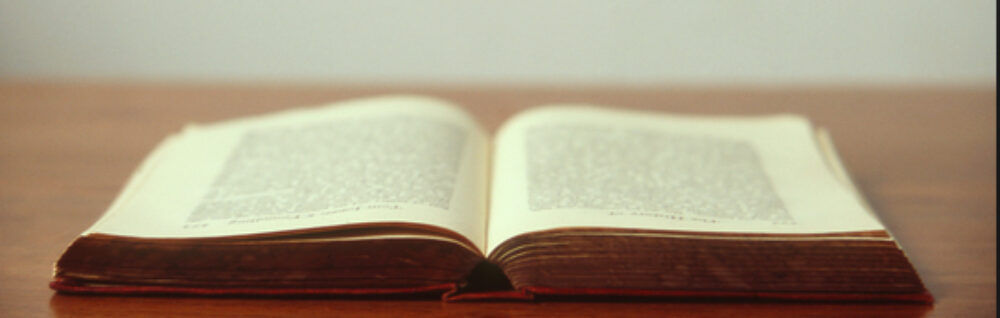
The book is not a static or fixed object, but rather a symbol of knowledge, ideas, and norms–one that is shaped by our cultural values, which have shifted and evolved since the dawn of time. This demonstrates that ideas are non-linear; through the decades, the book has changed, being adapted into different modes of media. Rather than viewing the book as a mere object, it should be interpreted as a mode of language–one that, in whatever form it takes, reflects our ways of thinking and our pursuit of truth and knowledge. One great example of this can be found in the Hebrew-Aramaic and Christian Greek scriptures: although there are different versions of these texts, they all accomplish their purpose–to guide, to educate, and to demonstrate the divinity of truth. Therefore, this raises the question: what does the book represent? It represents the conventions of human memory and guidance–something infinite that seeks to share a universal experience–offering, different ways of thinking, different ways in which we engage with the world as we know it. In this instance, we seek to deconstruct, to alienate, and to differentiate the materialistic qualities of the book and expand on the duality this represents–blurring the boundaries between media and language. “Knowles’s books, like her artistic practice, offer readers nourishment, reminding us that the book is an exchange” (Borsuk 108). In this instance, because the books exchanges with the reader it vividly paints an interaction, or more a transaction with the reader– one that creates a space for intellectual curiosity that collectively unifies individuals that seek to enrich their understanding not intellectually (not only in this manner), but feeds into the realm of human complexities– nurturing our curiosity and creativity. Further demonstrating that books are not just a vessel of knowledge but imparts in our modes of communication and exchange. Ultimately, the book lives not as an object but as a symbol for mankind– one that is present and allows us to learn , question and engage with the world in a different manner; one that interjects across our innermost needs and desires.
Tag Archives: book as content
Week 5: Books Becoming Content Based
After reading Chapter 2 of Amaranth Borsuk’s The Book, the curation of the book itself went from an intricate handmade artform to a mass production to fit the newfound purpose of the book, which is to use it for its content. Last Tuesday’s class in the Special Collections, we took the time to observe a variety of texts and the craftsmanship of the book itself. The covers, bindings, and format of the text revealed a history of the book without the reader even having to open it. For example, the intricate handmade cover of the Dominican Catholic Hymns book portrayed its importance with its ornate embellishments and high-quality leather. Being able to see the different handcrafted books in person highlighted the dramatic shift from books as art objects to books as content-based mediums.
I took a glance at my own personal book collection, and couldn’t help but notice that the majority of the books on my shelves are paperbacks with creased spines and flimsy covers that lacked any artistry. I flipped through the pages and noticed that most of the paper itself was so thin that I could see the words faintly through the other side. These observations display how “the printing press changed the book by facilitating its proliferation and separating the idea of the book from the object” (Borsuk, 76). Prior to the printing press, the book reflected more than the content inside. It was a portrayal of status and wealth not just a container of knowledge. The printing press made books more accessible and created the shift from sacred, one-of-a-kind artifacts to everyday commodities, valued primarily for the content they carried rather than the material form they took.
In my SOC730 course: Advanced Social Theory Class, we are discussing Marx theories that explain that with the increase in automation and capitalism we will see a decrease in work hours and more time for individuals to pursue arts and , to my understanding, more time to appreciate art. Will automation continue to decrease the artistry of books leaving them as disposable vessels of information? Or, perhaps, will it create space for a resurgence of book crafting as people search for meaning and beauty in tangible, handmade forms?
Is that true?
When I read Borsuk’s line that printing “reframed the book as content rather than object its form a mere vessel for the information it contained,” (p.57) I felt both curious and uneasy. The word mere makes it sound like the physical book is almost worthless, just a container for words. But is that true? When I think about my own reading, I don’t see books as “mere vessels.” I always notice their form. A book’s cover, the texture of its pages, even its size makes a difference. A small paperback I can carry in my pocket feels different from a large hardcover I need two hands to hold. Doesn’t the way a book looks and feels affect how you read it?
On screens, though, every book looks the same. Kindle, Wattpad or any reading app makes text uniform, black words on a glowing background. In some ways, that’s convenient the story is all that matters. But sometimes I wonder, does this sameness flatten the reading experience? Do we lose something when every book feels identical?
Interestingly, digital reading has made me appreciate physical books more. I love seeing a shelf of colorful spines or picking up a book with unusual design choices. Publishers know this too they release special editions with decorative covers or unique layouts to remind us of what makes print special. Isn’t it funny that screens, which were supposed to replace books, have instead made us value their physical form even more?
So I come back to Borsuk’s phrase. Maybe in the early days of printing, the book was treated as a vessel. But today, I think it’s both vessel and object. Books carry words, yes, but they also shape our experience of those words through their form. They are not “mere” anything they are living companions that travel with us, change us, and remind us that reading is always more than just content.