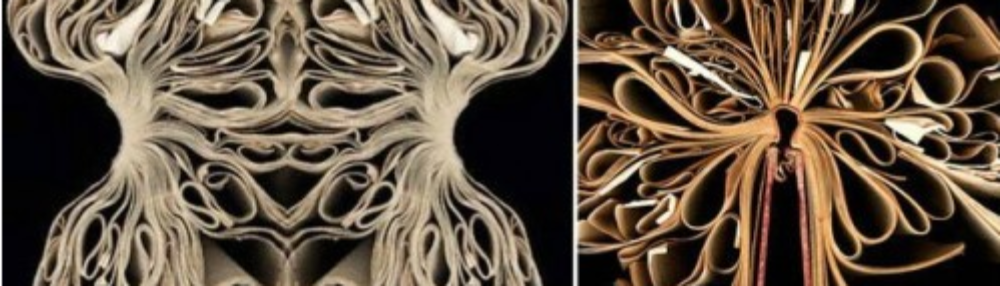


Books are often treated as neutral vessels or objects whose value lies primarily in the text they carry rather than the form that carries it. This assumption persists even as digital media increasingly separates content from materiality of the book, reinforcing the idea that the book’s body is secondary to its meaning. However, this view overlooks the significant ways books function as material, embodied extensions of the book owner. Books are touched, carried, marked, shelved, displayed, damaged, lost, and preserved. They archive time and attention, hold the memories of their use, and occupy space within cultural happenings. When one collects books, they have a full archive of who they are. They do not merely reflect identity but serve to form identity as well. My bookwork project argues that personal book collections function as bodily extension and identity through material ownership. Similarly, DNA is a double helix structure that has intertwining nucleotides, like books in a personal library, that hold the genetic information that makes us who we are as individuals. In other words, our identity. To explore this claim, I created a sculptural bookwork that is a double-helix DNA structure composed of pages and covers from my personal library.
The Book Helix is a sculptural bookwork that materializes my argument that books as objects function as extensions of the body and archives of the self. Constructed as a double-helix DNA structure using pages and covers from my personal library, the bookwork visualizes how just as DNA encodes the genetic information that defines who we are. Personal books in a book collection work like nucleotides in DNA helix to encode memories, intimate reading experiences, and material traces like marginalia that collectively shape identity.
The choice of DNA as a formal metaphor is intentional. DNA holds information that determines how a body develops, adapts, and survives, similarly, books encode the ideas, values, and affective experiences that shape who we become. The pages used in the sculpture are not interchangeable. They are taken from books that have marked specific moments in my life such as periods of learning, uncertainty, affirmation, and change. In this sense, the work treats books not solely as commodities but as material traces of lived experience of my life narrative. Each strand represents a trajectory of intellectual and emotional development, while the spiral structure emphasizes continuity, inheritance, and growth over time with each new book added to my collections. By transforming books into a bodily structure, the work insists on the vulnerability and intimacy of reading practices. It asks viewers to reconsider their own libraries.
Susan Stewart’s On Longing explains important ideas for understanding personal libraries as identity forming archives, a concept that is materially portrayed in The Book Helix. Stewart argues that book collections derive meaning from their accumulation, arrangement, and proximity to one another (Stewart, 1993). Objects within a collection become narrative markers, producing meaning through their intimate relationships and proximity to one another and the owner. When applied to books, this idea reveals how personal libraries function as material autobiographies. They are archives that record who we have been, what we have valued, and how we have changed over time.
Books acquire significance through the specific moments at which they enter our lives. We collect books as gifts, during periods of curiosity or obsession, through academia or education, or as part of childhood. Each book marks a particular memory, experience, or emotional context. When books remain in a personal collection, they become fixed points in an evolving narrative of selfhood. The Book Helix materializes this process by using pages and covers from books acquired at different moments in my life, treating each page as a narrative marker rather than as a simple vessel of text. The sculpture portrays a visible accumulation of markers from my personal library, demonstrating how identity is formed through lived experience. Each page functions as a material “marker” drawn from a specific book within my collection, and, like nucleotides within a DNA strand, these fragments accumulate over time forming who I am.
Stewart’s emphasis on accumulation and proximity is central to the structure of The Book Helix. Rather than having individual books on their own, the sculpture intertwines pieces from many texts into a single double-helix form. This reflects Stewart’s argument that collections produce identity through narrative association. The helix structure emphasizes continuity, suggesting that identity is not composed of discrete moments but formed through overlapping experiences that persist over time. Books function especially powerfully within collections because they register time in visible ways. Marginalia, underlining, old post-it notes, cracked spines, and faded covers act as inscriptions of lived experience. These marks transform books into what Stewart describes as souvenirs. These objects matter because of the memories attached to them not because they can be exchanged or replaced (Stewart, 1993). In The Book Helix, these material traces are preserved rather than erased. Pages bearing signs of wear are incorporated into the sculpture highlighting how books are a primary source of meaning. The work insists that these traces are not damage but memory.
The Book Helix also demonstrates how fragile pages are turned into a bodily structure, reinforcing the idea that books function as extensions of the self. Like DNA, which carries information necessary for continuity and survival, personal books store individual experiences and memories that cannot be replaced by another copy. The Book Helix shows how books within a collection operate as material anchors of identity and objects that preserve the past while remaining physically present in the ongoing formation of the self.
While Susan Stewart’s argument explains how personal libraries work as narrative systems of identity, it does not fully account for how the materiality of the book itself actively produces meaning. Stewart shows why books matter within collections, and Johanna Drucker’s work clarifies how books matter as objects. Where Stewart emphasizes accumulation and memory, Drucker turns attention to material structure. They argue that the book is not a neutral container but a performative object whose physical properties shape interpretation and experience (Drucker, 1995). This shift from collection to form is essential for understanding The Book Helix, which does not assemble books as symbolic artifacts but transforms their material bodies into a new structure that is meaning making.
Rather than treating the book as a simple medium, this approach demonstrates how structure and physical presence shape interpretation. Johanna Drucker’s The Century of Artists’ Books argues that books are not passive vessels but performative objects, whose properties actively produce meaning (Drucker, 1995). Artists’ books, in particular, disrupt the illusion that books should disappear in the act of reading. By making books through unconventional structures, like sculptural configurations, artists’ books expose the ideological norms embedded in conventional codex design. The Book Helix pages used in the sculpture cannot be read sequentially. This challenge of linear reading norms redirects attention from textual content to material presence. What matters is not what the books say, but what they have held: personal experience, use, and memory. By transforming books into a DNA structure, the bookwork portrays their role as makers of identity.
Janice Radway’s essay “Reading Is Not Eating” challenges dominant ideas that paint reading as consumption. Radway critiques the idea that texts are passively absorbed by readers, arguing instead that reading is an active, interpretive, and socially situated practice (Radway, 1986). If reading were simply a form of ingestion, books would lose their value once their informational purpose was fulfilled. However, readers routinely keep books they may never reread, preserving them for reasons that exceed utility. These attachments reflect the relational nature of reading. Books are not depleted through use. They accumulate meaning through continued presence. Radway’s argument helps explain why material traces such as marginalia, creased spines, or underlined passages matter. These marks do not indicate consumption but interaction. They show moments of emotion or transformation. Books thus become records of embodied engagement and the formation of identity.
To understand books as bodily extensions requires a shift away from seeing them as external tools and toward recognizing them as material participants in the formation of identity. This perspective challenges the assumption that the book’s role ends once its text has been read. Instead, books persist as objects that absorb traces of interaction, memory, and affect, functioning in ways that closely resemble the body itself.
Drucker argues that books are performative forms whose material structures actively produce meaning (Drucker, 1995). The codex, with its sequence, binding, and tactility, organizes bodily engagement like how a reader holds the book, turns its pages, or navigates its materials. These physical interactions are not secondary to interpretation. When books are treated as bodily extensions, their material vulnerabilities take on new significance. A cracked spine, a torn page, or water damage is more than aesthetic deterioration. These marks resemble evidence of time, use, and survival. Drucker’s emphasis on material presence allows us to see such damage not as failure but as bodies that age. They accumulate marks that reflect lived histories rather than idealized forms.
Janice Radway’s statement that “reading is not eating” supports that books work as a bodily extension of its owner. Radway challenges consumption-based metaphors that portray reading as a process of ingestion followed by disposal (Radway, 1986). If reading were truly consumptive, books would lose relevance once their informational content was absorbed. Yet readers rarely treat books this way. Instead, they keep them, return to them, and allow them to occupy space in their lives long after the act of reading has concluded. This persistence shows that books function relationally rather than instrumentally.
Radway’s argument reframes reading as an interactive and embodied practice, one that produces long lasting emotions. Marginalia, underlining, bending the corner of a page, and stains are not signs of use in the sense of depletion, but records of engagement. These marks transform books into hybrid objects of part text and part autobiography. In this way, books begin to serve bodily extensions. Books remember where we lingered, where we struggled, and where we returned.
A personal library is not merely a collection of random items but a curated narrative or archive that tells a story about its owner. What matters is not only which books are present, but how long they remain, where they are placed, and which are allowed to coexist. Stewart notes that souvenirs are valued not for their intrinsic properties but for their ability to anchor memory and sustain personal narrative. Books operate similarly. A book kept for years often holds significance because it marks a particular moment in an individual’s life such as a course taken, a period of questioning, a relationship, or a shift in worldview. The book’s continued presence allows that moment to remain accessible, materially embedded in everyday space.
The DNA metaphor at the center of The Book Helix makes this argument visible. DNA encodes biological information that creates growth, development, and continuity. Similarly, books encode the intellectual, emotional, and personal experiences that shape identity over time. By constructing the sculpture from pages and covers taken from my personal library, the work treats books as material carriers of personal history rather than abstract symbols of knowledge. The double-helix structure emphasizes relationality. Identity, like DNA, is not linear or singular but produced through interaction and repetition. Reading experiences accumulate, overlap, and sometimes contradict one another, but together they form an evolving self. The intertwined pages in the helix reflect this process suggesting that no single book determines identity. Instead, meaning emerges through entanglement, through the ongoing presence of many texts within a shared material space.
Ultimately, to think of books as bodily extensions is to acknowledge that identity is not formed solely in the mind. It is shaped through sustained, material engagement with objects that carry memory and meaning. Books become part of the self not because they contain information, but because they participate in lived experience, absorbing traces of who we were at the moment of encounter. The Book Helix invites viewers to reconsider their own relationships with books. What stories do our shelves tell? What parts of ourselves are stored in the objects we preserve? And what does it mean to care for books not simply as sources of information, but as extensions of who we are?
Work Cited
Borsuk, Amaranth. The Book. MIT Press, 2018.
Drucker, Johanna. The Century of Artists’ Books. Granary Books, 1995.
Pressman, Jessica. “Bookwork and Bookishness.” Interview with Brian Dettmer and Doug Beube, 2018.
Pressman, Jessica. “Jonathan Safran Foer’s Tree of Codes: Memorial, Fetish, Bookishness.”, 2018.Radway, Janice. “Reading Is Not Eating.” Feminist Studies, 1986.
Stewart, Susan. On Longing: Narratives of the Miniature, the Gigantic, the Souvenir, the Collection. Duke University Press, 1993.