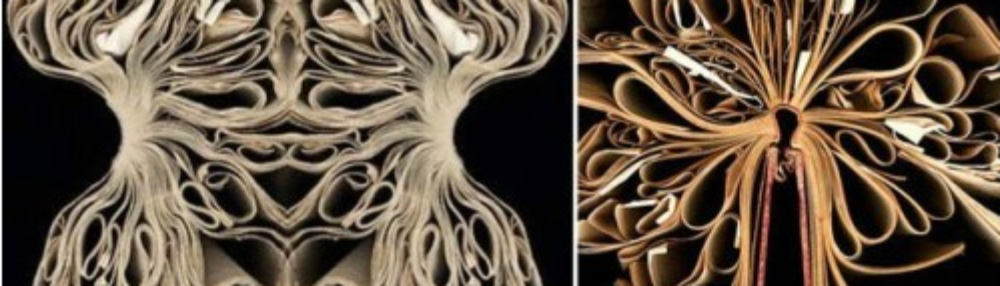
Never in my life have I considered books to be similar to a living creature. Yes, I know they are made of organic materials and that they each have a story (just like humans, dogs, or even fungi). Yet, books have evolved just like any other species, they have lived through millennia, and they have started in very different circumstances from where they are today. Books were made for humans, but the reason why and how they are still made has changed throughout history.
That is why bibliography is a thing. Yes, humans have invented a study of human inventions, but specifically for books. It isn’t simply about reading the contents of a book, but “the study of the lives of material books, widely defined, including their production, circulation, and reception” (“What is Critical Bibliography?”). Books signify great shifts in human history from political, social, and ideological means. By reading the physicality of a book (and not the exact contents), we can see how different societies functioned and how knowledge was disseminated to the public. We can see where the books come from based on the materials used as well as how the materials are used. We can see who bound the book and when based on the intricate binding patterns. All of these details matter to book history and understanding books as a functional part of human society.
While we might observe the physical aspects of books and determine where and when they were made, we can also observe intellectual and artifactual evidence of authors, readers, and scholars from a specific era. For example, an original copy of a book might’ve been handwritten, with a copy manuscripts produced. Take for example, The Canterbury Tales, one of the most handwritten English texts, that had 84 manuscripts and 4 incunabula (prior to 1500). This book received heavy criticism from scholars who’d write on copies, leaving marginalia, another aspect of bibliography to be studied. Bibliographers can use marginalia to see how books were received by audiences and learn of various social factors during that time.
What we have been learning in our lab is also incredibly valuable. It is difficult for me to even imagine a handwritten book. All I have ever read has been typescript books, all mass-produced and hardly made for longevity. The Book by Amaranth Borsuk that I own is already falling apart and I bought it at the beginning of September. We are living in an age where we aren’t taught to value the physical nature of the book but to consume the knowledge the text offers. Today, most books are made of cheap materials for cost-effectiveness and mass-dissemination, lacking the quality they used to have. While I whole-heartedly agree with the idea to make books accessible to the public and not just scholars, I also believe that, by understanding the nature of bibliography, is to also bring in perspectives that pertain to the environment and how we can adapt rather than it having to change for us.