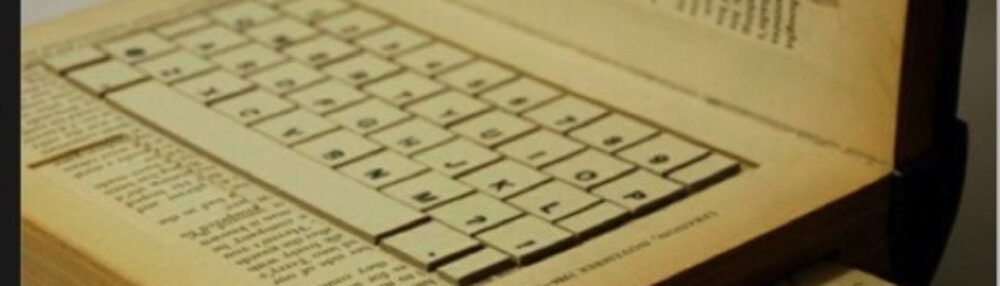
Over the past weeks, my thoughts about the book have slowly shifted. From body, to space, to page. Each chapter of Borsuk’s The Book has opened a new way of seeing what it means to read. This week, reading Chapter 4, I realized that all these ways were already connected by something larger: the book as interface.
Borsuk reminds us that the book is not only an object we hold, but a surface where meaning happens. It stands between us and the text, turning thought into touch, paper into feeling. What struck me most was the line “The book accommodates us, and we accommodate to it.” (p. 198) It captures exactly what I have been circling around all along. Reading is not just something we do, but something that also shapes us. We lean toward the page and the page leans back.
In earlier chapters, I imagined each page as a room, a space to walk through. With Borsuk’s idea of the interface, that room now has a threshold, which is the moment where we cross from our world into the book’s. The interface is that invisible border, one that feels natural only because we have learned not to see it. When she describes how modern devices try to make the interface “transparent”, I think back to Mak’s observation that we have been trained to treat the page’s edges as the limits of our thinking. Both show that what feels natural is often the product of design. A quiet space built around our attention.
What makes Borsuk’s idea powerful is that it reintroduces the body. Touching, turning, swiping, each is a way of thinking through movement. The gestures may have changed, from paper to glass, but the intimacy remains. Reading becomes a circuit that includes us. The author, the text, the page and the reader’s hands all connected in one loop of attention.
Looking back, I have really enjoyed this journey through The Book. Each chapter felt like walking a little further inside it. From its body, to its rooms, to the very surface that connects us to it. What is most interesting to me is how much my own perception has changed along the way. I began by thinking of the book as something to look at, but now I see it as something to move through. The book is not a fixed thing, but a living relationship. A body that greets us, a space that invites us in, and finally, an interface that completes itself only through our touch. Every time we turn a page or brush a screen, we close that circuit. In the end, the book is not what stands between us and meaning. It is the place where we meet it.