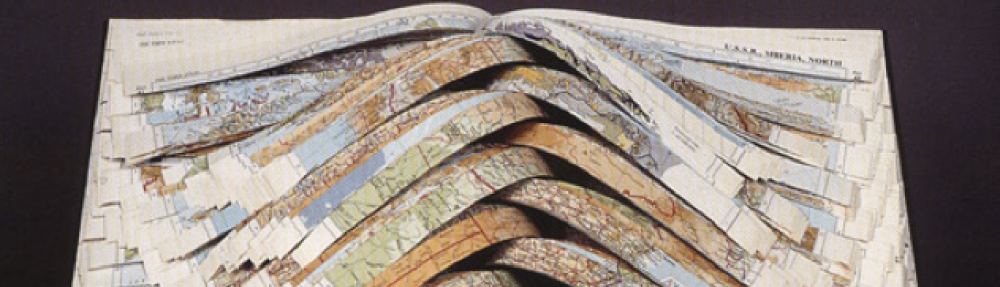
Artist Erica Baum defines the book by defining the verb “contain” (qtd. in Amaranth Borsuk, “Essential Knowledge: The Book”). Following Baum, I’m considering “book” as a verb: to book a reservation, to “book ‘em” in a police databank, “[t]o record in a book, and related senses” (Oxford English Dictionary). To be “booked” in these senses is to be produced as information that is variously legible across what Robert Darnton (1982) calls the “communications circuit”, which models the associational “life cycle” of a book object across prosumer actors (“What is the History of Books?” 67). In each instance, the booked referent is recorded and “contained” as data in an information system. This system is distributed across a communications circuit of readers, producers, and other actors — not all of whom (or which) read the booked information as content, but all of which interact with and entangle the book object in a web of temporal and spatial signifiers. We can thus examine the book as a network which materially reproduces time signatures.
The thinkers profiled in Erkki Huhtamo and Jussi Parikka’s introduction to Media Archaeology (2011) variously frame time as a medium which intersects with other media: books, film, social gatherings. “Archaeology” itself entails the reading of bodies across time, which theorists like Marshall MacLuhan, Walter Benjamin, and Siegfried Zielinski apply to media studies (5, 6, 10). These theorists understand media as circuits which interconnect with other media and bodies through material, temporally-situated exchanges. In writing our bibliographies, we approach media archaeology to record the historic, circuited interactions that are “contained” in, by, and as the book object. Our prosumption expands the book’s circuit through our own temporal interactions with its body, the exchange forging future contexts.
So I’m considering the book object as something which may or may not outlast me, but that which operates by a specific temporality. The book I’ve chosen for my bibliography was published in 2007, but its context expands before and beyond this date. It is generative to consider how the life cycle of the book object differs from your own — it might be a bit like mindfully approaching nonhuman animals with an understanding of how their behavior is shaped by their life cycles. I make this connection not only because the organic materiality of many books situates them as ecological artifacts, but because it is limiting to treat the book object as being removed from organic body-temporalities.
Dr. Pressman writes in “Jonathan Safran Foer’s Tree of Codes: Memorial, Fetish, Bookishness” (2018) that “[f]etishism . . . involves attributing to an object the ability to possess and exert powers rather than seeing that object as part of a larger system of programmatic operations” (106). The fetishization of the book displaces it from its context or communications circuit, meaning that it displaces the book from its “life cycle” as a networked object. As a cultural and ritual artifact, the book’s “ability to possess and exert powers” is also the ability to possess and exert a value of atemporality. In a sense, the fetishization of the book vacates it of its life cycle by removing it from its communications circuit. Practically, this might involve a reader or bibliographer failing to notice signs of historical interactions that could reveal the temporal information “contained” in/as the book body. It’s important that we approach book objects with a mind to their communications circuits across time, including our own interactions with them and the possibility of interactions between future actors and the book.
This temporally-mediated approach can guide our readings of book objects as containers of time signatures and material interactions. We should not only read a book, but read that which has been booked. That sounds goofy, but it’s helping me ground my approach to handling book objects and bibliography.