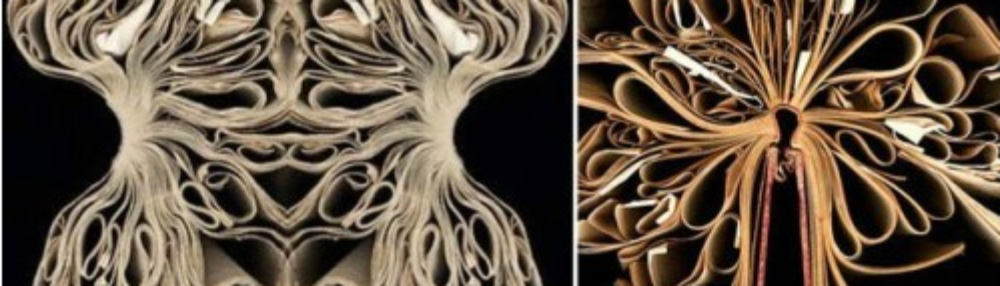
My Final Project: Ethiopian Healing Scrolls and Books as Accessories

Through a media‑specific analysis of Ethiopian healing scrolls, books become most meaningful when they are worn, carried, and embodied. The scroll’s stitched construction, tailored length, and bold imagery position it within a long lineage of wearable books, demonstrating that portability and customization are not secondary features but central mechanisms through which texts produce identity, mobility, and spiritual efficacy.

Part 1: The Bibliography

At the San Diego State University Library’s Special Collections and University Archives, Ethiopian healing scrolls sit quietly in their boxes, but everything about them suggests movement. They are long, narrow composite objects made from parchment strips sewn end‑to‑end. Each strip is thick and stiffened, lighter on the flesh side and darker on the hair side. The joins are stitched with leather using simple overcast or paired‑hole sewing, forming a continuous roll that can stretch several feet while remaining only a few inches wide. Rolled inward, the inscribed surface is protected, as if the scroll curls around its own meaning.

The vellum is coarse and rigid with age. Edges cockle, some strips crease from repeated rolling, and occasional thinning appears near stitch sites. Despite surface wear, the substantial thickness of each strip keeps the structure sound. The scroll is thick and stiff, wanting to stay curled up due to being unused for years. Text runs vertically in single columns along the length of the scroll. Decorative ruling separates text from pictorial fields, and faint guidelines help maintain margins. The Ge’ez script is written in black ink, with a secondary pink pigment used sparingly to highlight names or details. The consistent hand and occasional corrections suggest a single scribe working directly on the parchment.

Horizontal decorative bands—zigzags, triangles, chevrons—divide sections and frame images. Illustrations appear between these bands and are typically schematic: haloed figures, crosses, protective talismans, or anthropomorphic spirits. Bold outlines and selective color accents emphasize heads, eyes, or symbolic attributes. Marginal talismanic signs and small diagrams inhabit the spaces between text and image.

The scroll’s narrow width and considerable length reflect its purpose as a portable ritual tool. Handling wear appears along the edges and outermost layers, while repeated creasing marks frequent unrolling. The reverse side sometimes contains practice strokes or ingredient lists, suggesting practical use by a healer. Alternating text blocks and pictorial vignettes create a ritual sequence, guiding the practitioner through incantations and protective images.

Ownership marks vary: small inscriptions, seals, or later annotations. Repairs—patched holes, re‑stitched joins, added cloth or leather—demonstrate long-term use and value. As material objects, these scrolls sit at the intersection of manuscript, talisman, and ritual implements. Their stitched construction, combined inks, and clear signs of handling identify them as portable healing tools maintained by practitioners rather than books intended for passive reading.

Part 2: The Analysis

Ethiopian healing scrolls are religious objects designed to move: long, narrow rolls of parchment whose images, texts, and physical form work together as portable technologies for purging illness and restoring mobility. As Amaranth Borsuk notes, a book’s meaning emerges through how it is handled, and the scroll’s form is inseparable from the ritual actions it enables. Tailored to individual wearers, the scroll alternates Ge’ez text with pictorial plates exposed sequentially during rites meant to expel harmful forces.

The scroll’s construction emphasizes durability and portability. Thick parchment strips sewn end‑to‑end allow the roll to be tightly wound for transport and repeatedly unrolled for ritual display. Its narrow width minimizes bulk, while the long linear format provides a staged sequence: the healer unrolls to the next image, performs the invocation, then rerolls the scroll. Unlike a codex, which favors stationary reading, the scroll’s rolled format is optimized for motion—carrying, wearing, and field use. Jessica Pressman’s argument that new media revive older forms helps illuminate this contrast: the scroll’s mobility and image‑text hybridity anticipate contemporary portable media that merge functionality with embodied interaction.

Many healing scrolls are bespoke objects made to a client’s height so the unrolled sequence corresponds to body zones. The client’s name often appears, confirming the scroll’s directed purpose. This personalization allows the scroll to be wrapped around the body, converting it into a wearable talisman. Image placement follows a bodily logic: protections for the head appear near the top, those for the torso or abdomen appear mid‑scroll. Michelle Levy and Tom Mole emphasize that books acquire meaning through “the conditions of their use,” and the scroll’s customization demonstrates how its physical form is shaped by the needs of its wearer.

The pictorial program is central to the scroll’s function. Images are schematic and bold—emphasizing heads, eyes, haloes, or geometric talismans—so they read quickly during ritual exposure. High‑contrast outlines and selective color accents highlight operative features. Decorative bands frame each plate and act as tactile markers, enabling quick navigation. The imagery functions as both symbol and instruction, signaling which spiritual agent to invoke and which gesture to perform. Johanna Drucker’s work on artists’ books clarifies this dynamic: material structure shapes how readers navigate and interpret a book, and the scroll’s alternating bands of text and image direct ritual performance.

These scrolls are explicitly religious instruments whose therapeutic mechanism is spiritual. Christian iconography—crosses, haloed figures, archangels—combines with apotropaic geometries to anchor authority and repel harmful forces. The healer’s use of the image—exposure, touch, movement over the afflicted body—constitutes a ritual technology that enacts exorcism and restores mobility. Portability is integral: the scroll must travel to the afflicted, act upon their body, and accompany them back into social life.

Wear patterns and repairs document frequent handling. Darkened edges, creasing, and re‑stitched joins reveal repeated use. Leah Price notes that books often circulate as objects valued for their handling as much as their content, and the scroll’s accumulated wear makes visible its social life. Marginal additions and later hands mark episodes of adaptation for new clients. Mark Marino’s discussion of marginalia as evidence of a text’s evolving social life resonates here: added marks document the scroll’s movement through households and communities.

Mobility is also social and economic. Scrolls circulate as commissioned goods, gifts, or loaned items. Their production and repair involve craft resources and payments, creating ties among clients, healers, and suppliers. Ownership inscriptions and seals trace networks of care. Borges’s vision of an immobilized library contrasts sharply with the Ethiopian scroll, a book designed to circulate and act in the world.

Ultimately, the scroll’s purpose is to restore the patient’s capacity to move. In societies where mobility links to livelihood and social participation, a portable ritual technology that travels to the afflicted is especially significant. Wearing a scroll made and named for you aids reentry into everyday movement, signaling protection and documenting intervention. Viewed through mobility, Ethiopian scrolls appear as engineered objects whose structure, imagery, and repairs make them effective tools for itinerant spiritual care. Tracking scrolls as moving things recasts them not as static artifacts but as active participants in networks of healing, exchange, and movement that sustained religious life in Ethiopia for centuries.

Part 3: Books as Clothing, Books as Accessories: Embodied Reading and the Mobility of Text

Extending this analysis of mobility, Ethiopian healing scrolls also invite us to consider a broader and often overlooked dimension of book history: the ways books function as clothing, accessories, and wearable media. When a book is worn rather than held, its meaning shifts. It becomes not only a vessel for text but an object that participates in the shaping of identity, movement, and embodied experience. The Ethiopian healing scroll makes this dynamic unmistakable. Its form—long, narrow, stitched, and tailored to the wearer’s height—transforms it from a manuscript into a garment of protection, a piece of spiritual equipment designed to inhabit the body as much as accomExtending this analysis of mobility, Ethiopian healing scrolls also invite a broader reconsideration of what books are and how they inhabit the world. Their stitched parchment bodies, tailored lengths, and bold image‑text sequences reveal that books do not merely sit in hands or on shelves—they inhabit bodies. They wrap, touch, travel, and accompany. They are worn as much as they are read. When a book becomes something that can be carried on the body, wrapped around it, or displayed upon it, its meaning shifts. It becomes not only a vessel for text but an object that participates in shaping identity, movement, and embodied experience.

Amaranth Borsuk’s claim in The Book that books are “mutable interfaces” becomes especially resonant here. The Ethiopian scroll is not an interface between reader and text alone; it is an interface between body and world, mediating spiritual danger and physical vulnerability. Its portability is not incidental but essential: the scroll must move with the wearer because its power is activated through movement, wrapping, and bodily proximity. In this sense, the scroll is not simply read—it is embodied. Its meaning emerges through touch, motion, and the intimate contact between parchment and skin.

This embodied quality places Ethiopian scrolls within a much longer history of books as wearable objects. Michelle Levy and Tom Mole remind us that book history is shaped by “the conditions of [books’] use,” and those conditions have often included being worn, displayed, or carried on the body. Medieval girdle books hung from belts; miniature prayer books were tucked into pouches or suspended from rosaries; locket‑books held tiny devotional texts worn against the chest. In each case, the book’s portability shaped its function and its social meaning. A girdle book signaled piety and literacy; a locket‑book signaled devotion and intimacy. Ethiopian healing scrolls similarly signal protection, vulnerability, and spiritual identity. They are not merely texts but accessories of faith, designed to be seen, touched, and carried as part of the wearer’s daily life.

Understanding why people might want to wear books requires recognizing that books have always been more than repositories of information—they are objects that confer identity, intimacy, and agency. Wearing a book transforms it from a tool of reading into a tool of self‑fashioning. As Leah Price argues, books often circulate as objects whose value lies in their handling and display as much as in their textual content. While Ethiopian scrolls are not fashion accessories in the modern sense, they participate in a similar logic: wearing a scroll is a visible declaration of one’s spiritual needs and protections. It communicates vulnerability, faith, and the presence of ongoing ritual care. The scroll is not hidden away but worn, displayed, and recognized. Its presence on the body is itself a form of communication.

This is where individuality and customization become crucial. Ethiopian healing scrolls are bespoke objects: their length matches the client’s height; their inscriptions include the client’s name; their images are arranged to correspond to the wearer’s body. This degree of personalization is not decorative—it is essential to the scroll’s function. A scroll tailored to a specific body asserts that healing is not generic but individual, that protection must be fitted to the person who needs it. Levy and Mole’s emphasis on the “social lives of books” helps clarify this: the scroll’s life is inseparable from the life of its wearer. Customization becomes a form of recognition. The scroll acknowledges the wearer’s singularity, their embodied experience of illness, and their desire for protection that is literally made for them.

The scroll’s design reinforces this wearable, individualized function. Its narrow width, stitched joins, and rolled storage make it easy to carry on the body, slip into a case, or wrap around the torso. Its images—bold, schematic, high‑contrast—are optimized for quick recognition during ritual exposure. Its decorative bands act as visual and tactile markers, enabling navigation even in dim interiors or crowded marketplaces. These features are not ornamental; they are ergonomic. They allow the scroll to function as a wearable tool, a piece of spiritual equipment that moves with the healer and the patient. The scroll’s portability is therefore inseparable from its religious purpose: it must travel to the afflicted, act upon their body, and accompany them as they reenter the social world.

Johanna Drucker’s work on artists’ books helps articulate why this matters for understanding the scroll as a medium. Drucker argues that artists’ books challenge conventional assumptions about what a book is by foregrounding materiality, structure, and reader interaction. They make the reader aware of the book’s physical form and the ways that form shapes meaning. Ethiopian healing scrolls participate in this tradition long before the term “artists’ book” existed. Their form is their argument: the scroll’s healing power depends on its portability, its tactility, and its ability to be worn. Its material design is not an aesthetic choice but a theological one.

Mark Marino’s discussion of marginalia as evidence of a text’s evolving social life offers a final point of connection. The scrolls bear repairs, stains, creases, added talismans, and ownership notes. These marks are not accidents; they are evidence of movement. They show that the scroll traveled, was handled, was worn, was used. They are the physical equivalent of digital marginalia—traces of a book’s social life. Marino’s framework helps us see the scroll not as a static artifact but as a dynamic, evolving object shaped by the bodies that carry it.

Taken together, these perspectives reveal that Ethiopian healing scrolls are part of a broader history of books that move with the body, act upon the body, and become part of the body. They are wearable books whose portability is inseparable from their religious function. They are accessories that signal identity and vulnerability. They are garments that protect and heal. And they remind us that books have always been more than texts—they have been tools, companions, ornaments, and extensions of the self.

By reading the scroll through the lens of media‑specific analysis—and by engaging Borsuk, Levy & Mole, Price, Drucker, and Marino—we see that the scroll is not an anomaly but a reminder: books have always been bodies, and bodies have always been books.

Taken together, the Ethiopian healing scroll and the broader history of wearable books reveal that media are never neutral containers but active participants in the lives of the people who carry them. The scroll’s stitched construction, tailored length, bold imagery, and accumulated repairs show how a book can become a garment of protection, a tool of healing, and a record of movement across bodies, households, and generations. Its portability is inseparable from its purpose: to travel to the afflicted, to act upon the body, and to restore the very mobility that illness threatens. By reading the scroll through media‑specific analysis—and by situating it alongside traditions of girdle books, locket‑texts, and other wearable forms—we see that books have always been shaped by the conditions of their use, and that those conditions often involve touch, movement, and embodiment. The scroll ultimately reminds us that literature is not only something we read but something we inhabit: a medium that wraps around us, moves with us, and becomes part of how we navigate the world.

The Creation of a Personalized Healing Scroll

This handmade scroll functions as a wearable book—an individualized, portable, and spiritually charged media object that connects Baptist Christian heritage to the Ethiopian healing scrolls studied in class. Through stitched structure, symbolic imagery, and personalized inscriptions, the scroll enacts a media-specific theology of protection and identity, showing how books can be worn, embodied, and lived.

The scroll opens with an angel: afro‑textured hair, a halo, and a green eye on her dress. She stands at the top like a guardian, but also a witness. Beneath her, the inscription reads: “For her, Alexis Naomi, for whomst God gave his only begotten son.” The phrasing echoes John 3:16, in the King James Version, but shifts the tone toward intimacy and direction. Naming the recipient transforms the scroll into a personal object, much like Ethiopian healing scrolls that include the client’s name to anchor the work in a specific life.

The next section contains the Lord’s Prayer (Matthew 6:9–13), written in full. These familiar lines—often recited in church pews—take on a different presence when placed on a scroll meant to be worn. Surrounding the prayer are geometric patterns and symbolic drawings: a cross, a sun, a moon, and two open hands. These images form a visual grammar similar to the pictorial logic of Ethiopian scrolls, where symbols guide ritual action as much as text does. The hands suggest offering or surrender. The celestial symbols mark rhythm and divine order. The cross anchors the scroll in Christian iconography, while the surrounding elements expand its meaning beyond doctrine.

Further down, two closed eyes wearing makeup appear above the phrase “See no evil, child.” This line blends apotropaic logic with personal instruction. Ethiopian scrolls often use eyes, nets, and geometric traps to repel evil; here, the eyes are stylized and adorned, suggesting discernment rather than blindness. The phrase carries both protection and reassurance.

The final sections shift into prayer: “Please, protect this sinner as she is merely lost. But she will find herself at her destination, wherever that may be. Guide her safely, on the journey.” And then: “Remember your roots,” written above a tree. The tree grounds the scroll, connecting spiritual journey to ancestry, place, and growth. From angel to tree, the scroll moves vertically—heaven to earth, spirit to body.

The scroll is stitched with green thread, chosen for its personal significance. Black ink carries the words, with green highlights woven throughout. The material itself—lined notebook paper—reflects a practical truth shared across cultures: people make do with what they have. Ethiopian scrolls were made from parchment because that was available; this scroll uses notebook paper for the same reason. The choice underscores a continuity between past and present: sacred or meaningful books do not require rare materials, only intention and care.

The decision to make a scroll rather than a codex came from a desire to see whether personal beliefs could be expressed not only in words but in physical form. A scroll invites movement. It unrolls, wraps, and extends. It becomes something that can be worn, not just read. This aligns with Amaranth Borsuk’s description of books as “technologies that invite certain actions and discourage others.” The scroll is not meant to sit on a desk. It is meant to be carried, touched, and activated through motion. Ethiopian healing scrolls were tailored to the client’s height; this one is tailored to the torso, designed to be worn like a sash. Its meaning is inseparable from its physicality.

Michelle Levy and Tom Mole’s emphasis on the “material conditions that shape how books are produced and used” also resonates here. The scroll’s use is devotional, but also archival. It documents spiritual history, aesthetic preference, and emotional state. It is a record of belief and doubt, stitched together with thread and memory. In this sense, it belongs to a tradition of wearable media—girdle books, locket‑texts, and the Ethiopian scrolls studied in Special Collections. Each of these objects gains meaning not only from what is written on them, but from how they are carried and by whom.

Leah Price’s observation that books often function as “objects that circulate socially, not just texts that are read” offers another layer. This scroll is not about status in the conventional sense, but it is a declaration. It says: faith matters. Protection matters. Personalization matters. It is a visible, material sign of spiritual care. Not hidden away, but displayed, worn, and recognized. The scroll becomes a way of carrying belief outward, making it part of daily movement rather than private contemplation.

The scroll also reflects the course’s emphasis on media-specific analysis. This class taught that books are not just texts—they are technologies, objects, artforms, and archives. The scroll embodies all of these roles. It moves, protects, remembers. It is a wearable archive of Baptist upbringing, aesthetic choices, and evolving relationship to faith. It demonstrates how form shapes meaning, how material choices matter, and how books continue to matter as physical objects in a digital age.

In the end, the scroll is not perfect, and it is not traditional. But it is deeply personal. It carries meaning in its words, its images, its stitches, and its paper. It shows that interpretation does not require expertise—only attention, curiosity, and a willingness to ask why. And it proves that belief can live not only in the mind, but in the hands, the body, and the objects we choose to make.

Works Cited

Borsuk, Amaranth. The Book. MIT Press, 2018.

Borges, Jorge Luis. “The Library of Babel.” Labyrinths: Selected Stories and Other Writings, edited by Donald A. Yates and James E. Irby, New Directions, 1964, pp. 51–58.

Drucker, Johanna. The Century of Artists’ Books. Granary Books, 1995.

Levy, Michelle, and Tom Mole. “Introduction.” The Broadview Introduction to Book History, Broadview Press, 2017, pp. 9–28.

Marino, Mark C. “Marginalia in the Library of Babel.” markcmarino.com, https://markcmarino.com/diigo/..

Pressman, Jessica. “Old/New Media.” The Johns Hopkins Guide to Digital Media, edited by Marie-Laure Ryan, Lori Emerson, and Benjamin J. Robertson, Johns Hopkins University Press, 2014, pp. 318–323.

Price, Leah. What We Talk About When We Talk About Books: The History and Future of Reading. Basic Books, 2019.

Windmuller-Luna, K. Ethiopian healing scrolls. The Metropolitan Museum of Art, 2015 

Book Spines and Shelving

Fig. 1 Books on display and filed on shelves
Courtesy of Barnes & Noble

When perusing a library or bookstore, after admiring the initial books displayed on tables, one is often met with shelves of books. More often than not, these books are filed with their spines out, giving readers minimal information like the book’s title, author, and a sliver of the book cover’s aesthetic. Though today we might not think twice about this organizational choice, or perhaps even think it’s the most logical filing option, this method of storing and labeling books is relatively new. Historically, books have been stored in various positions: horizontal, fore-edge out, open on lecterns, among other ways, but rarely vertically with the spine outward, as is seen commonly today. Though the spine is essential to the book, as it binds the codex together and is central to how books are identified, its history is overlooked. Tracing the evolution of book storage, from tablets to codices, chained lecterns, and early shelving systems, reveals how the spine gradually transformed from a structural necessity to an integral aspect of the book.

Fig. 2 The library of the temple of Nabû at Dûr-Sharrukîn, G. Loud & C. B. Altman, Khorsabad Part II. The Citadel and the Town, OIP 40, Chicago, 1938, pl. 19c.
Source: https://www.csmc.uni-hamburg.de/publications/mesopotamia/2023-09-13.html

Before the side-bound book, written information took on different forms, notably tablets and scrolls, requiring varying ways of storage and showing the beginning of book-storing methods. Marking the start of book history is the clay tablet from the ancient civilization of Mesopotamia. Here, the earliest recorded written language, cuneiform, was born around 3100 B.C.E. Cuneiform physically manifested onto clay tablets that Amaranth Borsuk describes as, “generally rectangular with a slightly convex bulge” and ranged from “the size of a matchbook to that of a large cell phone — and could rest stably on a flat surface for storage or consultation” (Borsuk 7). In the article, “How did the ancient Mesopotamians archive their cuneiform tablets?” Assyriologist and professor at the University of Hamburg, Dr. Cécile Michel, discusses the various ways in which clay tablets were stored depending on their classification and purpose. For scholarly texts, like medical texts, literary narratives, poems, mathematical texts, etc, Dr. Michel notes that “tablets were often stored in niches in walls built of unbaked clay bricks.” For royal and official documents, e.g., administrative texts, accounting texts, treaties, and more, Italian archaeologists discovered a room in the palace of Elba containing over 17,000 clay tablets and fragments that had been arranged by content on wooden shelves that had since rotted. Some royal and religious texts were also either displayed for people to read or stacked and buried in the foundation of buildings to invoke divine favor or preserve knowledge. Regarding private documents, Dr. Michel discusses how “private individuals, for their part, kept dozens, hundreds and sometimes even more than a thousand cuneiform tablets in one or more rooms of their homes, making up their private archives.” She also notes that tablets have been found in baskets and boxes with labels as a means of storing and organizing them.

Fig. 3 Scrolls being stored on shelves
Source: Christoph Brouwer and Jakob Masen, Antiquitatum et Annalium Trevirensium (Liége: Jo. Mathiæ Hovii, 1671), vol. 1, p. 105

While the Mesopotamians developed their clay tablets, the Egyptians used papyrus from the Nile River to create scrolls, which became the primary method of recording information in Egyptian, Greek, and Roman culture. Scrolls were continuous rolls of papyrus, or later, parchment, that allowed for continuous reading. In these early forms of books, there was no equivalent to a spine that could bear identifying information, making the storage systems reliant on containers, tags, or spatial memory rather than visual labeling. In Henry Petroski’s The Book on the Bookshelf, he explains how scrolls were then kept in various ways, from being upright in boxes to laid flat on shelves that were further divided into pigeonholes. When bound manuscripts, or codices, are developed and introduced to differing societies, these varying methods of organization would affect how codices, which later become the familiar bound books of today, are stored.

As books were being introduced into early societies, they existed alongside scrolls and tablets, making for an interesting transitional period of storing multiple book forms while the codex simultaneously evolved into the bound book familiar today. Though scrolls were a popular book mode, a disadvantage of the scroll was its clunkiness while reading. Due to the scroll’s rolled form, they required something to weigh down a side of it, whether it be two hands holding either side or paperweights weighing down a side while a hand held the roll. Not to mention, scrolls were long and would take up a considerable bit of room. These inconveniences needed a solution. In China, the solution was folding scrolls back and forth, creating an accordion fold and form. Unlike the scroll, this accordion-folded book allowed people to access any part of the book, a convenient and welcome change that Borsuk says “play[ed] a key role in…establishing the codex in China” (36). This format represented a crucial step toward the codex, which continued to evolve across different cultures. In Greece, the codex took form after the Assyrian tablet and was a bundle of folded pages sewn together. This meant spines existed on books, as pages were sewn together, but only served as a functional feature rather than a decorative one or a directly informative one. Roman poet Horace suggested that these grouped, folded pages provided a lightweight alternative to the wax tablets used. This convenient and easy-to-make form of book would then be produced alongside scrolls.

Though the codex had its advantages and seems like the better design choice, this did not mean scrolls simply disappeared in production within the next decade. Instead, scrolls and codices were stored together, as previously mentioned. In this time, codices and scrolls were stacked and tucked away into closed cabinets or piled into trunks, keeping everything safely concealed. Reasons for the closed cabinets varied as Petroski mentions that a “clash of forms may have been what drove the widespread adoption of the closed closet,” or perhaps book owners “might have worried about the moisture accumulating, or dust collecting on the rolls, or vermin crawling into them, ” or maybe even “trouble with thievery or unauthorized borrowing of their scrolls” (34) caused book owners to opt for enclosed shelves. This approach of closed cabinets contrasts with contemporary book storage practices, in which books are usually out on open shelves or behind glass to emphasize visibility and aesthetic value. Though scrolls and codices coexisted for a significant amount of time, between the third and fourth centuries, archaeological evidence shows that the number of scrolls decreased while codex books increased in production. This shift in increased codex book production would consequently change how books would be stored and displayed.

Fig. 4 Jean Mielot at work, surrounded by both scrolls and books
Source: https://commons.wikimedia.org/wiki/File:The_Scribe_at_Work.jpg

As book production developed and expanded in the West, due to the rise of Christianity with monastic manuscripts, books became increasingly valued, leading to storage practices, such as chaining books, that emphasized protection and control of knowledge. Up until the thirteenth century, monasteries essentially had a monopoly on book production due to systematic influence like St. Benedict of Nursia issuing a rule requiring Benedictine monks to read daily, complete a book by Lent, and carry books while traveling, which emphasized literacy, having financial support for supplies, and having dedicated infrastructures, like a scriptorium, to concentrate on hand-copying texts. With these resources and rules in place, some monks became dedicated scribes, calligraphers, correctors, and rubricators for book production and trade or sale. In The Book, Borsuk describes how monks who served as scribes “spent six hours a day hunched before the page in a cold scriptorium, incurring back-aches, headaches, eye strain, and cramps, all while wasting away the daylight,” showing how tedious, time-consuming, and miserable the task of creating books was. Considering all the time and labor that went into crafting books, protection was warranted.

To work around these concerns of theft and destruction, monasteries initially used locked chests and later, libraries. As Petroski mentions, chests were “not much to protect the books from wholesale thieves — for those were to be kept off the monastery grounds — as to secure the books from surreptitious borrowers” (44). Though chests were convenient for transportation and a familiar way of storing books, the number of chests increased as more books were being produced or bequeathed to monasteries from deceased owners, like bishops. To accommodate the growing collections, books were placed next to each other in chests “with one of their edges facing up” (Petroski, 57). From there, chests were upended and fitted with shelves, creating an armarium. Armariums with fitted shelves made book care and retrieval easier, thus more apt for keeping a larger number of books. As collections grew in monasteries, and later universities and churches, separate rooms — libraries — became dedicated to housing books. Having dedicated rooms for books meant that books could be displayed more openly on tables or with unlocked armariums while also being protected behind the single locked door of the library, reflecting a shift toward centralizing control. Though there was more security from the library, this didn’t solve the issue of books disappearing occasionally.

Fig. 5 Chained library in Hereford Cathedral Source: https://en.wikipedia.org/wiki/Chained_library

With separate lockable rooms for books, there was a natural evolution toward more efficient and protective bookcases. Armaria, though useful for storage could not just be crowded into rooms as it would obstruct one’s light source or conceal the acts of book mutilation one might perform. A solution to this problem, then, was to not keep books in armaria, but to put them out on display on lecterns, which was eventually done. Lecterns had sloped surfaces for books to be displayed cover up and side by side. To prevent books from disappearing, books were chained to lecterns, or later, horizontal shelves above lecterns, with fore-edges out either stacked horizontally of filed vertically, reinforcing the idea that books were meant to remain stationary and open for consultation. In this way, the spine of a book became an anchor, and still, not an essential identifier of the book. The addition of chains to books was a logical step for the Middle Ages’ libraries that also symbolized the Church’s gatekeeping of knowledge, as books were not allowed for further reading outside of their libraries. Not to mention, the lack of obvious visual identifiers, like titles or authors, would force a person to be somewhat familiar with the collection or rely on someone with that knowledge. As time continued to on and more books came to fruition due to the printing press and moveable type, storing books with chains became a difficult task, prompting the chained shelving system to eventually change.

Fig. 6 Hereford Cathedral chained library Source: https://www.atlasobscura.com/places/hereford-cathedral-chained-library

The medieval lectern storing system developed into the stall system as the lectern system became increasingly difficult and frustrating to navigate, prompting a necessary solution. During the fifteenth and sixteenth centuries, the lectern storage system was still in use, but its usability became increasingly difficult and alarmingly expansive. This expansiveness can be attributed to Gutenberg’s printing press, which made books easier to produce. The Book on the Bookshelf notes that “when Humphrey, Duke of Gloucester was petitioned by Oxford University in 1444 to help with the building of a new library…. ‘according to the petitioners, ‘should any student be pouring over a single volume…he keeps three or four students away on account of the books being chained so closely together,'” (Petroski 72). This illustrates how the lectern system demanded substantial space, as Oxford University was petitioning for a new library, since existing facilities could not accommodate students’ needs for reading and work, while chained books further limited access by restricting movement, thus keeping “three of four students away” (Petroski 72). A temporary solution included installing shelves either above or below lecterns with books stashed away horizontally, which inevitably involved chains tangling. The more sustainable solution: the stall system. In the stall system, books were stored vertically on the shelves. Even though this was a step toward the contemporary style of shelving, books were filed with their fore-edges out, spines inward to the shelf, and still chained. In order to navigate this new structure in libraries, a bookcase would have a table of contents framed at the end of the case with books listed in order, as can be seen in the Hereford Cathedral’s chained library. To find a book, one would have to reference and remember a book’s number on a bookcase’s table of contents to find its position on a shelf. But, sometimes, a book’s fore-edges, clasps, ribbons, or other devices that held the book closed would be labeled with distinguishing words. In this way, spines were no more meant to be perceived than the underside of a desk or the back of a computer is.

Fig. 7 Antique books with similar binding
Source: https://www.ebay.com/itm/286191489165

It was during the sixteenth century that a shift to shelving books with their spines out and labeling spines developed as bookbinding methods changed to include less three-dimensional ornaments or designs, making it easier to file books vertically, and allowed bookbinders and book owners to experiment with decorating the spine. Prior to the sixteenth century, it was common for books to be bound in elaborate fashions, with their boards covered in leather or fabric and sometimes decorated with metal bosses, carvings, and jewels. These three-dimensional decorations made it virtually impossible for books to be filed vertically, hence another reason for books to have been filed horizontally. As time passed, and tooled leather bindings became more fashionable than repousse or other three-dimensional ornaments, filing books vertically became a viable option for organization. With this shift toward tooled leather bindings also came an opportunity for bookbinders to decorate book spines to a degree similar to the front and back covers. This did not mean that books were then suddenly filed with spines out, just that bookbinding was changing in a way that would make the shift to books being stored spine out possible. In this time as books increased in numbers and came to have a more standardized look, with book owners finding it fashionable to have the book collections bound to match, marking spines with some identification of the book’s content was necessary. The identifying markings were the book’s title and/or author, and date of edition, though the format of which these appeared was not standardized. Petroski notes “that is not to say that all books in a library would yet have been shelved with spines out, as demonstrated by the fore-edge-painted books of the Pillone library, which date from about 1580” (107).

Fig. 8 Antique illustration pre 1900 – library in house from 1800’s with books filed spine out. Source: https://www.istockphoto.com

Stepping into the eighteenth century, as books became more standardized in binding and size, the spine’s new role was not just as the backbone of books, but as an essential communicative component of the book. In The Book on the Bookshelf, Petroski focuses on Samuel Pepys’ book collection in the early eighteenth century, which featured books “shelved spine out, as had come to be the fashionable thing to do” (134). This indicates that the practice of filing books fore-edges out had shifted to favor filing books with their spine’s out over some time. As previously mentioned, books started to don titles, the author, and the edition date on the spine, which became a more common practice as time continued. From the eighteenth century and on, filing books spine out, became a method of storage practiced still in the twenty-first century. As this way of storage became more standard, book owners and books spaces, like libraries, could experiment with different organization systems, like the Dewey Decimal System developed in the nineteenth century.

The history of the book spine in relation to book storage and organization is a relatively long and significant one that is often overlooked. The history of the spine reveals how contemporary book spines were products of changing book technologies and attitudes. For centuries, book spines were stored in a way that concealed them and rendered them irrelevant to readers. Being filed this way reflected how systems of authority restricted, preserved, and controlled access to knowledge. It also echoed previous methods of filing tablets and scrolls, which were often stacked. As books increased in production, standardization, and were more widely available, the spine’s function no longer became one of pure structural functionality. The spine became a communicative device on a book. This transformed book spaces, like libraries, into places that could foster curiosity, as one could peruse book sections and look at titles, rather than going in knowing exactly what one was looking for. The shelving practice of spine out that we are familiar with today was not an immediate solution to book storage problems in the Middle Ages, but one that developed from evolving material technologies and cultural priorities. By examining the history of book spines and storage, one comes to understand that the modern shelf is not just an organizational convenience, but a reflection of how knowledge came to be seen, accessed, and shared.

Works Cited

Borsuk, Amaranth. The Book. The MIT Press, 2018.

Michel, Cécile. How Did the Ancient Mesopotamians Archive Their Cuneiform Tablets?, University of Hamburg, 13 Sept. 2023, www.csmc.uni-hamburg.de/publications/mesopotamia/2023-09-13.html.

Petroski, Henry. The Book on the Bookshelf. Knopf Doubleday Publishing Group, 2010.

Final Paper

Kiersten Brown

Professor Pressman 

ECL 596

12/14/25

The importance of design

De Magorum Daemonomania uses its material and visual technologies– its blackletter typeface and authoritative printing style– to convey a false sense of credibility and institutional authority. The book’s typography and format create this false illusion of legal structure, legal scholarship, and legal format. This aspect of legal formatting functions as a tool of persuasion, that is aimed at legal scholars and people with positions of power, in order to prosecute feared witches and demons of the time this was published. The authoritative formatting of this book changes the tone of the text, as well as who was most likely reading this book. In this sense, De Magorum Daemonomania exemplifies how early modern print culture could manufacture cultural belief—and cultural fear—through design. Design is more important than we think, and De Magorum Daemonomania does a good job demonstrating this. These factors affected the interpretation of the book and how those in Early Medieval Europe were reading De Magorum Daemonomania in relation to the current social climate. 

Translated from French into German by Johann Fischart. Both of these people were notable figures of the time, Jobin a notable printer and Fischart a notable translator of texts. The original author was Jean Bodin, who was a French jurist and philosopher as well as a member of the Parlement of Paris. This book has the Roman numerals D. M. LXXXI where the preface is, translating to 1581 and perhaps when the translation was first written or being worked on- so this copy was published in 1594. He was a very influential author of demonology during the late 1500s, which is reflected in the text of De magorum daemonomania, citing many other jurists and philosophers during this time. Jean Bodin was an important political thinker during the 1500s. Although, witchcraft and demonology was an afterthought for him, his main focus being on political economy and sovereignty. This book was still prominent enough to have a translation.  I believe the text functioned as a reference guide for those responsible with dealing and prosecuting the supernatural or demons, within religious or legal fields. Although, I am sure that De Magorum daemonomania shaped cultural fear in one way or the other surrounding demons and witchcraft. The work’s authoritative textual style with blackletter type, systematic and lawful reasoning, and visual style projected the image of credibility: providing justification for prosecuting or fear of demons. Bodin’s status as a jurist in society also definitely influenced who was reading this book and why it was seen as a scholarly source– it was deliberately a rhetorical strategy. 

When reading Borsuk’s The Book, I found her discussion of the book as an interface important when thinking about De Magorum Daemonomania. “It is, essentially, an interface through which we encounter ideas. Its materiality need have no bearing on its content, yet whenever we hold a codex book, we are subconsciously drawing on a history of physical and embodied interaction that has taught us to recognize and manipulate it” (Borsuk, 116). This discussion supports the idea that De Magorum Daemonomania uses its interface as a form of authority that readers take into consideration when reading and interpreting a text. Borsuk’s framing here helps explain how this book’s interface, specifically its physical form and typography, was so successful in creating this false sense of legality. This book’s visual technology of control– authoritative printing style– gave readers a false sense of credibility. Readers did not believe the text was credible just because of its content and argument, but also because of culturally conditioned ideas about what makes a book serious or legitimate. The power of publication and physical presence within this text is what made the text seem reliable and credible as a legal document and point of reference. Authority was performed through the aesthetics of De Magorum Daemonomania as an interface. The book’s design functions as a system of persuasion, which helps shape interpretation and lead to the prosecution of witches and demons. I believe Borsuk’s text exemplifies how early modern print media could shape cultural and societal fears, as well as encourage this violence that was enacted on believed witches and demons of the time. 

Furthermore, the physicality and format of this text creates a false sense of judicial authority. This text is incomprehensible to me, hence the language being in German, but with translations and analysis of the format of the book I gathered that this text is about demons, witches, sorcerers, and other cursed or “unholy spirits” – and how to prosecute them. Thousands of innocent people were prosecuted and wrongly killed during this time in the 1500s (and after) as there was a lot of fear and superstition surrounding these witches and devils. This book was used as a guideline for lawmakers on how to prosecute these “devil-mongers” and how they were to be investigated and prosecuted. Most of the book seemed to contain prosecution laws, hunting tactics, doctors studies on these creatures, and other cited texts and studies that involved demons of the time. Although the De Magorum daemonomania was not a formal legal code, its juristical format made it function as one. It seems like it was a guideline for jurists and prosecutors, its reasoning and citation of real laws blurs the line between law and superstition. This made the theology of De Magorum daemonomania feel like a real legal framework for the prosecution of innocent people. Its format makes it look less as a theology and more of a law manual, its methodical chapters and marginalia citing legal precedents giving it credibility. It seems to be imitating not only law and credibility, but also justifying the persecution of innocent people who are believed to be devil-mongers. It justifies people being cross-examined as devils, witches, and demons within judicial law. De Magorum daemonomania judicial format matters because it created rationale for conviction, this book circulated reasoning for law makers and others to actually convict people for these “crimes.” The format is problematic for this reason, as it mimics the format of actual legal decisions and laws in order to mimic credibility. 

Although the De Magorum daemonomania was not a formal legal code, its juristical format made it function as one. Its format functions as an interface of false authority and power, like I mentioned with Borsuk above, we encounter ideas through the interface. Subconsciously we draw from the interface when creating our own interpretation of the text. “A good interface, according to human-centered design principles, is like Warde’s crystal goblet: a transparent vessel through which we access the information we want. This invisibility may be marketed as utility, but it is not necessarily in our best interest” (Borsuk, 116). De Magorum daemonomania functions as this crystal goblet– which can blind the reader by simply interpreting the format of the book, its interface. This book seems like it was a guideline for jurists and prosecutors, its reasoning and citation of real laws blurs the line between law and superstition. This made the theology of De Magorum daemonomania feel like a real legal framework for the prosecution of innocent people. Its format makes it look less as a theology and more of a law manual, its methodical chapters and marginalia citing legal precedents giving it credibility. It seems to be imitating not only law and credibility, but also justifying the persecution of innocent people who are believed to be devil-mongers. It justifies people being cross-examined as devils, witches, and demons within judicial law. De Magorum daemonomania judicial format matters because it created rationale for conviction, this book circulated reasoning for law makers and others to actually convict people for these “crimes.” The format is problematic for this reason, as it mimics the format of actual legal decisions and laws in order to mimic credibility. “We are not generally accustomed to think of the book as a material metaphor, but in fact it is an artifact whose physical properties and historical usages structure our interactions with it in ways obvious and subtle” (N. Katherine Hyles, Borsuk, 118). 

The interface of De Magorum daemonomania is very important to its history, as is its blackletter typeface. The dark and heavy Blackletter type gave a commanding tone of credibility and power. In this sense, the design of the typeface reinforces the book’s ideological intent of seeming credible and knowledgeable. Dense strokes, sharp angles, and tightly packed paragraphs/lines are what gives Blackletter type this commanding tone that signals institutional authority. The design of this typeface was utilized to match the book’s ideological message about witches and demons– and reinforce it. Blackletter type has long been associated with theological, legal, and scholarly studies, its appearance in De Magorum daemonomania visually situates this book as reliable and powerful. The message this book conveys being reinforced by its typeface that structures the book’s argument. It works as a device to shape how readers perceive the text, before actually engaging with it. Blackletter type was the national type in Germany before the Nazi’s banned it in 1941 and replaced it. This ties into how deeply Blackletter type has been associated with questions of power, traditions, and authority. Within Bodin’s writing the typeface sought to legitimize his theological ideas and superstitions about demons and witches of the time. “The rules of typography are largely ancient maxims with very little, if any, empiricism to support them. They are a form of “craftlore,” practitioners’ lore, supported by intuition but lacking a theoretical and empirical foundation” (Brumberger, 1). Typography is not a legitimate point of authority, but the blackletter type was crafted in this way by Bodin and his publisher of  De Magorum daemonomania. This study by Brumberger also clarified how people are affected by typefaces when reading, and how it changes the way the approach and process the text itself. “The data from studies 1 and 2 provide strong evidence that readers do consistently ascribe particular personality attributes to particular typefaces and text passages. The typefaces and texts used in the project separated into clear categories according to their personas, and the differences were substantial … .the data supports theoretical perspectives that suggest carrying connotations” (Brumberger, 16). This study documented how different texts were interpreted– and dark/bolder texts were met with more authoritative writings than the lighter types. The design of the typeface in  De Magorum daemonomania is purposeful, as the reader is supposed to interpret the text in a scholarly tone. All together, these ideas about design history, typography, and the texts I read reveal how the Blackletter functions as an argument. Blackletter is used to perform authority within the text– convincing readers through its physical attributes as well as its words– that demonology is scholarly with legal discipline. 

Typography is important to the context of De Magorum daemonomania because of its “voices” that speak on behalf of the text and shape the way the reader understands the words. This idea is discussed by typography historian Robert Bringhurst. Blackletters “voice” is associated with medieval manuscripts, in forms like fraktur and textura, as the dominant typography of documents like legal codes, religious treaties, monastic manuscripts, and other academic texts of the time. As this typeface evolved into visual form, as we see in De Magorum daemonomania, this form became linked to institutions of scholarly and academic works. Blackletter had been adopted with early printers because of this idea that the aesthetic of these words created a sense of trust and establishment– books with the print appearing academic. During the time De Magorum daemonomania was printed, Blackletter still carried these connotations of scholastic legitimacy and seriousness, furthering the claim of authority it held. This typographic heritage and history reinforces Jean Bodin’s attempt to present demonology as a credible discipline grounded in scholarly and academic studies. The typeface makes this book look less like speculative theology and more like an official legal manual that should be trusted and referenced in legal cases. Blackletter was not just a typographic style but an ideological symbol. It attempts to anchor the text within institutional authority and scholarly reference, in order to be recognizable to early modern readers as correct. Bodin created this authoritative text and utilized blackletter type to assert this powerful tone the text created. 

As I have said before, the interface and format of De Magorum daemonomania is important for its interpretation, the printed marginalia emphasising this. Within the book I noticed how many pages and sections of it had printed marginalia– either sourcing or giving further clarification on a topic (according to google translate). This adds another layer to the authoritative formatting that this book gives off. This signals authority to the reader, and even if someone like me is not able to read the text, the marginalia gives the illusion of legal power and knowledge. Marginal notes printed in books lent a form of interpretive authority — reinforcing how “official” texts could embed guidance and claims beyond the main text. By analogy, a demonological or legal text with marginal glosses would likely have similar authority. “The script enabled the humanists to display a connection with those whom they considered their intellectual forebearers. In proposing this link with classical scholars and scholarship, the humanists hoped to add a sense of authority to their own work” (Mak, 23). When reading How The Page Matters by Bonnie Mak, I got a deeper understanding of how people used marginalia to link scholars or “reputable” sources to display themselves as figures of intellect. By referencing and creating associations with texts from notable figures or scholars of the time– within the marginalia of  De Magorum daemonomania– emphasized the legitimacy that the authors wanted to give off. By having associations from notable people or texts of the time, De Magorum daemonomania was able to securely establish themselves as scholars and people of intellectual knowledge. No matter if they truly believed that the information they were stating about witches and demons were true, they facilitated the format and marginalia to create the interpretations that they wanted. It was not decorative, flashy, or colorful- adding another layer to its assertive tone. This is a book meant to be handled, cited, and consulted– not used as a decorative piece. During the 1500s this book helped give superstition institutional stability and credibility among political figures. Being a printed demonological work, by writing these thoughts down it created a legitimate notion that demons existed, and that legal action needed to be taken against these creatures. Presenting these ideas in a legal format or manual style, it taught and guided readers what to think about when punishing or persecuting innocent people. 

Ultimately, De Magorum Daemonomania is more than an old book- it’s a reminder of how design, format, language, can all intersect to justify persecution. Jean Bodin’s text blurred the line between theological beliefs and actual fact and/or law. His work was one of the many during this time that created credible superstition. His judicial and scholarly tone, Blackletter typeface, methodical marginalia all came together to create credibility. With these designs and presentation, De Magorum Daemonomania transformed the fear of the time into institutional authority. I found this book so interesting because of the way it weaponized theological beliefs about witches and demons, and gave it an authoritative tone. As I took information from Mak, Borsuk, and other historians of typography and the interface, I found this to hold true– that marginalia, font, and physical aspects of a book play an important role when reading. Reading a book is not just about the words on the page, but also the format, design, and other physical aspects of a book that change the way we read and interpret them. De Magorum Daemonomania was designed to create a scholarly tone, when really it was nothing more than theological ideas and superstition. I think it’s important to think about this, even though this was written in the 1500s, does not mean this sort of manipulation is not present today. The physical form of the book gave the content credibility, and gave powerful people the authority to prosecute the innocent. This connection with content and form emphasizes Borsuk’s claim that the book acts as an interface– that readers engage with more than just the words on the page. Visual materials of the book shape how readers understand the text they are reading and consuming, whether or not they realize. In De Magorum Daemonomania we see this reflected with the typography of the text, the marginilia, format, and other physical attributes. This goes for books today as well, visual presentation and form matters within the interpretation of the book itself. Font, layout, book art, and more are all things I look at when reading a book. I am not just reading and interpreting the words but also the format of the book. I never thought about these aspects of reading until this class, and am grateful to have had the opportunity to do so. I have learned a lot throughout the course of this semester, and now I realize the importance of the book as an object just as much as its content, both come hand in hand to shape the book. De Magorum Daemonomania shows how these things mattered to readers back then, just as much as it matters to readers now. 

Works Cited

Bodin, Jean. De Magorum Daemonomania. Translated by Johann Fischart, Bernhart Jobin, 1594. 

Lindfors , Tommi. “Jean Bodin.” Internet Encyclopedia of Philosophy, iep.utm.edu/jean-bodin/  Accessed 26 Oct. 2025. 

Guimon, Katy. “Johann Fischart: Research Starters: EBSCO Research.” EBSCO, 2023, www.ebsco.com/research-starters/biography/johann-fischart

Behringer, Wolfgang. “Demonology, 1500–1660 (Chapter 22) – the Cambridge History of Christianity.” Cambridge Core, Cambridge University Press, 2008, www.cambridge.org/core/books/abs/cambridge-history-of-christianity/demonology-15001660/1C9CAEA1E975FA528959F3A88D500438.  

Mak, Bonnie. How the Page Matters. University of Toronto Press, 2011.

Brumberger, Eva R. “The Rhetoric of Typography: The Persona of Typeface and Text.” Technical Communication, vol. 50, no. 2, 2003, pp. 206-223. ProQuest, http://libproxy.sdsu.edu/login?url=https://www.proquest.com/scholarly-journals/rhetoric-typography-persona-typeface-text/docview/220988793/se-2.  

Bringhurst, Robert. The Elements of Typographic Style. Hartley & Marks Publishers, 2004.