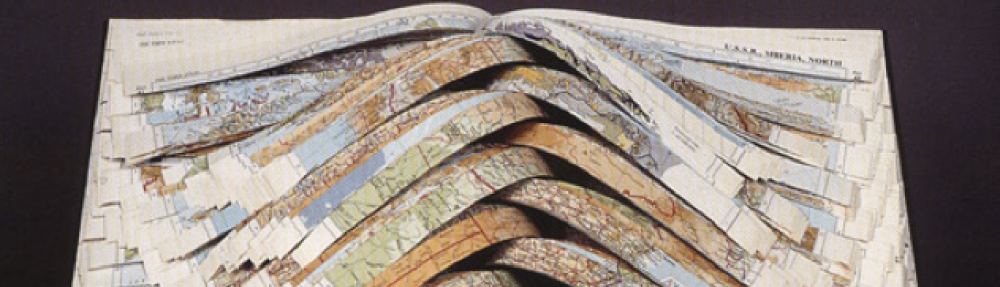
In 1941, Jorge Luis Borges published his short story, “The Library of Babel.” This winding labyrinthine narrative details an infinite library in which every possible book written in every conceivable language is stored within the hexagonal rooms. The librarians of Babel wander through the library and dedicate their lives to reading as many of these books as possible. Some rarely leave the vicinity of the hexagons that they were born in while others search for the Vindications, books that detail someone’s entire life. Others devote their lives to finding what Borges describes as the book of all books, which is theoretically the cipher to the entire library. The desire to learn it all fuels their search and they become consumed by it.
This book of all books is the heart of my project and led me to create the impossible through the form of an artist book. Taking inspiration from the artist books we examined in Special Collections and Amaranth Borsuk’s “The Book,” I created an artist book that utilizes tunnel binding to create the illusion of infinity and capture the weight of Borges’ work. Each hexagon slowly became a room in the library, complete with bookshelves that span the walls and a stray librarian wandering through. I used watercolor paints to add depth and dimension before attaching each paper to an accordion folded strip of paper. This allows the reader to pull the pages out and see the illusion of infinity when looking through the cut out. In Borsuk’s “The Book,” she describes tunnel books, “When fully extended and viewed through an opening in the cover, the tunnel book’s superimposed flat planes create the illusion of depth.” This description inspired me to create a tunnel book in order to portray the infinite in a way that was conceivable. Even the title, taken from a quote of the short story, “The Library exists ab aeterno.” On the back of the first panel, I wrote the first few opening lines from “The Library of Babel.” Due to the construction of the artist book, the reader would have to dismantle and possibly damage the book in order to read the quote. This detail alludes to the frantic destruction of the Library of Babel that some of the librarians caused in search of the Vindications. What I hoped to achieve with this project is to demonstrate the fanatic needto pursue knowledge, to pursue more. We live in a time where information is quite literally at our fingertips and we have become oversaturated with new publications. Due to this, Borges’ work remains prevalent even nearly 85 years later as he demonstrates the deep rooted fanaticism that surrounds books and the pursuit of knowledge.
Borges’ narrator is one of the many librarians who explains the unusual inner workings of the library and how different librarians navigate the books and mythos of the library. He recounts the many theories surrounding the library, and how it was determined to be infinite. He states, “when it was proclaimed that the Library comprised all books, the first impression was one of extravagant joy. All men felt themselves lords of a secret, intact treasure. There was no personal or universal problem whose eloquent solutions did not exist– in some hexagon. The universe was justified, the universe suddenly expanded to the limitless dimensions of hope.” The overwhelming joy at discovering the library is infinite is similar to the introduction of the internet. There were hardly any regulations on what could and could not be done on the internet. This freedom seizes the librarians and leads them into chaos. At first, having all knowledge at hand seems like a good thing as every single problem would have a solution. However, it creates more problems. Borges notes that the librarians became consumed by the possibilities that the library had to offer and sparked their interest in the Vindications. In their search for these biographies, the librarians were frenzied in their lonely searching, abandoning their hexagons, murdering one another, and destroying books in the process. The pursuit of knowledge becomes a dangerous quest that taunts the seeker.
Further in the short story, Borges introduces the concept of ‘the Man of the Book.” Borges writes, “We know, too, of another superstition of that time: the Man of the Book. In some shelf of some hexagon, men reasoned, there must exist a book which is the cipher and perfect compendium of all the rest: some librarian has perused it, and it is analogous to a god.” The concept of the Man of the Book is at the root of my project. The idea of someone discovering and reading the cipher to all knowledge is incredibly moving and it fuels the librarians’ desire to learn more and strive to become a Man of the Book. To read and absorb everything means that they are well rounded in their research and knowledge. Today, readers attempt to read and collect books as fast as they possibly can because there is an incredible influx of media to consume. However it is impossible to read all of it. In Gabriel Zaid’s book, “So Many Books: Reading and Publishing in an Age of Abundance,” he confronts the issue of the overabundance of books and how it is just not possible to read every book published. In his book, Zaid writes, “When we say that books should be read by everyone, we aren’t thinking. Our simple physical limitations make it impossible for us to read 99.9 percent of the books that are written. Humankind writes more than it can read. If for every book published one or two languish unpublished, then two or three million books are written every year.” Much like the librarians’ work being futile, it is impossible today for a reader to attempt to read everything. In order to become a Man of the Book, we must be more open to conversation and piece together information gathered from other people. Zaid remediates these concerns with the suggestion that readers do not need to read everything. Rather, readers should not focus on reading everything but dabble in anything. The conversations drawn together by various media sparks more connection between people. In order to become a Man of the Book, we must be more open to conversation and piece together information gathered from other people.
In conclusion, Borges’ short story, “The Library of Babel” explores the fanaticism of the pursuit of knowledge. We must be aware of the dangers that go along with the search for more. In a time where the market is saturated with new media nearly everyday, it becomes apparent that everything cannot be consumed. Rather, we should focus on cultivating community and inviting conversation to combat the desire to read everything.
Works Cited
Borges, Jorge Luis. “The Library of Babel.” Ficciones. 1941. Grove Press.
Borsuk, Amaranth, “The Book.” The MIT Press. 2018
Zaid, Gabriel. “So Many Books: Reading and Publishing in an Age of Abundance.” Translated by Natasha Wimmer. 2003. Paul Dry Press.
Books are often treated as neutral vessels or objects whose value lies primarily in the text they carry rather than the form that carries it. This assumption persists even as digital media increasingly separates content from materiality of the book, reinforcing the idea that the book’s body is secondary to its meaning. However, this view overlooks the significant ways books function as material, embodied extensions of the book owner. Books are touched, carried, marked, shelved, displayed, damaged, lost, and preserved. They archive time and attention, hold the memories of their use, and occupy space within cultural happenings. When one collects books, they have a full archive of who they are. They do not merely reflect identity but serve to form identity as well. My bookwork project argues that personal book collections function as bodily extension and identity through material ownership. Similarly, DNA is a double helix structure that has intertwining nucleotides, like books in a personal library, that hold the genetic information that makes us who we are as individuals. In other words, our identity. To explore this claim, I created a sculptural bookwork that is a double-helix DNA structure composed of pages and covers from my personal library.
The Book Helix is a sculptural bookwork that materializes my argument that books as objects function as extensions of the body and archives of the self. Constructed as a double-helix DNA structure using pages and covers from my personal library, the bookwork visualizes how just as DNA encodes the genetic information that defines who we are. Personal books in a book collection work like nucleotides in DNA helix to encode memories, intimate reading experiences, and material traces like marginalia that collectively shape identity.
The choice of DNA as a formal metaphor is intentional. DNA holds information that determines how a body develops, adapts, and survives, similarly, books encode the ideas, values, and affective experiences that shape who we become. The pages used in the sculpture are not interchangeable. They are taken from books that have marked specific moments in my life such as periods of learning, uncertainty, affirmation, and change. In this sense, the work treats books not solely as commodities but as material traces of lived experience of my life narrative. Each strand represents a trajectory of intellectual and emotional development, while the spiral structure emphasizes continuity, inheritance, and growth over time with each new book added to my collections. By transforming books into a bodily structure, the work insists on the vulnerability and intimacy of reading practices. It asks viewers to reconsider their own libraries.
Susan Stewart’s On Longing explains important ideas for understanding personal libraries as identity forming archives, a concept that is materially portrayed in The Book Helix. Stewart argues that book collections derive meaning from their accumulation, arrangement, and proximity to one another (Stewart, 1993). Objects within a collection become narrative markers, producing meaning through their intimate relationships and proximity to one another and the owner. When applied to books, this idea reveals how personal libraries function as material autobiographies. They are archives that record who we have been, what we have valued, and how we have changed over time.
Books acquire significance through the specific moments at which they enter our lives. We collect books as gifts, during periods of curiosity or obsession, through academia or education, or as part of childhood. Each book marks a particular memory, experience, or emotional context. When books remain in a personal collection, they become fixed points in an evolving narrative of selfhood. The Book Helix materializes this process by using pages and covers from books acquired at different moments in my life, treating each page as a narrative marker rather than as a simple vessel of text. The sculpture portrays a visible accumulation of markers from my personal library, demonstrating how identity is formed through lived experience. Each page functions as a material “marker” drawn from a specific book within my collection, and, like nucleotides within a DNA strand, these fragments accumulate over time forming who I am.
Stewart’s emphasis on accumulation and proximity is central to the structure of The Book Helix. Rather than having individual books on their own, the sculpture intertwines pieces from many texts into a single double-helix form. This reflects Stewart’s argument that collections produce identity through narrative association. The helix structure emphasizes continuity, suggesting that identity is not composed of discrete moments but formed through overlapping experiences that persist over time. Books function especially powerfully within collections because they register time in visible ways. Marginalia, underlining, old post-it notes, cracked spines, and faded covers act as inscriptions of lived experience. These marks transform books into what Stewart describes as souvenirs. These objects matter because of the memories attached to them not because they can be exchanged or replaced (Stewart, 1993). In The Book Helix, these material traces are preserved rather than erased. Pages bearing signs of wear are incorporated into the sculpture highlighting how books are a primary source of meaning. The work insists that these traces are not damage but memory.
The Book Helix also demonstrates how fragile pages are turned into a bodily structure, reinforcing the idea that books function as extensions of the self. Like DNA, which carries information necessary for continuity and survival, personal books store individual experiences and memories that cannot be replaced by another copy. The Book Helix shows how books within a collection operate as material anchors of identity and objects that preserve the past while remaining physically present in the ongoing formation of the self.
While Susan Stewart’s argument explains how personal libraries work as narrative systems of identity, it does not fully account for how the materiality of the book itself actively produces meaning. Stewart shows why books matter within collections, and Johanna Drucker’s work clarifies how books matter as objects. Where Stewart emphasizes accumulation and memory, Drucker turns attention to material structure. They argue that the book is not a neutral container but a performative object whose physical properties shape interpretation and experience (Drucker, 1995). This shift from collection to form is essential for understanding The Book Helix, which does not assemble books as symbolic artifacts but transforms their material bodies into a new structure that is meaning making.
Rather than treating the book as a simple medium, this approach demonstrates how structure and physical presence shape interpretation. Johanna Drucker’s The Century of Artists’ Books argues that books are not passive vessels but performative objects, whose properties actively produce meaning (Drucker, 1995). Artists’ books, in particular, disrupt the illusion that books should disappear in the act of reading. By making books through unconventional structures, like sculptural configurations, artists’ books expose the ideological norms embedded in conventional codex design. The Book Helix pages used in the sculpture cannot be read sequentially. This challenge of linear reading norms redirects attention from textual content to material presence. What matters is not what the books say, but what they have held: personal experience, use, and memory. By transforming books into a DNA structure, the bookwork portrays their role as makers of identity.
Janice Radway’s essay “Reading Is Not Eating” challenges dominant ideas that paint reading as consumption. Radway critiques the idea that texts are passively absorbed by readers, arguing instead that reading is an active, interpretive, and socially situated practice (Radway, 1986). If reading were simply a form of ingestion, books would lose their value once their informational purpose was fulfilled. However, readers routinely keep books they may never reread, preserving them for reasons that exceed utility. These attachments reflect the relational nature of reading. Books are not depleted through use. They accumulate meaning through continued presence. Radway’s argument helps explain why material traces such as marginalia, creased spines, or underlined passages matter. These marks do not indicate consumption but interaction. They show moments of emotion or transformation. Books thus become records of embodied engagement and the formation of identity.
To understand books as bodily extensions requires a shift away from seeing them as external tools and toward recognizing them as material participants in the formation of identity. This perspective challenges the assumption that the book’s role ends once its text has been read. Instead, books persist as objects that absorb traces of interaction, memory, and affect, functioning in ways that closely resemble the body itself.
Drucker argues that books are performative forms whose material structures actively produce meaning (Drucker, 1995). The codex, with its sequence, binding, and tactility, organizes bodily engagement like how a reader holds the book, turns its pages, or navigates its materials. These physical interactions are not secondary to interpretation. When books are treated as bodily extensions, their material vulnerabilities take on new significance. A cracked spine, a torn page, or water damage is more than aesthetic deterioration. These marks resemble evidence of time, use, and survival. Drucker’s emphasis on material presence allows us to see such damage not as failure but as bodies that age. They accumulate marks that reflect lived histories rather than idealized forms.
Janice Radway’s statement that “reading is not eating” supports that books work as a bodily extension of its owner. Radway challenges consumption-based metaphors that portray reading as a process of ingestion followed by disposal (Radway, 1986). If reading were truly consumptive, books would lose relevance once their informational content was absorbed. Yet readers rarely treat books this way. Instead, they keep them, return to them, and allow them to occupy space in their lives long after the act of reading has concluded. This persistence shows that books function relationally rather than instrumentally.
Radway’s argument reframes reading as an interactive and embodied practice, one that produces long lasting emotions. Marginalia, underlining, bending the corner of a page, and stains are not signs of use in the sense of depletion, but records of engagement. These marks transform books into hybrid objects of part text and part autobiography. In this way, books begin to serve bodily extensions. Books remember where we lingered, where we struggled, and where we returned.
A personal library is not merely a collection of random items but a curated narrative or archive that tells a story about its owner. What matters is not only which books are present, but how long they remain, where they are placed, and which are allowed to coexist. Stewart notes that souvenirs are valued not for their intrinsic properties but for their ability to anchor memory and sustain personal narrative. Books operate similarly. A book kept for years often holds significance because it marks a particular moment in an individual’s life such as a course taken, a period of questioning, a relationship, or a shift in worldview. The book’s continued presence allows that moment to remain accessible, materially embedded in everyday space.
The DNA metaphor at the center of The Book Helix makes this argument visible. DNA encodes biological information that creates growth, development, and continuity. Similarly, books encode the intellectual, emotional, and personal experiences that shape identity over time. By constructing the sculpture from pages and covers taken from my personal library, the work treats books as material carriers of personal history rather than abstract symbols of knowledge. The double-helix structure emphasizes relationality. Identity, like DNA, is not linear or singular but produced through interaction and repetition. Reading experiences accumulate, overlap, and sometimes contradict one another, but together they form an evolving self. The intertwined pages in the helix reflect this process suggesting that no single book determines identity. Instead, meaning emerges through entanglement, through the ongoing presence of many texts within a shared material space.
Ultimately, to think of books as bodily extensions is to acknowledge that identity is not formed solely in the mind. It is shaped through sustained, material engagement with objects that carry memory and meaning. Books become part of the self not because they contain information, but because they participate in lived experience, absorbing traces of who we were at the moment of encounter. The Book Helix invites viewers to reconsider their own relationships with books. What stories do our shelves tell? What parts of ourselves are stored in the objects we preserve? And what does it mean to care for books not simply as sources of information, but as extensions of who we are?
Work Cited
Borsuk, Amaranth. The Book. MIT Press, 2018.
Drucker, Johanna. The Century of Artists’ Books. Granary Books, 1995.
Pressman, Jessica. “Bookwork and Bookishness.” Interview with Brian Dettmer and Doug Beube, 2018.
Pressman, Jessica. “Jonathan Safran Foer’s Tree of Codes: Memorial, Fetish, Bookishness.”, 2018.Radway, Janice. “Reading Is Not Eating.” Feminist Studies, 1986.
Stewart, Susan. On Longing: Narratives of the Miniature, the Gigantic, the Souvenir, the Collection. Duke University Press, 1993.
The transformation of Thomas Moffet’s Insectorum Theatrum from a working scientific reference into a gilded collector’s item reveals how the materiality of books shapes not only their preservation but also their meaning, demonstrating that a text’s physical evolution across centuries creates layers of interpretation that are as significant as the content printed on its pages. My specimen box installation makes this argument tangible by literally treating the book’s material transformations as collectible evidence, turning the collector’s gaze back onto the collected object itself. By arranging fragments of marbled paper, gilded edges, tea-stained pages, and library labels in a shadow box like pinned insects, I’m asking viewers to examine the Insectorum Theatrum the way Moffet examined butterflies and beetles, as an object whose physical characteristics tell us something essential about its place in the world.
The specimen box format creates an immediate visual parallel between Moffet’s entomological project and my own project of studying book history. Just as Moffet collected, classified, and preserved insects to understand the natural world, I’ve collected material evidence of how this book was valued across time. Each pinned specimen in my box (the gilt paper edges catching light, the brown-stained pages showing centuries of handling, the pristine library catalog card) represents a distinct moment when someone decided what this book should be. The handwritten labels mimicking scientific specimen tags force viewers to look at book materials with the same careful attention a naturalist gives to examining a preserved moth. When I write “Specimen E: Marbled calf binding, c. 1780-1820” I’m treating that swatch of marbled paper as seriously as Moffet treated his insects, suggesting that the physical traces of a book’s life deserve systematic study and classification.
What makes this format particularly effective for my argument is how it physically separates material elements that originally existed together in one object. In my midterm, I wrote about how the gilt edges served as a “hinge point” in the book’s biography, marking when it stopped being a scientific reference and became a collector’s treasure. But when you look at the actual Insectorum Theatrum in Special Collections, all these different historical moments exist simultaneously in one bound volume, you can’t really see the 1634 working reference separately from the 18th-century rebinding. My specimen box pulls them apart. The tea-stained page with insect woodcuts sits on the right side of my box, representing the original naturalist use. The gilded edges and marbled paper is evidence of luxury transformation. The library materials cluster on the bottom corner, showing institutional ownership. By isolating each transformation as its own specimen, I’m making viewers experience what I argued in my midterm, that we need to understand each material intervention as a distinct moment with its own meaning and its own community of readers, even though they’re all part of the same object’s history.
Walter Benjamin’s essay “Unpacking My Library” helps me understand what I’m actually doing when I create this specimen box. Benjamin writes about how “for a true collector, the background of an item (its period, region, craftsmanship, former ownership) forms a ‘magic encyclopedia’ of which the object’s fate is the quintessence” (p. 3). When I gilded paper edges myself and created marbled patterns with shaving cream, I wasn’t just making props for an art project. I was trying to understand what Benjamin calls the collector’s way of seeing, where every object carries the weight of all the hands that touched it and all the decisions that shaped it. The act of physically creating these specimens made me think about the labor that went into transforming Moffet’s book. Gilding edges is harder than I expected. Your hand cramps and the gold paint gets everywhere and you realize that whoever did this to the actual Insectorum Theatrum in the 1780s spent hours on something that most readers would barely notice. That invisible labor is part of the book’s biography too.
But here’s where my project complicates Benjamin’s ideas about collecting. Benjamin celebrates the collector’s intimate, almost mystical relationship with objects. He writes that “for a real collector, ownership is the most intimate relationship with objects; it is not that objects come alive in the collector, but that the collector lives in them” (p. 7). The gentleman who paid to have Moffet’s book rebound in marbled calf and gilt-edged definitely had that kind of relationship, he saw the book as worthy of his dwelling, of his personal library that represented his cultivation and taste. But my specimen box argues that this collector’s love actually changed what the book meant. The tea-stained pages I created show a book that was used, consulted, maybe even taken into the field by naturalists. That’s a very different relationship to the object than the one represented by my pristine marbled paper specimens. When the book got gilded and rebound, it stopped being a tool and became, as I wrote in my midterm, “more copy than book, valued for its unique material properties rather than as a reproducible vehicle for intellectual content.”
My specimen box puts these different relationships on display simultaneously, which creates a kind of tension. The working reference specimens look messy and real, I intentionally crumpled them and added coffee stains and torn edges. They’re meant to feel handled, consulted, lived-with in a practical way. The luxury transformation specimens are beautiful and untouchable, with their shimmering gold edges and swirled marbling patterns that took forever to get right. And the institutional specimens are clinical and sterile, just printed labels and catalog cards that reduce the book to call numbers and preservation notices. Benjamin might say the middle phase represents the collector’s deepest relationship to the object, but I’m not so sure. Maybe the naturalist who spilled coffee on page 47 while trying to identify a beetle had just as intimate a relationship with the book, even if he didn’t gild its edges.
The shadow box itself (the glass case that contains all these specimens) performs the same transformation that happened when the Insectorum Theatrum entered Special Collections at SDSU. Benjamin writes about how the collector “lives in” his objects, building a dwelling with books as building stones. But what happens when that private collection becomes a public archive? The glass front of my specimen box literally puts the materials behind a barrier. You can look but you can’t touch, just like the actual book in Special Collections. By mounting my specimens behind glass, I’m showing how institutional ownership changes the collector’s intimate relationship into something more distant and studied. The book that was once part of someone’s personal dwelling is now a teaching object, valuable for what it can tell students about book history rather than for what it can tell naturalists about insects.
In the end, my specimen box argues that books have biographies just like people do, and their physical materials are the evidence of those lives. Each pinned specimen represents a different chapter( working tool, luxury object, teaching resource) and none of these identities completely replaces the others. They all exist simultaneously in the physical object we hold today. By treating the book’s materials as specimens worthy of collection and classification, I’m using Moffet’s own methodology against his book, or maybe for his book, turning the scientific gaze back onto the object that enabled that gaze in the first place. The Insectorum Theatrum collected insects; collectors collected the Insectorum Theatrum; and now I’ve collected the material traces of that collecting. It’s collectors all the way down, each one leaving their mark in gilt and marbling and catalog cards, each one transforming what came before while trying to preserve it.
Works Cited
Benjamin, Walter. “Unpacking My Library: A Talk about Book Collecting.” Illuminations, edited by Hannah Arendt, translated by Harry Zohn, Schocken Books, 1969, pp. 59-67.
Through a media‑specific analysis of Ethiopian healing scrolls, books become most meaningful when they are worn, carried, and embodied. The scroll’s stitched construction, tailored length, and bold imagery position it within a long lineage of wearable books, demonstrating that portability and customization are not secondary features but central mechanisms through which texts produce identity, mobility, and spiritual efficacy.
Part 1: The Bibliography
At the San Diego State University Library’s Special Collections and University Archives, Ethiopian healing scrolls sit quietly in their boxes, but everything about them suggests movement. They are long, narrow composite objects made from parchment strips sewn end‑to‑end. Each strip is thick and stiffened, lighter on the flesh side and darker on the hair side. The joins are stitched with leather using simple overcast or paired‑hole sewing, forming a continuous roll that can stretch several feet while remaining only a few inches wide. Rolled inward, the inscribed surface is protected, as if the scroll curls around its own meaning.
The vellum is coarse and rigid with age. Edges cockle, some strips crease from repeated rolling, and occasional thinning appears near stitch sites. Despite surface wear, the substantial thickness of each strip keeps the structure sound. The scroll is thick and stiff, wanting to stay curled up due to being unused for years. Text runs vertically in single columns along the length of the scroll. Decorative ruling separates text from pictorial fields, and faint guidelines help maintain margins. The Ge’ez script is written in black ink, with a secondary pink pigment used sparingly to highlight names or details. The consistent hand and occasional corrections suggest a single scribe working directly on the parchment.
Horizontal decorative bands—zigzags, triangles, chevrons—divide sections and frame images. Illustrations appear between these bands and are typically schematic: haloed figures, crosses, protective talismans, or anthropomorphic spirits. Bold outlines and selective color accents emphasize heads, eyes, or symbolic attributes. Marginal talismanic signs and small diagrams inhabit the spaces between text and image.
The scroll’s narrow width and considerable length reflect its purpose as a portable ritual tool. Handling wear appears along the edges and outermost layers, while repeated creasing marks frequent unrolling. The reverse side sometimes contains practice strokes or ingredient lists, suggesting practical use by a healer. Alternating text blocks and pictorial vignettes create a ritual sequence, guiding the practitioner through incantations and protective images.
Ownership marks vary: small inscriptions, seals, or later annotations. Repairs—patched holes, re‑stitched joins, added cloth or leather—demonstrate long-term use and value. As material objects, these scrolls sit at the intersection of manuscript, talisman, and ritual implements. Their stitched construction, combined inks, and clear signs of handling identify them as portable healing tools maintained by practitioners rather than books intended for passive reading.
Part 2: The Analysis
Ethiopian healing scrolls are religious objects designed to move: long, narrow rolls of parchment whose images, texts, and physical form work together as portable technologies for purging illness and restoring mobility. As Amaranth Borsuk notes, a book’s meaning emerges through how it is handled, and the scroll’s form is inseparable from the ritual actions it enables. Tailored to individual wearers, the scroll alternates Ge’ez text with pictorial plates exposed sequentially during rites meant to expel harmful forces.
The scroll’s construction emphasizes durability and portability. Thick parchment strips sewn end‑to‑end allow the roll to be tightly wound for transport and repeatedly unrolled for ritual display. Its narrow width minimizes bulk, while the long linear format provides a staged sequence: the healer unrolls to the next image, performs the invocation, then rerolls the scroll. Unlike a codex, which favors stationary reading, the scroll’s rolled format is optimized for motion—carrying, wearing, and field use. Jessica Pressman’s argument that new media revive older forms helps illuminate this contrast: the scroll’s mobility and image‑text hybridity anticipate contemporary portable media that merge functionality with embodied interaction.
Many healing scrolls are bespoke objects made to a client’s height so the unrolled sequence corresponds to body zones. The client’s name often appears, confirming the scroll’s directed purpose. This personalization allows the scroll to be wrapped around the body, converting it into a wearable talisman. Image placement follows a bodily logic: protections for the head appear near the top, those for the torso or abdomen appear mid‑scroll. Michelle Levy and Tom Mole emphasize that books acquire meaning through “the conditions of their use,” and the scroll’s customization demonstrates how its physical form is shaped by the needs of its wearer.
The pictorial program is central to the scroll’s function. Images are schematic and bold—emphasizing heads, eyes, haloes, or geometric talismans—so they read quickly during ritual exposure. High‑contrast outlines and selective color accents highlight operative features. Decorative bands frame each plate and act as tactile markers, enabling quick navigation. The imagery functions as both symbol and instruction, signaling which spiritual agent to invoke and which gesture to perform. Johanna Drucker’s work on artists’ books clarifies this dynamic: material structure shapes how readers navigate and interpret a book, and the scroll’s alternating bands of text and image direct ritual performance.
These scrolls are explicitly religious instruments whose therapeutic mechanism is spiritual. Christian iconography—crosses, haloed figures, archangels—combines with apotropaic geometries to anchor authority and repel harmful forces. The healer’s use of the image—exposure, touch, movement over the afflicted body—constitutes a ritual technology that enacts exorcism and restores mobility. Portability is integral: the scroll must travel to the afflicted, act upon their body, and accompany them back into social life.
Wear patterns and repairs document frequent handling. Darkened edges, creasing, and re‑stitched joins reveal repeated use. Leah Price notes that books often circulate as objects valued for their handling as much as their content, and the scroll’s accumulated wear makes visible its social life. Marginal additions and later hands mark episodes of adaptation for new clients. Mark Marino’s discussion of marginalia as evidence of a text’s evolving social life resonates here: added marks document the scroll’s movement through households and communities.
Mobility is also social and economic. Scrolls circulate as commissioned goods, gifts, or loaned items. Their production and repair involve craft resources and payments, creating ties among clients, healers, and suppliers. Ownership inscriptions and seals trace networks of care. Borges’s vision of an immobilized library contrasts sharply with the Ethiopian scroll, a book designed to circulate and act in the world.
Ultimately, the scroll’s purpose is to restore the patient’s capacity to move. In societies where mobility links to livelihood and social participation, a portable ritual technology that travels to the afflicted is especially significant. Wearing a scroll made and named for you aids reentry into everyday movement, signaling protection and documenting intervention. Viewed through mobility, Ethiopian scrolls appear as engineered objects whose structure, imagery, and repairs make them effective tools for itinerant spiritual care. Tracking scrolls as moving things recasts them not as static artifacts but as active participants in networks of healing, exchange, and movement that sustained religious life in Ethiopia for centuries.
Part 3: Books as Clothing, Books as Accessories: Embodied Reading and the Mobility of Text
Extending this analysis of mobility, Ethiopian healing scrolls also invite us to consider a broader and often overlooked dimension of book history: the ways books function as clothing, accessories, and wearable media. When a book is worn rather than held, its meaning shifts. It becomes not only a vessel for text but an object that participates in the shaping of identity, movement, and embodied experience. The Ethiopian healing scroll makes this dynamic unmistakable. Its form—long, narrow, stitched, and tailored to the wearer’s height—transforms it from a manuscript into a garment of protection, a piece of spiritual equipment designed to inhabit the body as much as accomExtending this analysis of mobility, Ethiopian healing scrolls also invite a broader reconsideration of what books are and how they inhabit the world. Their stitched parchment bodies, tailored lengths, and bold image‑text sequences reveal that books do not merely sit in hands or on shelves—they inhabit bodies. They wrap, touch, travel, and accompany. They are worn as much as they are read. When a book becomes something that can be carried on the body, wrapped around it, or displayed upon it, its meaning shifts. It becomes not only a vessel for text but an object that participates in shaping identity, movement, and embodied experience.
Amaranth Borsuk’s claim in The Book that books are “mutable interfaces” becomes especially resonant here. The Ethiopian scroll is not an interface between reader and text alone; it is an interface between body and world, mediating spiritual danger and physical vulnerability. Its portability is not incidental but essential: the scroll must move with the wearer because its power is activated through movement, wrapping, and bodily proximity. In this sense, the scroll is not simply read—it is embodied. Its meaning emerges through touch, motion, and the intimate contact between parchment and skin.
This embodied quality places Ethiopian scrolls within a much longer history of books as wearable objects. Michelle Levy and Tom Mole remind us that book history is shaped by “the conditions of [books’] use,” and those conditions have often included being worn, displayed, or carried on the body. Medieval girdle books hung from belts; miniature prayer books were tucked into pouches or suspended from rosaries; locket‑books held tiny devotional texts worn against the chest. In each case, the book’s portability shaped its function and its social meaning. A girdle book signaled piety and literacy; a locket‑book signaled devotion and intimacy. Ethiopian healing scrolls similarly signal protection, vulnerability, and spiritual identity. They are not merely texts but accessories of faith, designed to be seen, touched, and carried as part of the wearer’s daily life.
Understanding why people might want to wear books requires recognizing that books have always been more than repositories of information—they are objects that confer identity, intimacy, and agency. Wearing a book transforms it from a tool of reading into a tool of self‑fashioning. As Leah Price argues, books often circulate as objects whose value lies in their handling and display as much as in their textual content. While Ethiopian scrolls are not fashion accessories in the modern sense, they participate in a similar logic: wearing a scroll is a visible declaration of one’s spiritual needs and protections. It communicates vulnerability, faith, and the presence of ongoing ritual care. The scroll is not hidden away but worn, displayed, and recognized. Its presence on the body is itself a form of communication.
This is where individuality and customization become crucial. Ethiopian healing scrolls are bespoke objects: their length matches the client’s height; their inscriptions include the client’s name; their images are arranged to correspond to the wearer’s body. This degree of personalization is not decorative—it is essential to the scroll’s function. A scroll tailored to a specific body asserts that healing is not generic but individual, that protection must be fitted to the person who needs it. Levy and Mole’s emphasis on the “social lives of books” helps clarify this: the scroll’s life is inseparable from the life of its wearer. Customization becomes a form of recognition. The scroll acknowledges the wearer’s singularity, their embodied experience of illness, and their desire for protection that is literally made for them.
The scroll’s design reinforces this wearable, individualized function. Its narrow width, stitched joins, and rolled storage make it easy to carry on the body, slip into a case, or wrap around the torso. Its images—bold, schematic, high‑contrast—are optimized for quick recognition during ritual exposure. Its decorative bands act as visual and tactile markers, enabling navigation even in dim interiors or crowded marketplaces. These features are not ornamental; they are ergonomic. They allow the scroll to function as a wearable tool, a piece of spiritual equipment that moves with the healer and the patient. The scroll’s portability is therefore inseparable from its religious purpose: it must travel to the afflicted, act upon their body, and accompany them as they reenter the social world.
Johanna Drucker’s work on artists’ books helps articulate why this matters for understanding the scroll as a medium. Drucker argues that artists’ books challenge conventional assumptions about what a book is by foregrounding materiality, structure, and reader interaction. They make the reader aware of the book’s physical form and the ways that form shapes meaning. Ethiopian healing scrolls participate in this tradition long before the term “artists’ book” existed. Their form is their argument: the scroll’s healing power depends on its portability, its tactility, and its ability to be worn. Its material design is not an aesthetic choice but a theological one.
Mark Marino’s discussion of marginalia as evidence of a text’s evolving social life offers a final point of connection. The scrolls bear repairs, stains, creases, added talismans, and ownership notes. These marks are not accidents; they are evidence of movement. They show that the scroll traveled, was handled, was worn, was used. They are the physical equivalent of digital marginalia—traces of a book’s social life. Marino’s framework helps us see the scroll not as a static artifact but as a dynamic, evolving object shaped by the bodies that carry it.
Taken together, these perspectives reveal that Ethiopian healing scrolls are part of a broader history of books that move with the body, act upon the body, and become part of the body. They are wearable books whose portability is inseparable from their religious function. They are accessories that signal identity and vulnerability. They are garments that protect and heal. And they remind us that books have always been more than texts—they have been tools, companions, ornaments, and extensions of the self.
By reading the scroll through the lens of media‑specific analysis—and by engaging Borsuk, Levy & Mole, Price, Drucker, and Marino—we see that the scroll is not an anomaly but a reminder: books have always been bodies, and bodies have always been books.
Taken together, the Ethiopian healing scroll and the broader history of wearable books reveal that media are never neutral containers but active participants in the lives of the people who carry them. The scroll’s stitched construction, tailored length, bold imagery, and accumulated repairs show how a book can become a garment of protection, a tool of healing, and a record of movement across bodies, households, and generations. Its portability is inseparable from its purpose: to travel to the afflicted, to act upon the body, and to restore the very mobility that illness threatens. By reading the scroll through media‑specific analysis—and by situating it alongside traditions of girdle books, locket‑texts, and other wearable forms—we see that books have always been shaped by the conditions of their use, and that those conditions often involve touch, movement, and embodiment. The scroll ultimately reminds us that literature is not only something we read but something we inhabit: a medium that wraps around us, moves with us, and becomes part of how we navigate the world.
The Creation of a Personalized Healing Scroll
This handmade scroll functions as a wearable book—an individualized, portable, and spiritually charged media object that connects Baptist Christian heritage to the Ethiopian healing scrolls studied in class. Through stitched structure, symbolic imagery, and personalized inscriptions, the scroll enacts a media-specific theology of protection and identity, showing how books can be worn, embodied, and lived.
The scroll opens with an angel: afro‑textured hair, a halo, and a green eye on her dress. She stands at the top like a guardian, but also a witness. Beneath her, the inscription reads: “For her, Alexis Naomi, for whomst God gave his only begotten son.” The phrasing echoes John 3:16, in the King James Version, but shifts the tone toward intimacy and direction. Naming the recipient transforms the scroll into a personal object, much like Ethiopian healing scrolls that include the client’s name to anchor the work in a specific life.
The next section contains the Lord’s Prayer (Matthew 6:9–13), written in full. These familiar lines—often recited in church pews—take on a different presence when placed on a scroll meant to be worn. Surrounding the prayer are geometric patterns and symbolic drawings: a cross, a sun, a moon, and two open hands. These images form a visual grammar similar to the pictorial logic of Ethiopian scrolls, where symbols guide ritual action as much as text does. The hands suggest offering or surrender. The celestial symbols mark rhythm and divine order. The cross anchors the scroll in Christian iconography, while the surrounding elements expand its meaning beyond doctrine.
Further down, two closed eyes wearing makeup appear above the phrase “See no evil, child.” This line blends apotropaic logic with personal instruction. Ethiopian scrolls often use eyes, nets, and geometric traps to repel evil; here, the eyes are stylized and adorned, suggesting discernment rather than blindness. The phrase carries both protection and reassurance.
The final sections shift into prayer: “Please, protect this sinner as she is merely lost. But she will find herself at her destination, wherever that may be. Guide her safely, on the journey.” And then: “Remember your roots,” written above a tree. The tree grounds the scroll, connecting spiritual journey to ancestry, place, and growth. From angel to tree, the scroll moves vertically—heaven to earth, spirit to body.
The scroll is stitched with green thread, chosen for its personal significance. Black ink carries the words, with green highlights woven throughout. The material itself—lined notebook paper—reflects a practical truth shared across cultures: people make do with what they have. Ethiopian scrolls were made from parchment because that was available; this scroll uses notebook paper for the same reason. The choice underscores a continuity between past and present: sacred or meaningful books do not require rare materials, only intention and care.
The decision to make a scroll rather than a codex came from a desire to see whether personal beliefs could be expressed not only in words but in physical form. A scroll invites movement. It unrolls, wraps, and extends. It becomes something that can be worn, not just read. This aligns with Amaranth Borsuk’s description of books as “technologies that invite certain actions and discourage others.” The scroll is not meant to sit on a desk. It is meant to be carried, touched, and activated through motion. Ethiopian healing scrolls were tailored to the client’s height; this one is tailored to the torso, designed to be worn like a sash. Its meaning is inseparable from its physicality.
Michelle Levy and Tom Mole’s emphasis on the “material conditions that shape how books are produced and used” also resonates here. The scroll’s use is devotional, but also archival. It documents spiritual history, aesthetic preference, and emotional state. It is a record of belief and doubt, stitched together with thread and memory. In this sense, it belongs to a tradition of wearable media—girdle books, locket‑texts, and the Ethiopian scrolls studied in Special Collections. Each of these objects gains meaning not only from what is written on them, but from how they are carried and by whom.
Leah Price’s observation that books often function as “objects that circulate socially, not just texts that are read” offers another layer. This scroll is not about status in the conventional sense, but it is a declaration. It says: faith matters. Protection matters. Personalization matters. It is a visible, material sign of spiritual care. Not hidden away, but displayed, worn, and recognized. The scroll becomes a way of carrying belief outward, making it part of daily movement rather than private contemplation.
The scroll also reflects the course’s emphasis on media-specific analysis. This class taught that books are not just texts—they are technologies, objects, artforms, and archives. The scroll embodies all of these roles. It moves, protects, remembers. It is a wearable archive of Baptist upbringing, aesthetic choices, and evolving relationship to faith. It demonstrates how form shapes meaning, how material choices matter, and how books continue to matter as physical objects in a digital age.
In the end, the scroll is not perfect, and it is not traditional. But it is deeply personal. It carries meaning in its words, its images, its stitches, and its paper. It shows that interpretation does not require expertise—only attention, curiosity, and a willingness to ask why. And it proves that belief can live not only in the mind, but in the hands, the body, and the objects we choose to make.
Works Cited
Borsuk, Amaranth. The Book. MIT Press, 2018.
Borges, Jorge Luis. “The Library of Babel.” Labyrinths: Selected Stories and Other Writings, edited by Donald A. Yates and James E. Irby, New Directions, 1964, pp. 51–58.
Drucker, Johanna. The Century of Artists’ Books. Granary Books, 1995.
Levy, Michelle, and Tom Mole. “Introduction.” The Broadview Introduction to Book History, Broadview Press, 2017, pp. 9–28.
Marino, Mark C. “Marginalia in the Library of Babel.” markcmarino.com, https://markcmarino.com/diigo/..
Pressman, Jessica. “Old/New Media.” The Johns Hopkins Guide to Digital Media, edited by Marie-Laure Ryan, Lori Emerson, and Benjamin J. Robertson, Johns Hopkins University Press, 2014, pp. 318–323.
Price, Leah. What We Talk About When We Talk About Books: The History and Future of Reading. Basic Books, 2019.
Windmuller-Luna, K. Ethiopian healing scrolls. The Metropolitan Museum of Art, 2015
The book is a perfect object for consumption. The book as an object has the ability of satisfying each of a person’s five senses, making it an object that is wholly consumable by people and that is useful beyond its capacity to hold and preserve text. Books may take a variety of different shapes and appearances, they are able to be presented in both physical and digital spaces in a number of varying forms, however, within this essay the form of the book which should be considered is that which is bound with a front and back cover with paper pages within. This work will primarily refer to Penguin Publishing Group ‘Classics’ paperback books as an example and definition of a book object. This specific selection of a Penguin book is to be able to utilize what to many be the most commonly known and recognized book form and shape. Since the Penguin Publishing Group is one of the most popular books publishers in the world, the form its books take can be used to exemplify what most people would consider a “book,” to be. Books are perfect objects for consumption. The text featured on and within books is not the only part of the object which is interacted with, the entirety of a book is consumed by each of a person’s five senses when they are within its presence. Readers may easily consume the book through sight, touch, hearing, taste, and olfaction which reflects how the medium of the book, its physical presence and tangibility is as impactful upon the reader as the actual text on its pages. The physicality and the ability of the object to be consumed matters, it creates and initiates the interaction between reader and book to result in the reading of the text within.
The consumption of the book is initiated by one setting their sights on it. The visual exterior aspects of the book are the first impression of the book upon the reader and the first features to be significantly consumed by a reader. The design of a book is not an aspect that is simply passed over by readers, it is a principal feature that a person will fully behold and sample before deciding whether or not to open the book object. The visual form of the book is carefully designed for this consideration and consumption so that it may convince the reader to open the book object. When placed on a shelf among other books a spine will be the first feature of a book to be displayed, it must be attractive and appetizing to the viewer. When designing the spines of its books, Penguin Random House designers focus on creating spines that will, “pop on the shelf,” make one think, “Ooh I want to see more of that,” and that will appeal to the desire of having, “a selection of nicely put together spines from a series.” (Penguin, 2021).
The current lettering and design of spines that is common among many publishing houses was influenced and established because of Penguin’s design. As Penguin Archivist Thomas Birkhead describes, when paperback books began to increase in popularity the company’s publishers started to “pay a little more attention,” to the design of the spines, and decided to letter them vertically instead of horizontally (Penguin 2021). Although the spine of the book is at times minimal and simple, it is vital, the spine, providing the title, author’s name, and publishing house is exact, perfectly created for quick consumption by the readers eyes to convince them to pick up the book in mere seconds. The spine is the introductory component of the book, the hors d’oeuvre being the first aspect of the book to be seen by the reader and ingested by the reader that has convinced them to pull the object from the self.
In a person’s hands the book is viewed by its cover, before being opened the front and back covers are viewed to be consulted and judged by the holder’s eyes, perfectly designed to appeal to them and to convince their opening of the object. The viewing of a book’s covers is part of its consumption, they present a feast for the eyes’ consideration. The covers of books are designed with extreme care and attention, being, as Penguin Random House Children art director Anna Billson describes, collaborative projects between, “editors and the marketing, sales and production teams.” whose goal is to “visually,” bring to life what readers look for on shelves (Penguin, 2021). Book covers are products for readers, they are lively portrayals of the book that are essential for the reader’s attraction and appetite toward any specific book, one of the first features analyzed and looked at. The design of a cover may at times go through as many as twenty meetings, a great amount of consideration and study is taken to produce a perfect cover (Penguin, 2021). Covers are made to be appealing and intriguing to the taste of their specific audience and targeted reader, their design is curated so that said person viewing them will be perfectly pleased and interested by what they have just visually consumed.
The object and shape of the book, which is perfect to hold and carry, is specially created for a tactile experience, to be enjoyably held, felt, and cradled by the reader for an intimate and satisfying interaction and inherent absorption. The covers of many books are matte, Penguin specifically, made their classics matte in 2007 under art director Jim Stoddart (Penguin 2025). By doing so they now produce softcovers which are matte, smooth, and flexible and provide a comfortable tactile interaction with the book.
A book’s ‘smoothness,’ while lacking in glossy ‘slipperiness’ creates a pleasant physical interaction of the book that further promotes its consumption and reading. Soft cover books like Penguin’s which tend to be sized in dimensions of each cover being “129mm in width and 198mm in height,” featuring a spine of “20mm,” which makes a layout size of “270mm wide by 198mm tall.” (Penguin, 2025). This size allows for the object to be comfortably held, its softcover being lightweight and flexible as well, for easy transportation, carrying, and even folding if need be, whatever the needs of the consumer be. The book can be used perfectly for a reader’s needs, one can interact with its covers comfortably and do what they wish to affect it. A reader may consume the book through touching it’s form and leaving an imprint upon it, whether and imprint be defined by the leaving of creases touches and finger pringts on it, leaving marks of usage, dog-ear bookmarks or annotations are evidence of easy and accessible consumption of the object.
The physical form of the book is enjoyed by readers, it is a comfortable object that is easily interacted with and consumed. Digital books, presented on computers, tablets, or cellphones present text and information just aas well as physicial books may yet the do not deliver the same comfortable and consumable experience that physical book objects do. The tactile experience of a physical book object presents a full connection with the form, it is not separated by a power button or a screen or a keyboard, it is constantly present and ready for readers ingestion. A book can be opened at any moment, ready to face the reader directly for connection and presentation, the tactile turn of a books cover and page is a continued interaction and consumption of the form throught a readers hands and nerves. Lyngsoe Systems, which creates systems for book sorting within libraries, describes this physical interaction with a book objects as, “a sensory connection that digital formats cannot replicate…a full-bodied act of discovery, offering a reprieve from the distractions of modern technology.” (Lyngsoe Systems). The physicality of the object is significant to the reader’s consumption of the book, however it also matters when considering the later consumption of the text contained within the form. A physical book allows for a greater absorbition of the material within the book as well, as presented by Dr. Naomi S. Baron of the American University in her journal article, “Reading in a Digital Age” (2017), studies find that reading from a screen and scrolling through text instead of from a “stationary text,” like a physical book, “reading comprehension declined.” (Baron, 16). A notable preference to physical books exists among book readers, those who read are more likely to “re-read print,” and engage more with a text if it is provided in physical form. Printed books are favored by readers, many engage in digital books merely because of cost, citing that, “if costs were the same, they would chose to read print rather than onscreen.” (Baron, 18). The physicality of the book matters for the consumption of both the form and content provided by the object. The preference that readers display towards the consumption of text from a physical book, one they can feel and hold, describes that the tactile experience provided to a book’s holder impacts their understanding of the book’s stored information. The books form affects the absorption of the text within, meaning that as the text is read and consumed, so easily and congruently are body and physical aspects of the book ingested as well.
A portion of a reader’s ingestion of the book is a result of their causing and listening to the books’ sounds. Books are quiet objects, they do not make sounds unless intentionally made to by their user, and the noises they make as a result of interaction are typically only loud enough for the user to hear. These quiet noises made because of and for the reader of the book create a delicate consumption of the object, a special one that is not intervened or intruded on by any other person. A book faces toward its reader, creating a close connection between object and person, as a person reads their eyes scan the text, in a Penguin Classics book this text is small and fills thirty eight rows on a full page.
The placement and presentation of the text blocks on the page, regardless of their content, engross the reader within the book, causing them to be physically close to the book, fully focused with it. The specific lettering and text placement create a quiet reading of the book, its small font not meant to be read aloud or shown, perfectly provided for the full, undistracted, consumption of the book by one reader. However, thought meant to be read in quiet spaces as quiet activities books still produce sounds which are gentle, soft, and satisfying which readers may even seek to create and consume. The sounds that are made by the turning of the page of the placing of a book, or the scratching of annotations are purposely created by some readers and sought out for enjoyment specifically of the book’s medium. Creators of ASMR (autonomous sensory meridian response) content at times uses books as their medium for sound creation. A simple search on video sharing site, YouTube, provides insight into the desire to consume book sounds.
(Above: 125,709 views for Book ASMR from one YouTube Chanel | Below: 8,553,700 views for Book ASMR from just ten short form videos)
The sound made by books, the turning of it’s pages and the tapping of it’s covers result in millions of views for book sound content, content which does not focus on the reading of the book but only on the auditory interaction with it’s materiality. The sound of books, the sound produced by their usage is consumable, it has even become consumable content which readers might seek out and appreciate. Even when sound is absent from the reading experience that silence is a product of the book and one of it’s consumable aspects as well which appeal to the sense of the book holder and promote the objects usage and appreciation.
To taste an of object a person places it on their tongue to learn its flavor and to begin the consumption of the thing. But typically books are not tasted, not eaten or chewed, they are devoured differently than food. Books are not featured in menus or dinner plates but within a readers specific interaction with them there is at times a literal consumption of the book object. When reading a person may lick their finger to turn a page that is stuck to another. Using the temporary adhesive of their saliva to continue flipping through a book is a form of consuming the book object. As the person returns to their finger to their mouth to lick again they taste the residual flavor of the paper that may be left on their finger and then return their saliva to the page, placing a by-product of their digestion within the book. Saliva is created within the mouth to beginning the digestion of food. As explained by the dental care organization, Palatine Dental Associates, in their article “The Benefits of Saliva,” (2024), “Saliva plays a key role in the digestive process. It contains enzymes…which begin the breakdown of carbohydrates and fats in the mouth.” Hence, as a finger is brought back past a person lips after touching a page the taste of the page is introduced to the saliva and actually ingest by the body. This practice of flipping pages is not harmful to the reader, so within the mouth the beginning of the digestive process treats this interaction with the book exactly like food. In this sense the book is consumed by the reader by having its pages sampled at every other turn. The book object can be perfectly and harmlessly ingested even in this absentminded way, simply and out of the readers own habit for.
The last sense to which the books consumability appeals to is olfaction. The ability to smell the book is a direct, literal, and an easy consumption of it that can take place by simply being in the object’s presence. Books produce smells which are composed by a variety of their materials which make up their form. The scent of the page, ink, adhesive and cover material of the book all attribute to its scent which is absorbed by a person inhalation. As studied by the National Institute of Health, within an aritcle which describes, “How the nose decodes complex odors,” (2020), the process of smelling an object like the book involves scent coming into the body as “tiny molecules,” which, “stimulate specialized nerve cells, called olfactory sensory neurons, high inside the nose.” The processes of olfaction allows the scent of the book to be quickly analyzed and recognized by brain and therefore to a degree consumed by the body. Within his 2013 article for the Smithsonian Magazine, science writer Colin Shultz describes that the smell produced is caused as, “the chemical compounds used—the glue, the paper, the ink–begin to break down.” which release “volatile compounds,” that feature a “hint of vanilla, [since] Lignin, which is present in all wood-based paper, is closely related to vanillin.” The book object is created with wood-based paper which smells pleasant, the presence of this smell is evidence for the perfect design as an object that can be consumed. One can consume a part of the book simply by taking a whiff of it, of its good scent. This scent of the book is not subconsciously received, it is an active part of the book reading and consmeing experience, so much so that it has even been capatlized on separate from the book object. The smell of a book is ingested by every reader, and even sought out by some to be constantly duped when away from books. A desire for the scent of books, and therefore a desire for the consumption of books is obvious through the commercialization and capitalization of the smell of books into aroma objects like candles, scents, and fragrances.Entire websites exist dedicated to the sale of books scented objects. Sites like, Smells Like Books, feature signature products of book scented colognes and lotions for, “book lovers who want to carry a little piece of fiction with them – wherever they go.” and Frostbeard Studios who sell book scented candles which are indented to smell like specific books or even an Oxford Library. A search on online retailer Amazon’s website for “book scent,” even brings up over 2,000 search results of items that smell like books. The scent of books is ingested with every instance that the book is held and opened. The smell so satisfying that there is a market for it’s purchase, the smell of the object is a perfect way to consume the book, even when not actively reading from it one will be reminded of its form and then its content.
Book are perfect objects that can be fully consumed by a person. A book can fulfill each of a persons five sense allowing for a full absorption of the book object. Not only is the text featured within a book important to the reader, but the book’s medium, an entirely consumable bound codex, is relevant and impactful upon them as well. The book is able to be consumed by appealing to a persons visual, auditory, tactile, gustatory and olfactory senses, this ability of the physical object to be consumed increases it’s success as an information storage device, it makes readers more likely to engage with the books form and want to access the information within it. The opportunity of a book object to be consumed by a person creates greater opportunity for someone who is attracted by the form of the book to then choose to enter into the literary world.
“Amazon.Com Book Scent.” Amazon, www.amazon.com/s?k=book+scent&crid=VCCTN3VNC4JP&sprefix=book+scent%2Caps%2C397&ref=nb_sb_noss_1. Accessed 14 Dec. 2025.
Baron, Naomi S. “Reading in a Digital Age.” The Phi Delta Kappan, vol. 99, no. 2, 2017, pp. 15–20. JSTOR, http://www.jstor.org/stable/26388266. Accessed 14 Dec. 2025.
“Book Lovers’ Fine Fragrance.” Smells Like Books, smellslikebooks.com/collections/book-lovers-fine-fragrance. Accessed 14 Dec. 2025.
“Designing Penguin Modern Classics.” Penguin Books UK, Penguin Random House, 22 Oct. 2025, www.penguin.co.uk/discover/articles/penguin-modern-classics-design. Accessed 14 Dec. 2025.
“How Book Covers Are Designed.” Penguin Books UK, Penguin Random House, 14 Dec. 2021, www.penguin.co.uk/about/company-articles/how-book-covers-are-designed. Accessed 12 Dec. 2025.
“How the Nose Decodes Complex Odors.” National Institutes of Health, U.S. Department of Health and Human Services, 12 May 2020, www.nih.gov/news-events/nih-research-matters/how-nose-decodes-complex-odors. Accessed 14 Dec. 2025.
Musgrave, Amy, et al. “Designers on What Makes The Perfect Book Spine.” Penguin Books UK, Penguin Random House, 17 Feb. 2021, www.penguin.co.uk/discover/articles/book-spine-design-cover-designers-interviews. Accessed 12 Dec. 2025.
Schultz, Colin. “That ‘Old Book Smell’ Is a Mix of Grass and Vanilla.” Smithsonian Magazine, The Smithsonian, 18 June 2013, www.smithsonianmag.com/smart-news/that-old-book-smell-is-a-mix-of-grass-and-vanilla-710038/. Accessed 14 Dec. 2025.
“Template Jargon Buster.” Penguin Books UK | Official Site, Penguin Random House, 15 Oct. 2025, www.penguin.co.uk/about/work-with-us/cover-design-award/template-jargon-buster. Accessed 14 Dec. 2025.
“The Benefits of Saliva: An Essential Fluid for Health.” Palatine Dental Associates, 17 July 2024, www.palatinedentalassociates.com/the-benefits-of-saliva-an-essential-fluid-for-health/. Accessed 14 Dec. 2025.
“The Enduring Love for Physical Books and the Importance of Reading .” Lyngsoe Systems, Lyngsoe Systems Library Solutions, lyngsoesystems.com/library/knowledge-hub/trends/the-enduring-love-for-physical-books. Accessed 14 Dec. 2025.
Books have never been static objects, even though contemporary mass production steers us to see them as uniform vessels for text rather than dynamic, material objects shaped by the environments they inhabit and interact with. My midterm examination of the 1578 A Nievve Herball, or Historie of Plantes, located at San Diego State Universities Special Collections, revealed how the book’s physical condition holds a narrative just as compelling as its printed words. In fact, a narrative which would be incomplete by only looking at the words. I found the pages of Dodoens’ herbal discolored around the edges and spotted brown, with a trail of holes book worms have left behind. Before the creation of wood-pulp paper, most commonly used today, book makers used rag paper made from linen and cotton fibers. This material is both resilient, able to preserve itself from 1578 to 2025, but also vulnerable to light exposure, oxidation, and humidity. However, I discovered the “damage” to this copy is what made its story unique, transforming it from one of many identical copies into a rare artifact with its own biography. The narrative of a book is more than just the words inside, but can be found in the physical materiality of the container itself. In our contemporary moment, we are easily disconnected from the material history of the book. It has become easy to think of books as static containers of text, rather than organic artifacts. In order for me to truly read A Nievve Herball, or, Historie of Plantes, I had to look beyond the words, and unto the pages that hold them. This prompted me to explore further beyond the page, to go back in time before the existence of the white, thin, paper page itself. Despite the absence of the “page” we know today, reading and writing still flourished, however, the physical form it took remained closely tied to the natural world which interacted with it, making it easier to view as part of a broader, organic ecology. I have extended my original material investigation, a biography of a special collections book, by creating my own cuneiform inspired clay tablet. In doing so, placing the early modern codex into a broader history of book technology that stretches back to its predecessors in ancient Mesopotamia. This creative critical work demonstrates that the physicality of books, whether clay tablets or codex herbals, are organic, ecological artifacts whose meanings emerge through their material affordances and ongoing interactions with human and non-human forces.
Amaranth Borsuk reminds readers in her 2018 book, The Book, that “the story of the book’s changing form is bound up with that of its changing content” and that each book technology, from tablet to codex, offers its own “affordances” that shape how reading and writing occur (Borsuk, 1). When I examined the 1578 herbal, the bookworms’ holes and the browned rag paper revealed centuries of exchange with light, humidity, insects, and human touch. These marks formed their own ecological biography, evidence that the book has always been part of a larger system rather than a static, timeless container. However, these ideas directly echo the earliest history of writing, specifically the clay tablets of ancient Sumer and Mesopotamia, which were inseparable from their environmental origins. Borsuk explains that Sumerians turned to clay because it was “an abundant and renewable material” and because they already possessed “highly developed techniques for sifting and working with clay to create durable and lasting artifacts” (Borsuk, 4). Just like the rag paper of Dodoens’ herbal, clay was never neutral, it was chosen, shaped, and culturally meaningful because of its ecological availability. The clay had to be collected directly from the ground, worked by hand, and inscribed while still wet, making the material origins of writing almost impossible to ignore. Through this process, reading and writing remain closely connected to the environment, resources, and people from which they emerged, leaving far fewer gaps between the final product and the natural world which provided it.
My clay tablet artwork emerged from this recognition. To create it, I shaped wet clay into a palm sized slab resembling early cuneiform tablets, then impressed the surface with a stylus, a modern rendition of the original stylus carved from a reed. This process mirrors the ancient method described by Borsuk: “a scribe impressed a corner of the reed into the clay at an oblique angle, using combinations of wedge shapes to make characters” (Borsuk, 6). Shaping the tablet required direct physical engagement with the clay material. The wet clay clung to my hands, refusing to be overlooked. Unlike woodpulp paper, which disappears from our touch the moment we turn the page, the clay insisted to be noticed, making its natural origins, and my own role in shaping it, impossible to forget. Using my clay tablet and the cuneiform writing technique, I inscribed letters and symbols inspired by Mesopotamian signs, however, this is not the focal point of my artwork. A reader able to see past the words will find intentional imperfections; impressions of various leaves and sticks, textures of rocks and dirt, cracks and holes, and even finger prints. These marks reinterpret ancient cuneiform tablets and the deterioration in Doden’s herbal, transforming what might be called “damage” into a representation of the ecological relationship between “book” and the environment. In Johanna Drucker’s “The Virtual Codex: From Page Space to E-Space”, she observes that “a book… is not an inert thing that exists in advance of interaction, rather it is produced new by the activity of each reading” (Drucker). My clay tablet materializes this. Its meaning and history does not rely on the text, but on the reader’s ability to interpret its material surface. It must be “read” like the herbal, by reading the marks, textures, and traces. Its history is entangled with the materials and human and non-human forces that created and shaped it. The leaf impressions, the stylus wedges, and the drying cracks each represent different condensed historical moments in it. In both cases of the herbal and my tablet, these imperfections act as inscriptions of time, environment, and exchange. Just as the herbal pages bear witness to centuries of life, the clay tablet contains a condensed record of its own formation and interaction with the natural world.
This process of creating my critical artwork reveals that books have always been shaped by their physical materials and environments as much as by the text they contain. By moving back in time from the pages of Doden’s herbal to the cuneiform tablet, I came to understand reading and writing as an organic, ecological process with many participants rather than only a textual one. This art project demonstrates that the book has always been alive, evolving through interaction with the natural world. The clay tablet reveals what modern woodpulp paper can allow us to forget, that every book materializes from the natural world and is never finished with interaction or exchange. This project challenges our modern detachment from the materiality of the book, pushing us to see the “book” as part of a larger, organic ecology, as more than a vessel for information. Reading and writing is more than an encounter with text, but with matter, history, and environment; a process that does not start when you open a book, or stop when you put it down.
Works Citied:
Borsuk, Amaranth. The Book. The MIT Press Essential Knowledge Series, 2018.
“Cuneiform Tablets and Cuneiform Inscribed Other Items.” View Items, Arte Mission, www.artemission.com/viewitems.aspx?CategoryID=91. Accessed 14 Dec. 2025.
“Cuneiform Tablet: List of Magical Stones.” Achaemenid or Seleucid – Achaemenid or Seleucid – The Metropolitan Museum of Art, The Met Museum, www.metmuseum.org/art/collection/search/321680. Accessed 14 Dec. 2025.
Drucker, Johanna. “The Virtual Codex from Page Space to E-Space.” Alliance of Digital Humanities Organizations, companions.digitalhumanities.org/DLS/content/9781405148641_chapter_11.html. Accessed 14 Dec. 2003.
As in awe I look up Gates of leather in front Light births a new world A world of paper and font
Unfamiliar winds Risk the step and explore? Or just turn around Stay where I was before
A sudden sense A sense so known yet so strange Warm and welcome I feel Inner struggle, inner change
One step, two steps, I start thinking out loud Three steps, four steps There’s no turning around
By five my breath stops Six where I rethink one last Seven – breathe out Eight I pick up, walk fast
The first room greets me Walls of parchment in rise Ink creates furnishings Every color, every size
As in awe i roam A distant shadow i see Who is this shadow And does he know me?
Gesturing me to follow I think twice, but decide To follow this shadow Seeming familiar by surprise
My hand he then holds I feel light, I feel free I know who the shadow is He’s the friend that i need
The view from up top A land of beauty and mind A room marks our stop What might I now find
Every step feels well placed Every sight feels so known Every sense feels welcoming As if it was my own
A tap, a step, Follow who I see I know who the shadow is But does he know me?
Halting at a place Sunken deep at the bottom I seem to remember A place long forgotten
While i follow my friend His shape starts to show I know who the shadow is He is someone I know
Soon as we land Feet connect to the ground Light sparks up What have we now found?
The beauty of the past But while the find I admire I see my friend disappear As light gets brighter and brighter
Sadness, grief upon My friend who now is gone
He seemed to know It seemed this world was his I seemed to know A friend who no more is
He seemed to know He seemed to care What this world was about When to look and where
What all he had learned I’m glad that he shared Since I now fully recalled How for this place I once cared
The memories awoke, The world hugged me warm welcome As if I never had left This realm of quiet freedom
I came back, and I stayed For my mind had felt free I know who the shadow was The shadow was me
Introduction
My poem “The Shadow I Know” explores what it feels like to rediscover reading after years of “forgetting” about it. I show this return by turning the book into a world of rooms, memories and movement. The shadow figure in the poem reflects a part of myself I had forgotten: the version of me who used to love reading and who somehow disappeared over the years. By connecting this journey to Borsuk’s idea that “the book accommodates us, and we accommodate to it” (The Book, p. 198), Mak’s understanding of the page as an interface and Carrión’s description of the book as “a sequence of spaces… a sequence of moments” (p. 148), the poem shows that coming back to reading is more than just picking up a book again. It is a return to a part of myself that felt lost. By the end, when the light grows and the shadow dissolves, the poem expresses the realization that “there is no shadow of the past in a place that exists in the present.”
Essay
There was a time when reading was a constant presence in my life, even if it didn’t follow me everywhere. Next to my bed, however, there was always a growing stack of comics and graphic novels, piling higher and higher over time. Eventually, they moved into a bookshelf of their own. There were books too, but comics were what I truly loved. I read them obsessively and for a long time they were part of my everyday routine. And then, without any clear reason or moment I can point to, I stopped. Completely. For years, I didn’t read at all. No books and not even my beloved comics & graphic novels, nothing. When I finally returned to reading, it didn’t happen through a big decision but through something surprisingly small. A Kindle I bought for a university class. It should have felt odd or unfamiliar, especially because it wasn’t a physical book, but something about the experience clicked instantly. I fell right back into it. It felt almost like the old version of myself had been waiting somewhere, ready to take my hand. Suddenly, I was reading again. Books on my Kindle and comics on my iPad. The form factor had changed. What was once physical had become digital. And suddenly, I had everything I wanted to read available with me, wherever I went.
My poem is basically that process turned into a world you can walk through.
The poem starts with “gates of leather in front,” immediately turning the book into a physical threshold. I always liked how Mak describes this idea, how “the boundaries of the interface are always identical to the edges of the material platform of the page” (p. 3). That line stayed in my head because it made me see the page as an entrance, something we cross. In the poem, the speaker stands right in front of such a boundary and wonders whether to step inside or step back. That hesitation felt true to my own experience. It’s strange to return to something that once felt natural.
Once inside, the poem shifts into a different register. The world becomes spatial: “walls of parchment,” “rooms”, “furnishings” made of ink. This directly reflects Ulises Carrión’s idea that “a book is a sequence of spaces… a sequence of moments” (p. 148). When I wrote the poem, I didn’t think about theory first, but afterwards I noticed that the poem follows this exact rhythm. Moving from room to room, moment to moment. For me, reading again truly felt like that. Entering places I somehow remembered but hadn’t visited in years. Even reading digitally didn’t change that feeling. It still felt like walking back into something.
Borsuk’s description of the book as a body, with “a spine, a head, and even a tail” (p. 77), also helped me understand why the book in my poem behaves almost like a character. In my blogs I wrote about how this comparison made books seem more alive, almost like companions. My poem plays with this idea too. The book-world doesn’t just sit there, it greets the speaker, pulls him forward, opens itself up. That relates well to Borsuk’s line: “The book accommodates us, and we accommodate to it.” (p. 198). When I started reading again, it really felt like the book (or Kindle, in this case) met me halfway, like it was inviting me back.
But the emotional center of the poem isn’t the rooms. It’s the shadow.
The shadow appears in the poem before anything else is fully understood. He feels familiar and unfamiliar at the same time: “Who is this shadow / And does he know me?” When I wrote that, I wanted to capture the strange feeling of returning to a past version of myself. The shadow leads the speaker through the book-world, sometimes ahead, sometimes beside him. That’s exactly how it felt when I suddenly began reading again. Like someone I used to be had returned, but only little by little.
The poem becomes more personal as it continues. The rooms start to feel “well placed,” the sights “known” and memories begin to resurface, just like when I opened some of my old books or (especially) my old comics again and recognized small details I had forgotten. It was comforting and strange at the same time. Borsuk writes about how books carry “residues of reading,” traces of past encounters. I felt that directly. Some memories lived in those pages and stepping back into them felt like being welcomed by something I once loved.
The turning point in the poem is when the light intensifies. The line “I see my friend disappear / As light gets brighter and brighter” is where the metaphor shifts: the shadow, the past self, disappears not because it’s lost but because it has merged with the present. This is where the final insight comes in:
“there is no shadow of the past in a place that exists in the present.”
For me, this means that once reading became part of my life again, the version of myself who used to love reading didn’t feel like a memory anymore. He became present again. Whole again. Not a shadow, but me.
In the end, my poem is about returning. Not just to books, but to a self I had forgotten. Using the ideas of Borsuk, Mak, and Carrión helped me understand the journey in a more concrete way. As movement, as interface, as space, as encounter. Reading is not just reading. It’s stepping into rooms that hold memories. It’s meeting a body that has its own history. It’s crossing a boundary that leads back to oneself.
There are exactly 548 books on my shelves. I know this because I counted them. I counted them because it felt necessary to me to quantify my collection and in some ways better understand my persuasion towards the book.
Until recently, the book existed for me as a thing that simply was. It had no beginning or end or much history, if any at all. The book was something that was written, and then after it was written the book became something that was read. It was a way of seeing the book only for the words inscribed upon its pages and the thoughts that those inscriptions denoted. It was the book as content. This content was intertwined with the author and the author’s work, their word order and syntax and voice and style. Mine was a view of a “picture of the author as originator,” as Amaranth Borsuk puts it in The Book (61).
I believe that this is likely the most commonly held view of the book. The majority of readers and non-readers alike consider the book inextricably linked to the author—so-and-so wrote a book, I’m reading a book by, have you checked out ____’s new novel? They’re all phrases we’ve heard before and heard often, and for good reason. Often the prose is beautiful, or we are moved to tears or fits of rage by a plot. These are the things that have been created by the author and the things that stick with us after we are done reading the book. The issue here is that, for the person who owns the majority of the books they’ve read, the collector, they will spend far more time acquainting themselves with the exterior of their books than the contents therein, and the overwhelming majority of that time will be taken up by the passing observation of the arrayed spines of the codexes on the shelf.
I suppose then, that I should instead to a close observation of these spines. This is the only way to truly understand the breadth of a collection. You must run the tip of your finger along the spines and you will feel each movement forward and back like it is the beat of a pulse, what Jeremiah Brent describes as “an opportunity for people to look in and see where you’ve been and where you’re going” (McKeough). Let us see where I have been, where I might go.
A CLOSE READING OF MY OWN SHELVES
If we begin with own bookshelf, then we will find very quickly that these books are arranged in alphabetical order by author’s surname. A to Z, nothing fancy. What seemed to me at the time of its arrangement the most logical ordering of any book on any shelf if the collector were to go back and be hunting for a particular volume after they have shelved it. I understand this ordering now as a subconscious inability to detach the author from the book. In other words, the book was inseparable from its content, and as we follow the spines and the pattern of their forward and backward movement, there are certain deviations that can be found, breaks in the seeming randomness of book width, areas where one particular publisher or one particular author or one particular style of binding take over for a time.
The first impossible to ignore of these moments is in the middle so the Ds, where we find books by Anthony Doerr. There are two nearly identical first-edition copies of Cloud Cuckoo Land. All that separates them from one other is the knowledge that the author has signed his name on different pages in each copy. One was purchased new, as a thirty-dollar signed edition from Barnes and Noble the week of the book’s release. The other was found in a thrift shop in Ketchum, Idaho and purchased for four dollars years after it was published.
What truly makes a signed copy of a book special is that these are the only copies of the books that the author has actually written in. All the rest are just transcriptions of words originally handwritten or typed, pumped out in identical copies by the thousand. A signed book is a unique book. A signed book is a book that by its virtue of being signed cannot be separated from the author. It is the only book that an author has a tangible relationship with.
There are many signed editions in my collection. Some, that are very special to me, were books written and signed by my friends: Demree McGhee, Matty Matheson, Dan Melchior, Patti Callahan Henry. Some are writers whose work I have admired and sought out to sign my books: Seth Lerer, Lynne Thompson. Other books I have purchased because they are signed by authors who I consider central to the literary canon (and I have a faint hope will be worth a lot of money someday): Ocean Vuong, Louise Erdrich, and Doerr.
My bookshelves at home.
As we move our finger along there are other moments that should stand out to us, beginning just a couple shelves down past the Ds, if we are paying attention. There are areas where authors seem to have wrested control of entire lengths of self for themselves. There are three authors among the hundreds represented in this collection that have more than ten books to their name on these shelves: Ernest Hemingway, Brian Jacques, and Cormac McCarthy. Each of these authors enjoyed at least one period in my life in which it seemed as though I moved through a world colored by their prose.
Brian Jacques was the first. From the age of ten to fourteen or fifteen I read and collected 19 of his works. My bookmark from the sixth grade is still wedged inside a copy of Marlfox, one of Jacques’ many fantasy novels set in the Redwall universe. Most of his books are published by Ace Fantasy and are mass-market paperbacks, though there are some larger paperbacks and hardcovers in the mix. A typical Christmas morning as a child usually saw me unwrapping one of these books.
Then came Hemingway. It’s really hard to overstate his impact on me as a reader and a writer, and it’s easy to see as he’s got more books on these shelves than any other author at 21 copies. And if we are to believe that we can derive some knowledge of a person from the mere positioning of books on their shelves, then it will come as little surprise to know I have been an international volunteer in two wars, or that I will be living in Hemingway’s Idaho home as a writer-in-residence come April.
Last is McCarthy, with 10 books on the shelf. The real estate taken up by his books is not as expansive as Jacques or Hemingway, but his influence is easily seen in the prose I write. There is an affinity for the polysyndeton and for the description of landscape and for the American Southwest and I have once driven the whole south Texas map of No Country for Old Men and climbed around the gutters of Knoxville pretending to be Suttree.
There are other moments to notice as we move along these spines, but they are less prominent, they take closer observation, and they say things very quietly. There are a few books of poetry, 8 in total. I have never been drawn to the poem the same way I have been drawn to prose, but when poetry hits, it hits hard. These books are, more often than not, oddly shaped and leap forward from the usual range of depth of the spines. Layli Long-Soldier’s Whereas does this most noticeably, jutting out from a row of books otherwise mostly uniform.
There are damaged books too, here and there. Pieces that look like they have been saved from something. A copy of Felix Salten’s Bambi is missing the covering on its spine entirely. It looks like a sheaf of glued together pages on the shelf. Other books have frayed corners, torn dust jackets, water-damaged covers, but for the most part, the books in this collection are well taken care of.
Toward the end of the shelves we come to the reference books and collections. Best American Short Stories, copies of the Qur’an and the Bible, travel guides to Europe and the Florida Keys, and translation dictionaries that look like they were well-used for a season and then largely forgotten about.
Below the reference books there is a shelf of haphazardly leaning books that are out of alphabetical order with the rest of the shelves. None of them have been opened. They are the books that are (supposedly) soon to be read. The existence of this shelf creates a bit of a misconception, though. It seems to imply that all the rest of the books on these shelves have been read, and this just isn’t the case. A good number have, probably close to 75 percent, but this is a collection. This is not a track record of every book I have ever read, nor is probably anyone’s bookshelf. Mine is not well-curated. The spines are in many colors and some copies are worth money and some are worth nothing, but they all share the trait that I had some kind of passing interest in owning them, whether this is for aesthetic purposes, for the merits of their content, or for the novelty of the manner of their acquisition (where they were purchased/found, who they were given to me by, etc). There are many that I have not read in their entirety and do not ever intend to.
The next shelf down is a perfect example of this. Here we find photo books, coffee table books, and cookbooks: We Came from Fire, Lost in Appalachia, Great Art Explained. I open them often enough, but when I do it is to leaf through their pages to admire an image, maybe find and read one short passage if there is any text in the book at all. But these books were chosen for their aesthetic value, because I like to imagine I will one day have a home in which these will lie on a coffee table or in an area where guests will pass and they will pick up these books and leaf through them with scant commitment. They are meant to be seen and appreciated. And while they can be, and they are, owning them is very much not about reading.
There is a final shelf of books owned for these same purposes. This shelf sits high on the wall and is prominently centered. On it there are many leather-bound editions from the Easton Press, the Franklin Mint, and other publishers of collectible special editions. Of Mice and Men, The Hobbit, War and Peace, The Sound and the Fury—books considered classics of high enough stature to be reprinted on pages with their edges gilded and bound in leather. Their spines carry hallmarks that seem to harken back to an earlier day. Raised bands give texture to the spines and allow the words on them to be divided in a way that is pleasing to the eye. And while these are very well-made books, just like the photo books they are not meant to be read cover to cover. They are opened once in a great while and leafed through, maybe to find a stirring passage, maybe to look at the illustrations the publishers commissioned for them, but these books are owned largely for aesthetic purposes, and they look vintage, and the look old, and the look important, but in reality these are just mass-produced (albeit beautifully) collector’s items that carry little to no historical value, although they do look like it.
In a corner of this top shelf there are three more stacked books. They are rare first editions of Hemingway’s For Whom the Bell Tolls and A Farewell to Arms. These are also meant to be seen more than they are meant to be read. I especially enjoy telling the story of finding that first edition copy of A Farewell to Arms, which was tucked away in a booth in an antique store, listed for twelve dollars. I bought it immediately. It is worth hundreds on the market (thousands if it had its dust jacket), but it is priceless to me for the manner of its acquisition.
There are many other first editions on these shelves. Things that either are now, or I hope in the future will be of historical value, and in some cases they function as an emergency parachute of a retirement plan if these authors should become collectible someday far into the future. Classics include The Things They Carried, Jarhead, and a first paperback edition of The Old Man and the Sea to go along with the edition of Life magazine Hemingway’s novella was first printed in. There are modern titles that I picked up with the hope that these may someday become a treasured possession: About Grace—Anthony Doerr’s first novel, James by Percival Everett, A Thousand Splendid Suns, Buckeye, The Passenger—McCarthy’s penultimate novel.
Where the leather-bound editions intend to impart the air of historicity, these books, often unassuming, or in the case of The Things They Carried, really ugly, actually, truly, are a part of literary history. If we based them solely on their content and their position as artifact this would be something to be admired in a collection, but they do not have the sophisticated, highly curated, historically emotional appeal of the leather-bound editions. The book, and by extension the bookshelf, is only what we see.
But there are other things on these shelves too. Things that are not books at all. A camel-bone-hilted dagger from an Omani souk, pewter statues of motorcycles, a shot glass from the Icelandic Phallological Museum with an artistic penis printed on its side, photographs from war zones, a manually-wound golden Jaeger-LeCoultre alarm clock, a wooden sign that says THE STODDARDS’ made by my father forty years ago, a slim stack of records, a trunk that holds even more keepsakes and mementos, a tisbeh, binoculars, piggy banks, framed postcards, and much more. All these things add to thw whole of the shelves. They function as one artistic unit, and the books on them are impossible to separate from the other objects they are displayed beside.
The bookshelf is not just a place for storage or organization. It is a collection. It is a display. It is an art piece.
In the same vein, the book is not simply a repository for information. It too is an art piece. It too is meant for display. The book is a thing to be collected.
THE BOOK AS COLLECTIBLE
In August of 2025, The Guardian published an article on the decline of reading for pleasure among Americans. In it, author Benjamin Lee cites data from a study conducted by researchers at the University of Florida and University College London that found a three percent annual decline from 2003 to 2023 in readers who read for pleasure outside of work, falling to a low of around 16% in 2023, with information gathered “from more than 236,000 Americans who participated in the American Time Use Survey.” The study analyzed readership beyond just the book, including audiobooks, print magazines, and other forms of reading material. This is something that has widely been lamented by pundits and scholars nearly everywhere, with many wondering if we were seeing the death of literacy, and by extension, the death of the book and print media. Those with a pulse from the turn of the millennium on can probably remember a time they heard the oft-repeated phrase “Print is dead.”
Of course, we know that it is not. As Jessica Pressman states in just the second paragraph of the introduction of her book Bookishness: Loving Books in a Digital Age:
“In the twenty-first century, we no longer need books, physical codices, as reading devices. We have other means of reading, writing, communicating, and archiving. But that doesn’t mean some of us don’t want books. And that want manifests everywhere. Indeed, at the moment of the book’s foretold obsolescence because of digital technologies—around the turn of the millennium—we saw something surprising: the emergence of a creative movement invested in exploring and demonstrating love for the book as a symbol, art form, and artifact” (1).
And there is data to back this up. Publishers Weekly stated in 2022 that “unit sales of print books rose 8.9% in 2021 over 2020 at outlets that report to NPD BookScan. Units sold were 825.7 million last year, up from 757.9 million in 2020. BookScan captures approximately 85% of all print sales. In 2020, unit sales were up 8.2% over 2019, which saw 693.7 million print units sold” (Milliot). Emily Temple, writing for Literary Hub in response to this data, asks, “So what’s going on here? Why are Americans buying more books, but actually reading fewer of them?” She and the team at Literary Hub had no compelling answers, but the evidence seems to point toward a rise in bookishness, or the value of being seen as a bookish person. From this, we can extrapolate that the book has become less about its content or the consumption of its knowledge, but rather about the act of collecting. Why else would someone buy something that is meant to be read and not read it? Because the purchase, in all probability, was meant for display.
There are probably a million Reddit, Tumblr, Instagram, and TikTok posts that proclaim the same thing: buying books and reading books are two separate hobbies. This is not due to some innately capitalistic American need to purchase, but from the more deeply human tendency to collect. We collect many things: some people collect mementos that remind us of a journey or accomplishment; some people collect coins and old currency; some people collect classic cars; some people collect taxidermy and human teeth; some people collect wristwatches and jewelry. In collecting, often things are first acquired for their beauty. They are admired and fondled and gushed over, but this is not what keeps them in a collection.
A person who buys a classic car but never drives it or works on it has no real connection with the vehicle other than an appreciation for its aesthetics. Likewise, if a man buys a wristwatch but never wears it, it is very easy for the collector to then sell the watch. What gives a collection value are the stories we are able to tell ourselves about the things in that collection. We imagine who might have handled that ancient drachmae and what it might have been used to purchase in its day. We imagine what that bobcat stuffed and sitting on a mantel might have done in its last days, or we recall the frigid morning of the hunt that brought down a sixteen-point buck. As Walter Benjamin says of his collection, “Once you have approached the mountains of cases in order to mine the books from them and bring them to the light of day—or rather—of night, what memories crowd in upon you!” (66). Without this connection, these items are just items, without a story, without a memory, they are soulless decoration.
So when we collect books, we are telling a story about ourselves. We are saying that we are well-read, knowledgeable, intelligent, that we are capable of great thinking or of appreciating the rhythms of the written word, that we are patient, that we can sit in idle contemplation divining things from the world and through the divinations of others.
And unlike many things we collect, the book is able to be displayed, en masse, to anyone who comes into our home. Collections of books are outwardly facing, while other things are inwardly facing. You would be hard pressed to find the space to display an entire collection of vintage vehicles, you would be foolish to display a collection of incredibly expensive watches and jewelry without a high-tech security system, and the same goes for the display of coins, and walking into a room full of dead animals is an experience that teeters on the edge of being rustically charming and macabre.
Unlike these other collectible mediums, books are relatively safe, cheap, easy to acquire. The bookshelves still allow us to show off in some ways, if we have rare or old books in our collections, and they give us the opportunity to show people what it is that we value without feeling like we may be over-exposing ourselves or becoming audacious. Nobody ever went into a room and said that the amount of books made them feel uneasy (probably). But I know many people who have gone into rooms of taxidermy and felt a little squeamish, plenty who saw mounds of gold and silver and were turned off by its garishness.
When we collect books, we are able to do so for appreciation of their aesthetics, history, or content, and each of these is equally as valid as the other. With the rise of the digital age and its various subscription services, we have fewer and fewer opportunities to own anything physical—to collect—especially if it is a form of entertainment. Books allow us to reclaim some of that agency we have lost. And even if we never read them, we are able to appreciate what they symbolize or how they look. We are able to collect them and form a story of ourselves around them.
ANALYSIS OF MY COLLECTION
On a randomly selected shelf in the J-L range of my own collection, there are 35 books, of these 35 I have read 29, and this trend holds through most of the shelves in my library. The catalyst for my collection and acquisition is most often because I want to read the book, to consume it for its content, to marvel at its prose or its plot. In acknowledging this, I must also acknowledge that this must skew the perception of my collection. It is a collection based almost entirely on the status of the author, and in appreciation of that status I am saying something about myself, that I am intelligent, that I enjoy high literature, that I am well-read.
But there are many books on these shelves that I will probably never read, never even open. The Malice of Fortune by Michael Ennis is one good example. I know nothing about the book or its author and I am certain I’ve never even opened it up, but the spine is interesting and I bought it at an estate sale for one dollar. Bullfinch’s Mythology and The Agony and the Ecstasy are another two I do not care to read, but I do want them to be on my shelf so that they can proclaim something about me and what I value, maybe that I care for the classics of antiquity and that I am appreciative of great art and story.
I also have to look at how I’ve chosen to display this collection. In organizing the books by the last names of their authors, I have subconsciously centered the author over the book itself, and if we evaluate the things that stood out in my earlier biography of my bookshelf, we must do it with this knowledge in mind. What would have leapt out at me in this close reading if these volumes were arranged by color? What about by subject matter? As this collection is set up now my central interests (aside from the words and value I place on certain authors) can only be gleaned from assessing the collection as a whole.
While I have always seemed to center the book’s content, I have not only ever collected books I intended to read. In Syria with the YPG, our unit collected any printed book in English or Kurdish, just for their virtue of being in languages we could all universally understand. The same was done with printed English books in Ukraine. I usually played a central role in the acquisition and collection of the books, but they were intended as a communal library for everyone, so I made no distinction other than their language. As a result, when it came time for me to find something to read, I often went to books I otherwise would not have looked twice at. Titles that come to mind are The Decline and Fall of the Roman Empire and Shantaram. These were books collected for their language (content), but also for their mere existence, and so the subject matter they tackled was wide-ranging and eclectic.
My collection at home follows what is to me a very chronological progression. I know which books I have had since I was ten, which books I have had since I was twenty, and which ones I have had since I was thirty years old. They follow an arc as a reader and a writer. Though may have informed my writing, thee are certain books on the shelf that I have purchased only to get to know an agent’s interests, or to try to learn a new technique from the prose.
In all this, I am left with something to wonder. I appreciate the aesthetic of a bookshelf, of its many knickknacks, of this collection’s ease of reference granted by its organization, but I wonder what I might find different about my books if they were displayed differently. How might I refer to them in new ways? How might I even better appreciate the aesthetics if these shelves were set up to be maximally pleasing to the eye? If they were organized purely for aesthetic purposes or all bound in leather, what then would the collection’s appearance say to those who saw it? Different assumptions might be made of me, my persona as a collector may be less tied to my persona as a writer and a reader, even though for me, these are inextricable from one another.
I may never be able to truly separate the book from its content. It hits just too close to home. But I do feel that through my education and analysis of my shelves and others, I can appreciate the book for the things it is in addition to content. The book is a collection of words, of images, of thought. But the book is also another form of art too—one that is visual, like a great tile mosaic of sorts. The book is an object in and of itself. And that object is one that can be collected as any other, that can have its own narrative tied to it or fabricated from it, that can be obsessed over, that can be admired, fondled, fawned over. We can turn a page and appreciate the quality of its paper or the gilded edges or the leather binding or the dust jacket somehow fifty years old and still pristine or the history that comes attached to the book, how this book once changed the world, how reading it, or even owning it, changed yours in some small way too.
Works Cited
Benjamin, Walter “Unpacking My Library,” Illuminations, translated by Harry Zohn. Schocken Books. 1931.
For the final I have decided to circle back to my midterm, on the book from special collections- De Magorum Daemonomania. De Magorum Daemonomania uses its material and visual technologies– its blackletter typeface and authoritative printing style– to demonstrate a false sense of credibility and institutional authority.
This time I want to focus more heavily on the work as a media object rather than its text itself. The book’s typography and format creates this false illusion of legal structure, legal scholarship, and legal format. I am going to bring in these points from my midterm, but expand on them with outside sources, with a focus specifically on the authority of the typeface and how it shaped how De Magorum Daemonomania was read and interpreted. This aspect of legal formatting functions as a tool of persuasion that is aimed at legal scholars and people with positions of power, in order to prosecute feared witches and demons of the time this was published. The authoritative formatting of this book changes the tone of the text, as well as who was most likely reading this book. In this sense, De Magorum Daemonomania exemplifies how early modern print culture could manufacture cultural belief—and cultural fear—through design. Design is more important than we think, and De Magorum Daemonomania does a good job demonstrating this. I also am going to bring in some outside sources that analyze ideas of witchcraft in early European times, as well as works that analyze the significance of typeface. Both of these factors also affect the interpretation of the book and how those in early Europe were reading. Borsuk’s The Book will also bring in aspects to support my thesis and claim, touching on the history of typeface and typography. I am excited to expand on my midterm, as I was very intrigue about the history of this book and the history of typography.