Traces

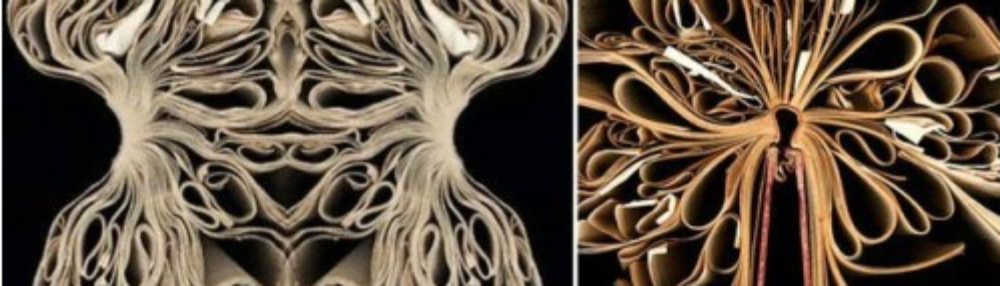
I think there are traces of everyone we meet and have a relationship with etched deeply into ourselves. I think about my past friend Arwen who liked to dip her sourdough bread into her tomato soup—a behavior I still do today, even if our friendship has long since ended. This is also true of physical items such as books, scrolls, etc as mentioned in our reading, “What is Bibliography?” From marks left on the pages indicating wire lines that ran across the wooden mould to a watermark, there are physical traces are present on the object itself showing the relationship between the maker(s) and the object. There are other marks that could lead to who once held the book, and their ideas on it written with in the margins. Just like Dr. Culbertson said, it’s a mystery and we are the detectives who are tasked with unearthing the objects history. I’m finding out this class is as much archeology as it is history and english. We could also think of ourselves as Indiana Jones, without the dangerous adventures (maybe), looking for something in unfamiliar territory.

These traces also lead us to ask why and what. Why was this method used? Why was this specific material used? What can we gleam from this information? What is the significance of using this method and material? What is the meaning of the universe and why are we here? (Okay maybe not that one.) (No I wasn’t trying to reach the word count.) (Why are you still reading within the parentheses?) These are questions that might not always have answers because they are lost in the void or to time, but it is important to hypothesize because it is important for us to try and understand, so we can figure out where we as a society want to go. In the short excerpts we read, a couple of them. (Derrick Spires, Lisa Maruca and Kate Ozment) mention using Bibliography as a way to identify as wells as resist oppression and also mend structures of oppression. All through sometimes microscopic traces left on books, scrolls, etc. I only wish we had more time, and resources (such as carbon dating, microscopes, etc.) available to us to aid in our journey this semester.

The Church, Power, and Gutenberg

When reading chapter 2 of “The Book,” I questioned why Gutenberg was mentioned so prominently when it came to the printing press (yes he made many great achievements but he was not the first, see page 72’s mention of Bi Sheng). The answer that came to light is from page 72-73, “Evidence suggests that Gutenberg printed Latin schoolbooks and papal indulgences before completing his Bible as a means of supporting his press and currying favor with the Church” (Borsuk 72-73). One of the main reasons why I think Gutenberg has his place in history is because he curried favor with the Church—one of, if not, the most powerful entity of the time. The Church had overwhelming influence and a seemingly endless amount of funds. Gutenberg was first, and foremost, an entrepreneur, as seen in his earlier pursuits of gem-polishing, and “producing and selling mirrors to pilgrims” (Borsuk 65). And his print shop was one of his business ventures. Therefore, Gutenberg’s first motive is money—not necessarily the spread of knowledge. (It also helps that he was born into a rich family.)

In knowing this, it is not far-fetched to assume Gutenberg made a business decision to fall in line with what the Church wanted—it was a symbiotic relationship; the Church got to spread their message with ease, and Gutenberg was able to continue his business. On top of this, Gutenberg most likely knew that people were likely to buy religious books, because the Church was so powerful and most people subscribed to its faith. In printing the Bible and other religious texts, Gutenberg secured himself in the Church’s eyes, and thus in history.

Those with (and in) power are often able to either write history, or make us see it through their lens. Gutenberg’s story is an example of controlling the narrative. By making sure Gutenberg’s print shop stays alive through the Church’s funding, the Church is able to decide what is printed. If Gutenberg printed something the church was against, they could pull their funding and force Gutenberg out of business. They can decide to censor other perspectives and voices. It echoes the same problem today, of those in power trying to control and censor knowledge.

Content Developing Alongside Technology

Within the first few pages of “The Book,” by Amaranth Borsuk, there is a quote that really opened my eyes to a thought I’d never had before. The quote is as follows: “Content does no simply necessitate its from, but rather writing develops alongside, influences, and is influenced by the technological supports that facilitate its distribution” (Borsuk 3).This idea that the writing within a book, scroll, website, etc. has not necessarily been the impetus of certain kinds of technology, but vice-versa. My mind immediately thought about fanfiction posted on sites such as AO3 or Tumblr. Fanfiction is writing based on another person’s story, comic, TV show, movie, book (etc), that is not ‘cannon’ (isn’t actually in the story either at all or at the moment) in the original work. This can cause a fracturing of the story into something new, but still related to the original, that can be disseminated through those aforementioned sites to other fans of these stories. My point here is that fanfiction seems to have been mainly an effect of the web—aka a new technology that is able to support its distribution. I had always though of it being the other way around, that it was the content that caused evolution within the technology. So flipping this idea on its head in regards to some content was something that caused me to think about which technologies made it possible for certain content to become available, made, and popular.

Why invent ‘new’ media?

While reading both texts for this week, there was a specific quote that caused me to question why ‘new’ media is made/pursued. The quote is as follows: “Yet the work of the new is precisely what inspires us to reconsider the old and to recognize the intersections and convergent histories of old and new” (Pressman 1). This flip of thinking about ‘new’ and ‘old’ media from the perspective of new to old is what caused the question of why people decide to make ‘new’ media to surface in my brain. And the answer I came to is that the ‘new’ media often has an aspect that ‘old’ media does not, and that aspect generally makes the dissemination of ideas and knowledge (etc.), faster, easier, more efficient, and more widespread. People decided to advance their existing media into ‘new’ media to achieve those aforementioned goals of faster, easier, more efficient, and more widespread distribution of ideas and knowledge (etc). Because people naturally want to share their ideas and knowledge. While I read the Broadview text first, the quote in Dr. Pressman’s article caused me to look back to the first reading, and connect it with the previous question and answer. In the Broadview text, each new iteration of media/technological advancement (scrolls, codex, printing press, decrease in printing cost, and the addition of the internet) had a shorter timeline than the previous (also stated previously in class). This is due to the why question posed at the beginning of this blog, and its subsequent answer. The more advanced things got, the quicker information spread, and people were able to come up with new ideas in a quicker/easier fashion, that then become ‘new’ media. While the book as a medium can be considered ‘old’ media to some degree, even something like sprayed edges and more creative cover designs adds a ‘new’ element that causes those books to be more widespread and in a way ‘new’ media because it has become more than ‘just’ a book. (I’ve definitely bought a book just because I liked the sprayed edges and cover design—I actually really enjoyed the book, but originally bought it because of the book’s physicality as an object, or what Dr. Pressman would describe as bookishness). Sometimes, more people are likely to buy a book because of the aesthetics, but also end up genuinely enjoy the text or story inside, but it wouldn’t be as widespread if it wasn’t as attractive physically (some people do judge a book by its cover).

A Bigger Beast

Marino’s text is more than just a continuation on The Library of Babel, but instead enhances upon the idea. Specifically when Marino adds, “It began when I read that story .” It is not so much the words in the sentence itself, but instead the hyperlink embedded in the sentence. Instead of looking physically (by physically I mean having to walk from one hexagon to another and manually picking out a book with one’s hands etc) for the next book or annotation one can immediately head to the next with just a click. By doing so Marino is showing that the interwebs is a place where choice is immediate, and it is much easier to fall down the rabbit hole of searching—everything is at your fingertips in almost an immediate fashion. This is a bigger beast than the library in Borges’s story because of that immediate access for people who can connect to the world wide web. And the choices can be even more overwhelming than within the library in the story due to the fact that most of the hyperlinks pressed often lead to a multitude of other possible hyperlinks. On top of that this speed makes the possibility of information even more fragmented, because one can switch so fast from one idea to another. This makes me question the choices the rest of you made. Did you click on the hyperlink in that sentence? Did you click a different one? Did you stop at just one? What were the choices you made, and how did time limit those choices?