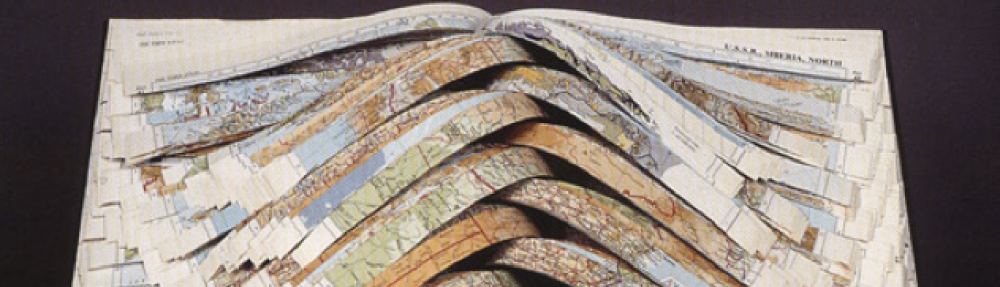
“The methodical task of writing distracts me from the present state of men. The certitude that everything has been written negates us or turns us into phantoms. I know of districts in which the young men prostrate themselves before books and kiss their pages in a barbarous manner, but they do not know how to decipher a single letter. Epidemics, heretical conflicts, peregrinations which inevitably degenerate into banditry, have decimated the population. I believe I have mentioned suicides, more and more frequent with the years. Perhaps my old age and fearfulness deceive me, but I suspect that the human species — the unique species — is about to be extinguished, but the Library will endure: illuminated, solitary, infinite, perfectly motionless, equipped with precious volumes, useless, incorruptible, secret.”
This paragraph comes just before the end of “The Library of Babel” by Borges. Throughout the story, this narrator presents his experience of the Library straightforward and factually. He acknowledges the existence of other views (the mystics, the “impious”), but he dismisses them.
“The mystics claim that their ecstasy reveals to them a circular chamber containing a great circular book, whose spine is continuous and which follows the complete circle of the walls; but their testimony is suspect; their words, obscure. This cyclical book is God” (2).
“The impious maintain that nonsense is normal in the Library and that the reasonable (and even humble and pure coherence) is an almost miraculous exception. They speak (I know) of the `feverish Library whose chance volumes are constantly in danger of changing into others and affirm, negate and confuse everything like a delirious divinity'” (6-7).
I, however, am a firm believer in the constantly-changing nonsensical library and the circular chamber (I, myself, have seen the god-book. It was torus-shaped.). Clearly, I’m a mystic. I could say I’ve been a mystic my whole life. Ironically though, I only felt comfortable calling myself a mystic since reading William James’ lectures on mystical experience. James was one of the first scholars of religion as a social phenomenon. He qualified “real” mystical experiences. After reading his qualifications, I realized I’d had real mystical experiences before.
But who was William James to decide what makes a mystical experience real or not? And who is this “man of the library” to decide what parts of the library are real or not? He’s not the “Man of the Book” (6). He’s just another wanderer. And what good has his wandering done? “In adventures such as these,” he says, “I have squandered and wasted my years” (6). Going back to that penultimate paragraph, the narrator looks back at the living world. He laments those who worship books but can’t read them. What about those who can read but cannot fully understand?
Isn’t that all of us? What human can read something and fully understand all the nuances and connections to other texts, events, people, memories? I can’t even remember all of the individual influences that come together to help me create a new piece of writing. But that’s sort of a creative dream of mine: a hypertext that manages to connect everything. Like Marino’s Marginalia, but nothing not highlighted. Highlights on highlights. Infinite footnotes. “It does not seem unlikely to me that there is a total book on some shelf of the universe” (6). I agree that it could exist. I wish I could create it.
But what would be the point? All of the connections that I could make are not all of the connections that could be made. It would need to be something that EVERYONE took part in creating. And at that point, I’m just creating The Universe. The book that this peregrine is looking for is the entirety of the library.
“I pray to the unknown gods that a man — just one, even though it were thousands of years ago! — may have examined and read it. If honor and wisdom and happiness are not for me, let them be for others. Let heaven exist, though my place be in hell. Let me be outraged and annihilated, but for one instant, in one being, let Your enormous Library be justified” (6).
From one wandering mystic to another… You are that One. You’re examining and reading the book right now. And you’re also writing it. This is the book. “Epidemics, heretical conflicts, peregrinations which inevitably degenerate into banditry,” are the book. “suicides, more and more frequent with the years,” are the book. The humans, about to be extinguished (in 1941. Plenty of reason to think that in 1941.) are the book. It’s the whole thing.