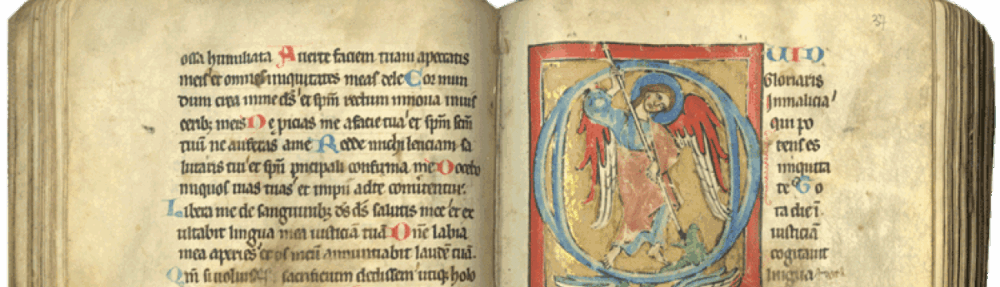
In The Book (2018), Amaranth Borsuk foregrounds the networked production histories of book media. In an example from 1153, hair follicles on a parchment page evidence the remediation of a living being into book materials (52). I have been reflecting on Borsuk’s reproduction of this parchment page in comparison to Jonathan Senchyne’s warm instances of human “traces” through book media in The Intimacy of Paper in Early and Nineteenth-Century American Literature (2020), which I encountered in Dr. Pressman’s Literature’s Media course in Fall 2024. Senchyne’s traces manifest moments of human interconnection, creating an empathetic bond between readers throughout time and place that situates how a book object traversed its setting. In one example, the handprint of a reader marks time from 1657 (Senchyne 15). The organism which traces its memory in Borsuk’s parchment leaves the trace of a time marked more violently: unlike the human craftsperson, the animal/s lost its life in the parchment production process. How do we read media for traces not only of life, but of death?
If its materials influence the ways that we interact with and perceive a book, the book also influences the ways that we interact with and perceive its materials: that is, our understanding of trees is influenced by our interactions with paper, and our understanding of animals is influenced by our interactions with parchment and vellum. Borsuk notes that, in first millennium CE Egypt, the cyperus papyrus plant was exploited to near-extinction in papyrus production (14). Did a similar fate befall the animals whose hides were culled for use in parchment production? How did the economy of parchment shape human-animal relationships, contextualizing the role of animals in human trade and information production?
The parchment product mediates a power organization and economy of human-animal relationships in which animal bodies are exploited, alive or dead, and in which their passage from living to dead is directed by human actors. This leads me to question how life and death are configured in “media ecologies,” and how significant death is to media production. The reeds, the animals, and the trees which compose common book media interact with eventual readers as de-autonomized bodies – traces of once-life and the conditions which created their death. The plant or animal’s body is remediated from living to dead. This exploitation interrelates with the ecological violence of capitalism, imperialism, colonialism, and their social permutations.
Considering this, Borsuk’s chapter has raised new research questions for me. How were the bodies of animals used for parchment and vellum production symbolically and culturally encoded as products of information production, economy, and “the very nature of thought itself”? (44) How were human interactions with these animals shaped by the association of living organisms with product? Further, how were the lives and animal cultures of these creatures shaped by their exploitation in the vellum and parchment trades? Did botanical and zoological adaptations occur through these contexts? This would make good material for a study of nonhuman reader networks and media ecologies, which N. Katherine Hayles gestured towards in her presentation at SDSU last semester.
These questions relate to my capstone project-in-progress, which in part historicizes scientific galvanism through a disability studies framework. The galvanic slab is a site of networked interconnection between human, nonhuman animal, and technological bodies – much, I’m now realizing, like the parchment or vellum page. We know that the information in a book can be violent – and so, I need to emphasize, can be the production of the book. The medium might be fatal. I’m now thinking about anthrodermic bibliopegy (the custom of binding books in human skin) as it relates to spectacles of capital punishment, which also featured heavily in galvanism. Borsuk’s materiality study has made me more aware of the ecocritical, ethical, and thanatological implications of the human-animal-technology circuit in disseminating information and encoding meanings through trans-species interactions with book media. The dead reed, animal, or tree is a key model in contextualizing the material production of book objects. Who died to make this object? Who killed? How does the fact of death-production influence how we interact with and present the object? Now that I’m finding some footing, I want to get serious with media studies and explore these wider effects as I handle objects in Special Collections with more attuned sensitivities.