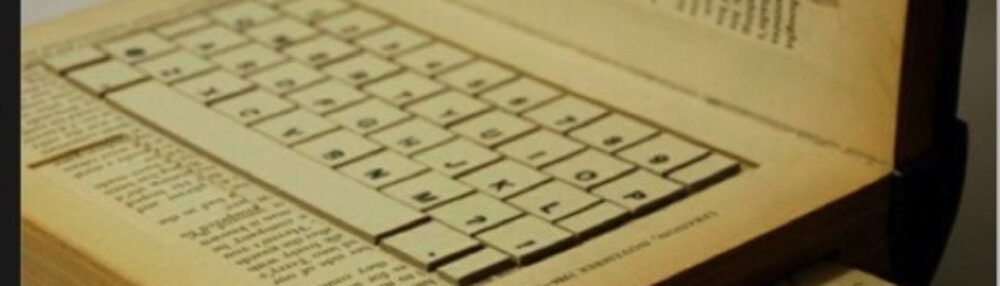
“Unpacking my Library”

Walter Benjamin’s “Unpacking My Library” offers a unique and personal look into the life of a book collector, prompting us to reconsider what it means to truly “own” a book and what it means to be a book “collector”. It is a wonderful final reading for this class. Benjamin begins by stating that “I am unpacking my library. Yes, I am. The books are not yet on the shelves, not yet touched by the mild boredom of order” (Benjamin, 59). A chaotic scene for new discovery within one’s own archive is set. 

What struck me is how Benjamin distinguishes between collecting and a collection. He emphasizes that a true collector’s passion “borders on the chaos of memories” and that the act of collecting is tied to stories and histories rather than just utility or monetary value. A collector does not simply collect books for their content or value, but for the deeper meaning each item holds. Benjamin explains, “The most profound enchantment for the collector is the locking of individual items within a magic circle in which they are fixed as the final thrill, the thrill of acquisition, passes over them” (Benjamin, 60). Each book becomes a vessel of memory and discovery, as a way for the collector to see through objects into their unique past. Our midterm project, writing the biography of a book, taught us this, exhibiting how the materiality of books are more than vessels for written content, but artifacts with their own rich histories and stories to tell. Benjamin also highlights the unpredictability of acquiring and collecting books, where even catalogued items may offer surprise or new information. Benjamin recounts discovering a rare illustrated book he had never thought of owning, describing it as a freedom given to a lonely book. For him, the “true freedom of all books is somewhere on his shelves” (Benjamin, 64).  This resonated with me, especially after our studies of archives, where we have found how exciting it can be to discover unexpected connections, histories, and the unique lives of objects. 

In “Unpacking my Library”, Benjamin reminds us that collecting and creating one’s own archive is not passive, but an emotional and physical endeavor. Our collections are reflections of our passions and memories which can be found in the content of our books and the pages themselves. This class, and Benjamin’s reading, inspires me to explore deeper into my own archive of books to uncover, or rediscover, something new.

Childlike Wonder

If this class and these last two readings have taught me anything, it is to approach the physical aspects of books, their history, and subsequent possible future with a childlike wonder. In the humdrum of certain classes, and constant pressure to be serious about the grades my perfectionist brain yearns to achieve, as well as the social expectations bearing down on my shoulders to be a serious adult, my research/assignments—while still interesting—become drained of color. The information and the search for information feels more like a means to an end rather than the end itself, and the process itself becomes a challenge to rush through and away from. There is no genuine wonder within my learning sometimes.

But with the experience I have now, and especially this quote from Unpacking My Library, “Among children, collecting is only one process of renewal; other processes are the painting of objects, the cutting out of figures, the application of decals-the whole range of childlike modes of acquisition, from touching things to giving them names…everything said from the angle of a real collector is whimsical,” I am reminded to see with the eyes of a child just discovering something (Benjamin 61-62). It is this childlike wonder that carved the path for the “Bookwork” mentioned on pages 8-9 in Dr. Pressman’s book intro. The sculptors utilized what Benjamin describes as “childlike modes of acquisition.” They touch and shape the book into something new, coming at it with a childlike wonder that makes it their own.

The midterm and these readings made me realize I am still able to have that childlike wonder without the seriousness clouding the work. I can discover things and be excited from those discoveries, and not do it just for a grade but because I genuinely am in awe from the information. It was the physical inspection—the holding, touching, and the turning of the pages—of Copernicus’s book, along with the discovery of questions, that reignited that childlike wonder spark in my brain. I wasn’t sorting through a vast amount of research with no direction, but instead a path that was being revealed to me for the first time that made me want to dig deeper.

It’s like going from being oxygen deprived to your lungs being drenched in O2. I felt excitement and wonder during school for the first time in a long time, and I’m glad these readings actually put it into perspective for me. Now going forward, I’ll make sure this child like wonder stays with me, no matter what I choose to do in the future.

Week 13: Books to Read or Collect

When does a book reader become a book collector? Most who read, who pursue reading as a hobby, will borrow, or buy, and own books. They will have a bookshelf or bookshelf’s to display and keep their books, bit are they collectors of them or just owners? While reading Unpacking My Library, by Walter Benjamin, I became interested in the process by which someone becomes a collector of books rather than simply a reader of them. Through the reading I figure that the collection of books, not only the ownership of them, is intentionally, one has to state that they are a collector of books in order to be one.

If a reader has a large number if books in their library it is not a collection until they deem it one, until they do it is a group, library, or an assembly, not an intentional collection. To collect books is to appreciate them and see them beyond the material they hold, but as Benjamin describes, to love them as , “the scene, the stage, of their fate.” (Benjamin, 60). There is a difference between a person who says that they love reading and books and a person who says they love books and owning them, one is a reader, one is a collector. A person who reads may be a collector, but there is not always a certainty that a collector is a reader.

I have realized that I am teetering on the verge of becoming a collector of books, not just a reader of them. I used to only buy books if I intended to read them immediately, as a reader I have had rules for my shelves, just as he had ruled that “no book was allowed to enter [them] without the certification that [he] had not read it.” (62). But the rules I have for my book ownership are changing, I now have begun to buy multiple editions of the same book, or have bought books that I will read “one day,” even if a planned date for reading is non-existent. I want to have books not just to read, but because I like having books, I am becoming a collector, my library of books is now a collection of chosen books, not just an assemblage of literary devices.

Self-Representation Through Book Acquisition

In the chapter “Unpacking My Library, Walter Benjamin indirectly displays books as a commodity, and as it has been discussed in this class plenty, an object to fetishize. As Benjamin unpacks his library, he gives the reader “insight into the relationship of a book collector and his possessions, into collecting rather than a collection” (pg. 59) by recalling the various methods of collecting books and the mental or emotional loops one experiences during these acquisitions. Some of these methods of acquisition mentioned are writing books yourself, going to auctions, and buying from bookshops. 

In this excerpt, Benjamin spends a considerable amount of time talking about the method of getting a book through an auction, and how this method not only requires recognizing the quality or provenance of the book, but also being aware of one’s competitors who will keep “raising his bid – more to assert himself than to acquire the book” (pg. 64). In Benjamin’s lamentation of the auction’s fierce and prideful atmosphere, it is obvious how books have been marked as objects of fetishization and serve as an outward projection of a persona which is explored in Dr. Pressman’s Bookishness. As Dr. Pressman discusses how “bookshelves as a means of self- fashioning and self- representation” through “judging people by the covers of their books” (pg 34) in the context of physical codices and the rise of the digital page, it’s not thoroughly explored how the cost books also contributes to self-representation, as much as it is explored in “Unpacking My Library.” In Benjamin’s excerpt, the cost of the book and how it’s acquired is practically the focus. This act of finding a book, whether that be through auctions, going to bookshops, or travelling around the world as Benjamin has done, becomes less about the book and more about the wealth needed to acquire the book and the stories about retrieving the book. Though Benjamin ends up buying Fragmente aus dem Nachlass eines jungen Physikers at a secondhand shop, what makes the story riveting is that he was at an auction where he had been outbid, and then learned how to wield a lack of interest in these spaces to get what he wanted. The interesting part is less the book and more the story of getting the book.

The conversation of bookishness is constantly being furthered as the semester progresses, showing me how every aspect of a book and outside of a book can be part of fetishization. It also reminds me that plenty of objects have not gone unfetishized, as “every passion borders on the chaotic” (Benjamin, 60) and is a part of an obsession, whether we acknowledge it or not.