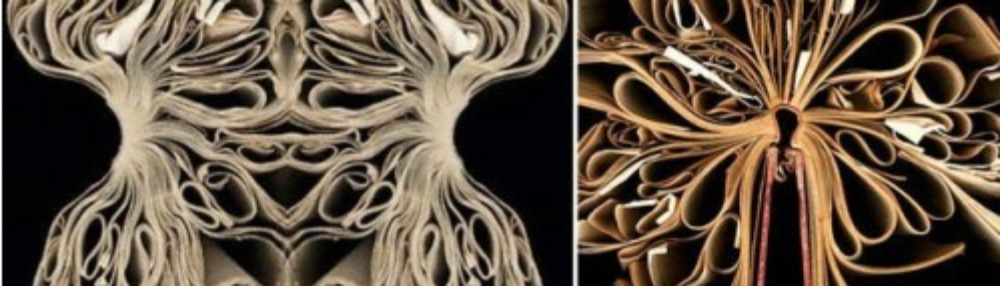
The Book as Space – Walking through Rooms of Language

In the last few weeks, I have often looked at how we move through books. From the ancient scroll to the modern codex, I kept thinking about reading as a kind of motion. Something that happens across pages, screens, and feeds. But looking back, all of these movements were still two-dimensional. They took place on flat surfaces, even though the books themselves and the devices we read on exist in a real, four-dimensional space. This week, Chapter 3 of The Book suddenly brings that missing dimension into play. Ulises Carrión’s idea that “a book is a sequence of spaces… a sequence of moments” (p. 148) opens up a completely new perspective. The book is not just something that opens before us, it opens around us.

Carrión’s line suddenly brings a sense of real space into play. It makes me see reading not as an act of moving from page to page or from chapter to chapter, but from room to room. And just like rooms in real life, every room has its own function and its own decoration. Some rooms are bright while others are narrow or silent. The same goes for chapters and pages. Each one feels unique in its own way and is arranged differently, but none of them are meaningless. When Carrión uses the word “sequence,” it already carries a sense of rhythm. The rhythm of one space leading into another, one moment following the next. “Spaces” then opens the page outward, turning reading into something we can step into. And with “moments“, Carrión adds a sense of time, reminding us that every act of reading happens only once and never in exactly the same way again.  

If we think of a page as a room, then the words become its furniture, objects carefully placed by the author. Every word sits somewhere for a reason. For me, Carrión’s idea creates the picture of the writer as an interior designer, arranging language so that the reader can walk through it. Reading, then, is not only about following a line of text. It’s about entering and walking through spaces, that slowly shape the meaning of the book.

Looking back on my earlier reflections, this feels like the next step in a larger journey. I began with the scroll, thinking about the linear movement of reading, then moved to the codex as a flexible form and later to the book as a living body. Now Carrión adds a completely new layer. The book as space. What used to feel flat suddenly gained depth. Each time I turn a page, I am not just moving forward in text but stepping into another room. It makes every act of reading feel like walking through a house built out of language, with new doors that keep opening as you go.

The Book as Idea

The book is an expression of ideas that are formed by the desire to create, share, and work. Each facet and piece of the book is used to express the ideas and creativity of an author, from it’s covers, which can depict great artist and introduction, to its pages that might be beautifully illuminated, and even including its fonts and included images. The book is a canvas for words and information as well as a stage for an author to fully express their point of view where they can connect with their indented reader to the best of their ability. Books in through this purpose are, as Borsuk in, The Book, writes, “always a negotiation, a performance, an event.” (147).

The book used and viewed as an idea, rather than just as an object allows for a broader and more creative use of it as a medium. It allows author to use every surface of the book for their message and tone, allowing the reader to read from the book before ever opening it, when the book is an idea the reading and comprehension of it begins at first glance, a very first touch of the binding immediately introduces the authors perspective and subject. The book as an idea also allows for more inspiration for authors writing within it, being able to take the ideas provided by the books’ shape and form into fuel for their stories, like as done by author Stephane Mallarme, who formed his story on the page like an actual shipwreck, making readers as they turned the pages, “complicit in the shipwreck.” (129). The book as an idea becomes ideas, a tool for inspiration and evolution of the books presentation and form, idea allows the book to change, not forced into a rigid and single standard shape.

Chapter 3: The Book as Idea

In Chapter 3 she writes: “Muted books take on a totemic significance. Because we can’t ‘read’ a book object or book sculpture, we see the idea of the book, a metaphor that has penetrated our culture so deeply it informs the language we use to describe ourselves.”

This made me realize how much the book is more than just paper and ink. Even when we strip away the actual text, the shape and idea of a book still carry symbolic meaning.

Borsuk connects this to how deeply the book is embedded in culture and language. I never thought about how many expressions in English (and in German, too) are built on the metaphor of the book. For example, someone can be “an open book,” or we might “judge a book by its cover.” These phrases have nothing to do with literal books, but they show how strong the idea of the book is in shaping how we talk about people and life.

The phrase “totemic significance” stood out to me as well. I learned a totem is something that represents a belief system or community identity, and thinking of the book in this way is powerful. It means that books are not only tools for reading but also cultural symbols we treat almost with reverence. I thought about how in my home, even when we didn’t read certain books anymore, we still kept them on the shelf, as if just having them there made the room feel more intellectual or meaningful.

For me, this passage helped to see that books work on two levels at once. They are objects you can read, but also symbols you can’t escape. Even in an age of screens and e-books, the metaphor of the book is still shaping how we understand knowledge, identity, and even morality.