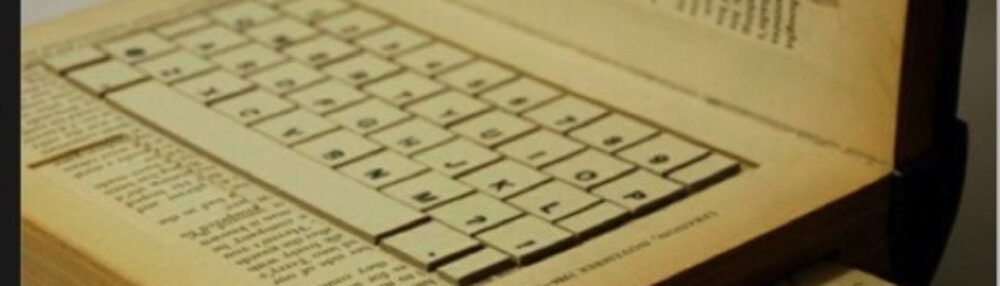
After seeing the video, A Screen and Page I honestly thought it was really neat and rather interesting. I have always heard of augment reality and how it can help with a lot of things, but I do think this is pretty smart. The computer glasses read a “QR” like code which are hieroglyphs that the computer reads and then a text pops up which tend to be poems, short stories and such which I find very accessible, yet not as accessible.
I say that it is accessible, yet it isn’t because not everyone can afford augment reality glasses with a computer that is able to run the software properly. I also find it very ironic how we still need to use a book in order to have this screen and page thing to work even though society is doing their greatest efforts to go fully digital. It reminds me of previous class discussions about how technology is always looking to better itself and make itself new but always having to rely on physical book aspects to maintain its identity and proper use. Examples such as bookmarkers still being used in digital media, highlighting, annotating, circling and such. I do think the concept is really interesting and intriguing.
A Screen and Page is fascinating because it begins to make you wonder as to how this piece of literature is classified. The formatting, structure, and such are all experimentally done well and it goes to also show that literature in general is experimental, and I do believe we should play around with it more. Like our discussions and how Pressman mentioned in previous classes, there is nothing stopping you from creating a book however you want. Having this kind of mindset has me excited to see other various forms of digital media and how we interact with it as well as to how maybe one of us can create a neat book that changes how we perceive books in general. My only scare and complaint about digital media is how will AI play a part in it all and if people use AI to write their stories, then who do we call the author? The person who put the prompt into the machine, or the machine that pumped out all the words and ended up calling it a “story”? Many interesting questions and conversations to have around digital media and why it is important in today’s time.
Many of the books that I encountered during our visits to special collections were interesting and very much fascinating, but not as fascinating as the 1554/60s Latin text, Four Books of Rhetoric addressed to C. Herennius / by an uncertain author. Cicero’s/ revised by Paulus Manutius, son of Aldus which translate from its Latin name Rhetoricorvm ad C. Herennivm libri IIII / incerto auctore. Ciceronis … / corrigente Pavlo Manvtio, Aldi filio. One of the oldest if not the oldest Latin-based text that talks about rhetoric and how it was designed to help students create a more powerful speech for themselves. It is a four-part book in which is part talks about a specific rhetoric technique that can help shape your thoughts and emotions as you talk to someone. The author is claimed to be Ciceronis, but there are claims from people saying that he only simply added specific parts of information and that this is simply a compilation of works.
The book is small around 5.5 inches length with a width of 4 inches which deems it as an octavo formatted book and that tells us that this book was designed for more personal use and easier portability. Its cover has been replaced a few times, and we can see that from not only the different color scheme, but also the spine which has multiple different textures with different colors that do not correspond to our cover here. There is also a bit of writing on the bottom of the spine, but I was not able to confirm nor make out to what it was, but I did find it interesting how we are still able to see some of the spine’s lettering regardless of its readability.
The only damage and tear that the outside of the book had was mainly on the spine and we can see it from the top of it where there are 2 different types of materials being used which is most likely animal hide over a pasteboard or piece of wood. The bottom is flaking quite a bit which starts to show the wood like material used for its spine and cover.
How is the spines condition doing? Well, honestly, not too great as the spine will start to crack if you open the book too much which made it difficult to fully open and examine the book, but it is very understandable as to why we cannot open it fully. Due to it being a book that talks about how you can master speech, craft persuasion and such; it’s no wonder many people used this book back in the day and its worn-out spine is the clearest clue as to how many times it was opened and used.
As for writing or markings within the book, there seem to be only writing numbers from the SDSU special collections library which makes sense, but there is one really interesting thing that I cannot wrap my head around. That is the fact that one of the owners decided to color the publishing logo’s anchor orange/brownish which can be seen on the first page of the book when opening it. There are also really dark circles with heavy ink next to the logo as well as another hint of that orange on the top of the page as well. As for illustrations, that is quite literally the only one which is Aldine Press’s logo who are a famous publishing company known for enjoying and reviving classic literature from Greek and Latin stories as close to their original form and storytelling so that modern audiences can enjoy them. Essentially, the cared about persevering books and keeping it authentic to the source material so much so that you knew you had an official copy from them because the book would not have a stench. Speaking about it having a stench, we of course at SDSU have an official copy, and I did confirm that the book does not have a bad stench; in fact, it has a rather dirt like smell to it, but nonetheless, it goes to show how companies cared about preservation because this book is almost half a century old and it does not stink at all!
The book is also bounded by hand using a thread to sew between the pages and the spine. Aldine Press was known for their mixture of technology and hands on creation in which the print was being pressed on the paper while the rest of the book like its cover, and spine were handled by hand. Not only would they be bounded by hand, but the company would allow custom covers to be ordered. Sadly, this one has gone through many different renovations so we will never know if the owner ever ordered it in a custom way or if it just remained with the normal cover that all the copies had.
Part II.
The most interesting thing about this book is the fact that its margins are more than an inch, and the text itself is literally 60% of the pages size. You would think that the page would be filled with letters, but no, its most margins taking up the space which is neat because I would personally want a book this small for its accessibility and I don’t think I would have assumed that it had this much marginal space. It almost seems as though the text is inviting the reader to join the conversation and talk with it, which is so interesting because this is a book that teaches people how to talk in a more critical way.
I could not open the book fully, but there were multiple pages where there were book worm sightings. From the very beginning of the book to the very end, and we can see that the book worm really did dig through a good number of pages. Other than dirt, water and similar stains, book worms were often the hallmark of this book’s “blemishes”, and I think that’s pretty nice because it goes to show how the owners took care of it and how great the material is to a degree. There are other editions of the book in which they have some of the four copies inside the book or all of them such as this one right here. There were none that had a translation inside
As opposed for the copy being modified or have any writing marks on it. There seem to be none and the only “markings” I could find were just corners of the page folded which seems as though someone was reading it and decided to “bookmark” it in a way so that they may continue reading it at a later time.
The text is a Latin rhetoric book that teaches students how to argue, deliver speeches better, have better communication in general. It was widely used during the Renaissance time period and was often regarded as the book to use in school to teach to students. Considering that this is one of the oldest texts in Latin, we must also remember that this is also one of the earliest books that talks about rhetoric which makes it an extremely valuable piece of work for that time period and for the future.
I also do believe that the margins reflect a rather personal use for this book since it is a book about self-improvement in a way. The margins being more than an inch wide is what caught me by surprise because with a small book you would not want the margins to be that wide. You would want the text to fill the page and perhaps be a bit bigger so that you can read it clearer on the go. Ultimately, I can see students reading this book when going to school or simply having it on them to study one of the four books since this one book.
One final thing that really fascinated me from this book was the formatting and structure of certain pages where the text seems to just take its own form sometimes. I couldn’t make the correlation between the formatting and the content itself, but I found it rather beautiful and mesmerizing to look at which fits the standards of the Aldine Press where they would want to make their texts correspond to beauty itself.
In “Electronic Literature,” Scott Rettberg says that “the computer is essential to the performance of the literary activity.” This line really made me stop and think. I never thought of literature as something that needed a computer to exist. For me, literature was always about printed books, paper, and words. But Rettberg shows that for many writers today, the computer isn’t just a tool for typing. It is part of how the story comes to life.
The more I thought about it, the more it made sense. Some stories or poems online couldn’t even exist without technology. They might move, play sounds, or let the reader make choices that change the story. In that way, the computer becomes part of the art. It is not just helping to present the story, it actually is the story. I find that really interesting because it changes how we think about what literature can be.
As an exchange student here at SDSU, I notice how natural it feels for people my age to experience stories through screens. We already read so much online every day — from messages to social media to news. So when literature also moves into the digital world, it feels like a natural step. At the same time, it feels strange because it is not the quiet kind of reading I grew up with. You have to click, listen, or watch. It becomes something more active.
What I liked most about Rettberg’s idea is that it connects people. The computer becomes a space where writers and readers meet in a new way. The writer is not only telling a story but also designing an experience. And the reader is not just reading but also taking part in it.
I still love holding a real book in my hands, but I think this new kind of literature shows how creative storytelling can be today. It makes me curious about what will come next. Maybe in the future, literature will not be something we just read, but something we actually experience together.