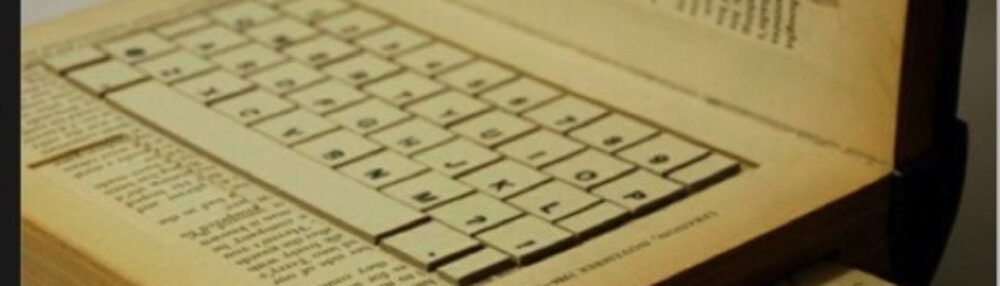
As I begin each introduction, I must rewrite and rephrase about thirty different ideas spiraling in my mind, knowing that whichever sentence I end with, that’s the one. As far as this post goes, my voice exists no farther than the words on the screen. I can’t illustrate anything, speak it a certain way, nor can I even pick my font. Then, upon reading about William Blake in Borsuk’s chapter 3 of The Book, I realized how much ownership of my work I’ve given over. Going over chapter 3 and a work by Doug Beube, I pose the question: how much of a book is really our’s?
The first line that caught my attention from Borsuk told of artists “who saw the book as a means of circumventing the power system of the art world. (69)” This implies the artists are not in power already, which I personally have come by with publishers pitching unreasonable prices for their services. This idea extends so far that a term had to be invented, called an “artist’s book,” implying that the book was not already the artist’s.
One dedicated man, William Blake, found a way to circumvent the power system. While it’s noted that Blake created his printing method partly for financial reasons, it’s also important to account for his societal and political motives. Against child labor, urban squalor, and slavery, refusing to use print shops was an act of defiance just as much as a stylistic choice. In fact, his style is his defiance. We know this work is Blake’s because it represented his ideas.
Borsuk states his work, “brought the hand back into the book. (73)” So, I wondered, is my hand missing? Rather, is my hand essential? Answers may vary, so too as times change the answer, but looking at the portfolio of Doug Beube, I understand the artist’s book may take any form, so long as the artist deems it so. This is further illustrated by the long list of book forms Borsuk includes, like Craig Dworkin’s work. While a part of me may idolize the craftsmanship put into a book, I believe the book only takes form when it truly represents you. If that comes in the form of novels written on a chalkboard or in the form of handcuffs, so be it. At the end of the day, it’s called the “artist’s book” for a reason.
I’m eager to hear what work of Doug Beube’s caught you, as he and his work have had a big impact on me and mine. We can share more on Thursday!
Hello Samuel, it was interesting to see how you questioned the agency one has in the process of book-making outside of just creating the contents that a book can contain. When reading about how William Blake took initiative in creating his own book because of the publishing industry being expensive, arguably unfairly so, and to protest the industry functioning on child labor, urban squalor, and slavery, I was reminded of how significant art is in politics and how people can create things without needing a middle man, like a publisher, though it can help. I agree that the book takes form when it represents you, in any shape or form like mentioned, but also, when it is able to reach others for their own exploration.
Hey Samuel, I found your question about how much of a book really belongs to the author super interesting. The part where you talk about Blake refusing to use print shops stood out to me and I like how you connected that to the idea of creative control. It’s fascinating to think of “his style as his defiance” and it made me wonder how much control we actually have today when most of what we make exists digitally. Your point about “bringing the hand back into the book” feels especially relevant now.
Hi Samuel,
I found it interesting that you said, “a book only takes form when it truly represents you.” For an artist book to be a manifestation of art and creativity, it has to be a true representation of themselves and doesn’t Usually follow traditional book format or content outlines.