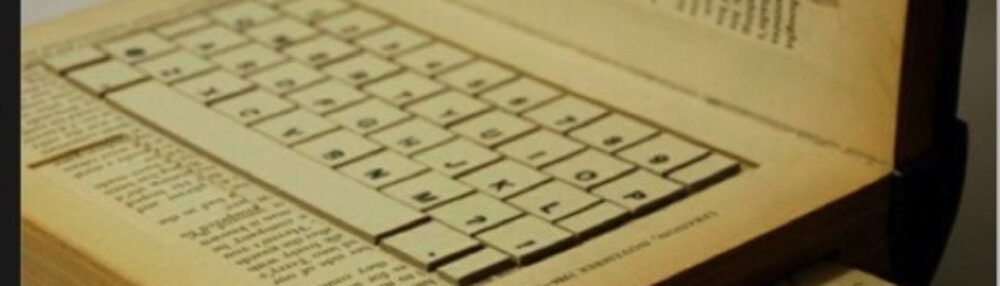
Our class began by looking at books as objects with various characteristics. Books have both material elements, such as paper, glue, and ink, and content elements, such as the content itself, the table of contents, and, not to be forgotten, the bibliography.
D.F. McKenzie takes up this idea in “Bibliography and the Sociology of Texts.” For him, bibliography is “the discipline that studies texts as recorded forms, and the processes of their transmission, including their production and reception.” His following statement is crucial: “forms effect meaning.” A text is therefore dependent on its form; its materiality influences how it is perceived and understood.
At the same time, we know that we need context to understand texts and their messages. McKenzie makes it clear that bibliography examines not only the technical aspects, such as paper, typography, and binding, but also the social processes. Who produces a text? Who distributes it? Who reads it? A newspaper in the 19th century, a novel, or a post on Instagram—all are texts, but the medium and their context change what they mean. McKenzie also expands the term further by writing that bibliography should encompass “all forms of texts.” This includes flyers, digital media, and other forms of recording. The core idea that bibliography can be understood as the life story of texts is very interesting. From production to distribution to reception. It shows that texts have a history.
In conclusion, McKenzie summarizes: “[Bibliography] can, in short, show the human presence in any recorded text.” I find this quote essential to understanding that books are not neutral objects. They carry a history that arises from the traces of human beings. The producer, the readers, and the publishers unconsciously create a story. Every text is therefore also a document of its time. Once again, I think back to our discussion in class: What is a book? I notice how every insight comes back to this question. And again and again, elements are added that I hadn’t thought about before.
Yes, great. “This includes flyers, digital media, and other forms of recording. The core idea that bibliography can be understood as the life story of texts is very interesting. From production to distribution to reception. It shows that texts have a history.” The skills of thinking about and through bibliography and book studies are part of the larger fields of material history and media studies. You are certainly starting to see the connections and the fact that definitions– of book, literature, etc.– can only take us so far!