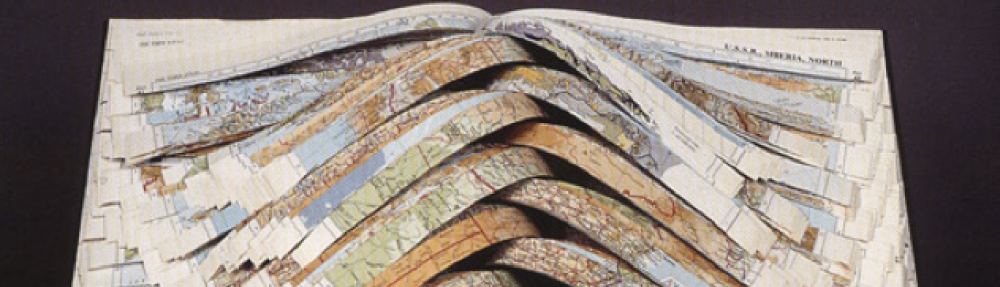
The excerpt from Johanna Drucker’s work and Borsuk’s third chapter recalibrate the thought process of understanding the artists’ book as an idea. Near the end of the Drucker’s excerpt we read she states, “Artists’ books take every possible form, participate in every possible convention of book making, every possible ‘ism’ of mainstream art and literature, every possible mode of production, every shape, every degree of ephemerality or archival durability.” (14) There is a profound importance in recognizing that the idea of a book is woven from the artist’s vision and transferred to the reader. The reader then recollects, shifts, and begins anew within the mental space of their mind but only after physically interacting with the book.
Likewise, I found myself further contemplating the the power of the book as an idea as I worked through Borsuk’s book. In the section titled “The Book’s Ideas” she writes, [on examination of artists’ books] “Thy remind us that books are fundamentally interactive reading devices whose meanings, far from being fixed, arise at the moment of access.” (145) In our modern world where everything is commodified, it becomes natural to assume that a book’s meaning is limited to what is inside of it. That could not be further from the truth. The role of the reader is designated to ask the right questions and consider the book outside of the text and in its materiality. By doing so, there is a recognition that the entire book in its form, materiality, and content, require a reader to decipher and further contribute to the book as an idea.
Great post. You are really starting to see how different types of books matter– and are made to matter– to different types of readers. “In our modern world where everything is commodified, it becomes natural to assume that a book’s meaning is limited to what is inside of it. That could not be further from the truth. “
Your blog post impressively shows how Drucker and Borsuk understand the book as a living idea. You emphasize that a book gains meaning not only through its content, but also through its form, materiality, and interaction with the reader. The connection between the artistic vision and the active role of the reader is particularly strong.
Hi Aron,
I had similar thoughts to yours. I liked how you specifically said that, “the reader is designated to ask the right questions and consider the book outside of the text and in its materiality.” What I got from the chapter as well was that a reader should be considering the each detail around the actual text of the book, wondering why an author or illustrator chose their specific covers and fonts, and then trying to completely understand how the book’s materiality affects it’s tone, message, and meaning. Thank you for your post!