The world is constantly changing, adapting, and transforming in new ways daily. Philosopher Aldous Huxley argues that a person can either expend all their energy to stop it, or they can accept the changes and attempt to use them to their advantage. As seen in Philip Meggs’ History of Graphic Design, chapter 16 states, “It is obvious,” wrote Aldous Huxley in 1928, “that the machine is here to stay. Whole armies of William Morrises and Tolstoy could not now expel it.… Let us then exploit [it] to create beauty—a modern beauty, while we are about it.” (Meggs) This passage is extreamly robust and uses strong language and imagery. First, the phrase “the machine is here to stay.” This quote may have been stated in 1928, but it is just as or even more relevant to our society now. This immediately reminded me of AI technology and the example where schools have accepted that AI is not going away anytime soon, so they are endeavoring to use it to their advantage. Additionally, the word “exploit” was a very strong word used in this passage. Exploit meaning: to make full use of and derive benefit from. This begs the question: do we exploit technology, or is it exploiting us? We use it to our advantage, but to what cost? Do we exploit the machine at the cost of exploiting ourselves? Some other great quotes by Aldous Huxley that I found are, “People will come to love their oppression, to adore the technologies that undo their capacities to think,” and “Technological progress has merely provided us with more efficient means for going backwards.” These quotes are extreamly telling and have come into full fruition. Our smartphones and ChatGPT do, in fact, make humans less intelligent. Therefore, we are exploiting these machines while at the same time exploiting our own right to think on our own and think independently of the machine.
BOOKS!!
ECL 596. Fall 2025. Professor Jessica Pressman with Anna Culbertson
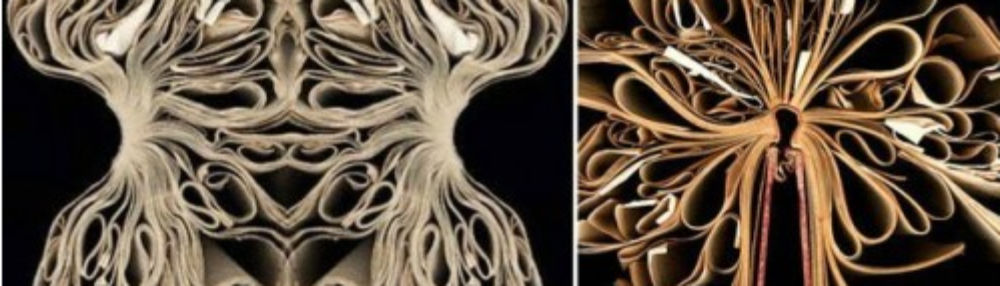
Great point about the feedback loop between humans and machines, which invokes our understanding of books as machines. This is also a very modernist idea and poetic, as machines became aesthetic, politic, and political during this period.
IA Richards — ‘A book is a machine to think with”
William Carlos Williams: a poem is “small (or large) machine made of words,”