Johanna Drucker and Amaranth Borsuk each center the book’s reader as its activator. Artist’s books, “which integrat[e] the formal means of [their] realization and production with [their] thematic or aesthetic issues”, hypermediate material production and interactivity (Drucker “The Artist’s Book as Idea and Form” 2). As both Drucker (14) and Borsuk (174) show, this meta function of the artist’s book is remediated in much electronic literature and interactive fiction. Following my interest in undertaking bibliographies of the Electronic Literature Studio’s collections, I’ve begun to read Drucker and Borsuk for guidance in bibliographing transmedia book objects. I had intended to codify these methods into personal guidelines for bibliographic work with objects in Special Collections and the E-Lit Studio, but I realized that I have more questions than answers regarding good bibliographic practice, and especially regarding the bibliography of inaccessible media.
For Drucker, an artist’s book is identified in part when “the informed viewer . . . determine[s] the extent to which a book work makes integral use of the specific features of [its] form” (9). Following this, Borsuk argues that artist’s books “remind us that books are fundamentally interactive reading devices whose meanings, far from being fixed, arise at the moment of access” — or inaccess (The Book 147, 188). Inaccessibility is intentionally encoded into many artist’s books, and, whether by artist design or tech companies’ designed obsolescence, it permeates digital media. The bibliographer’s context might itself create this inaccessibility, as in the case of a CD-ROM that can’t be played for simple lack of playback equipment. Such a bibliographer’s limited access to the object might actually invite closer documentation of what features are available for analysis, like the CD-ROM’s surface, jewel case, or related ephemera. This context also emphasizes that the CD-ROM should not be approached with assumptions that it is meant to be played or read in a singular, specific way (ex. by playback in a disc reader). Just as “‘bad’ printing” makes more obvious the materiality of printing processes (Drucker 17), digital inaccessibility makes obvious the systems on which a work is dependent for functioning. The limitations of the bibliographer’s activation invite connections between contexts.
…but where is the line between meaningful connections and presumptive conjecture? My main struggle is in balancing the positioned activation of a reader with the archival project of the bibliographer. The distinctions between speculation and inference are often ambiguous to me. What is the code for identifying conjecture versus evidence, particularly when informed speculation is the only way to connect historical gaps? Will my bibliography fail if I overly situate my own positioned interaction with the object, or is this an essential aspect of responsible bibliography?
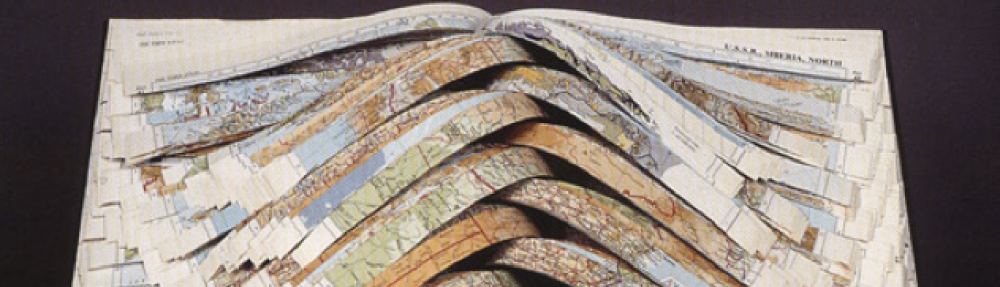
When my group and I examined a sixteenth-century codex in class, we carefully flipped its pages, moved it through light sources, and felt its cover to try identifying its materials. These were activations made possible and necessary by our positions in relation to the book object. Even documenting the book sculptures of Brian Dettmer and Doug Beube would involve moving around the objects and examining them — breathing in their space and context, connecting ocularly with their positions. Just as Borsuk shows that a reader’s movement through a book is a movement through time, space, and meaning (156, 178), the bibliographer has to move with the book, and this means that their subjective bodily experience is the contextually significant position for their activation.
So how do I reconcile my function as activator with the documentarian function of the bibliography? Isn’t the bibliographer’s context essential to document? If an artist’s book is only identified by “the informed viewer”, and if a book’s meaning only manifests “at the moment of access”, then an objective bibliography (as all objectivity) is impossible. What makes a bibliography functionally useful, and which actions of the bibliographer might damage this function? Is this really a question of objectivity versus subjectivity, or might it be more generative to foreground the function of the bibliographer as a subjective activator?
I realize that this is one of the most basic questions of archival and historian work, but it is also among the most essential to continually ask ourselves. I’d appreciate any thoughts that you all have on this, as I was hoping to come to some guiding conclusion but am still uncertain. Isn’t it only ethical for a book’s bibliographic activator to disclose the context of their activation?
Sick again, so sorry for the weakest post of all time.
Rain, I really enjoyed reading your post, specifically your ruminations on “meaningful connections and presumptive conjecture.” Alas, I only offer you the solace that I too have the same questions, and I hesitate in which manner I should present my bibliography. And I don’t think this is a weak post at all. In fact, I believe a post like this perfectly captures the ideations and questions Professor Pressman wants us to have an ask. You’re really getting down to the root and theory about this concept of hyperactivation in the same way we are, as a class, deconstructing and questioning the book itself. I always look forward to your posts, great job once again.
I agree with Jacob– this is a strong post, even if you are feeling weak (and I am sorry to hear that you are sick again). Indeed, I appreciate your focus on the reader here and the type of reading practice as the thing that distinguishes types of books. We haven’t talked much about readers yet, and we will, but you’re starting to recognize that different books promote different reading practices, and this is vital. Good work!